

Peter Simmonds runs a research group in University of Oxford. Very interested in the broader evolution of viruses and constraints under which they are placed.
Oxford, England
Joined June 2017
- Tweets107
- Following67
- Followers835
- Likes136
Here is my re-visiting of the C->U hypermutation phenomenon in SARS-CoV-2 genome 4 years from the start of the COVID pandemic:
tinyurl.com/mw3ezp6c
A trajectory of loss of C's / gain of U's, but weak 5' context effect and RNA structure dependence on edited sites. APOBEC 3A??

The downloadable ICTV Virus Metadata Resource contains information of virus names and the taxon they are assigned to:
ictv.global/vmr
As an example, here is the listing for members of the genus Hepacivirus. Is this what you meant?

Very experimental but also very surprising, here is some evidence for excess C->U changes in a range of mammalian RNA viruses, potentially related to the much discussed phenomenon in SARS-CoV-2:
doi.org/10.1371/journal.ppat…
Consequences for virus evolution: interesting.....

Job available on Oxford: 1 year post-doc investigating neutralising antibody responses to SARS-CoV-2 infections, serological assay comparisons and their application for COVID plasma and immune Ig treatment. Training in BSL3 working provided - contact [email protected]

Some interesting new data on SARS-CoV-2 B.1.1.7 infections from @jeremyratcliff and the lab, @HarvalHeliand & UK REMAP-CAP team
medrxiv.org/content/10.1101/…
Compared to WT, B.1.1.7 shows no intrinsic replication advantage but viral loads remain high even after Ab seroconversion

One of the fascinating implications of the model is how it redates the LCA of HCV to >300,000 BP before humans' Out-of-Africa migration. Maybe HCV did evolve within humans - genotype distributions may partly reflect geograhical /migrational separations
doi.org/10.1101/2021.02.09.4…

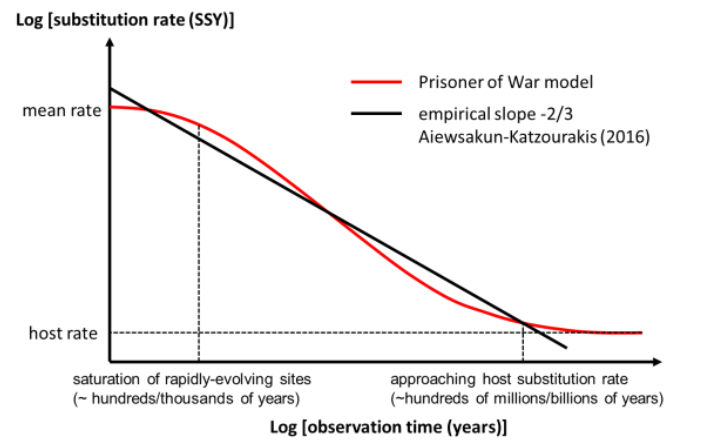
Great to see Mahan @Mahan_Ghafari, Aris Katzourakis's @ArisKatzourakis brilliant PhD student taking on ideas in the Prisoner of War model of virus evolution and putting them into a mathematical framework:
doi.org/10.1101/2021.02.09.4…
Vastly expanded evolutionary time frames.....
I don't think persistent replication of SARS-CoV-2 directly causes "long COVID":
ons.gov.uk/news/statementsan…
but clearly COVID-19 isn't a typical respiratory infection either. See our review of prolonged infections and mechanisms:
microbiologyresearch.org/con…

Recent analysis of SARS-CoV-2:
- Rampant C->U transitions
- high rates of non-synonymous change
- a mutational process likely driven by the host
- APOBEC-like context
- Potential widespread homoplasy
doi.org/10.1101/2020.05.01.0…
Spock: It's evolution, Jim, but not as we know it

