



ALT The Hubble Ultra Deep Field, released in 2004, is a million-second-long exposure (or 11.6 days) of a relatively empty patch of sky that revealed thousands of galaxies. On a black background is a smattering of light sources like confetti on the floor after a party. Some appear as small dots in the background in blue, white, yellow, and red. Some are larger with spiral structures or are ovals and circles. A few large white spots have orange halos, and appear larger than the rest. There’s one bright white spot with spikes of light, which is a relatively nearby star on this sea of distant galaxies. Image is watermarked “Credit: NASA, ESA, G. Illingworth (UCO/Lick Observatory and the University of California, Santa Cruz), R. Bouwens (UCO/Lick Observatory and Leiden University), and the HUDF09 Team.”


ALT A crescent Earth setting behind the Moon\u2019s horizon. Credit: NASA

ALT Earth setting behind the Moon as seen by the Artemis II crew. Over half the left side of the image is filled by the gray lunar surface, pocked with craters. Credit: NASA

ALT A close view of the Moon. Jagged circles of craters dot the gray surface, fading to dark on the left side of the image. Credit: NASA

ALT A crescent Earth setting behind a hemisphere of the Moon. Credit: NASA


ALT This image of the Moon and Earth was captured by a camera on one of the Orion spacecraft\u2019s solar arrays during the Artemis I mission on Dec. 5, 2022. The white Orion spacecraft can be glimpsed on the left side of the image. The gray cratered surface of the Moon takes up the lower half of the image. The Earth resembles a crescent moon in the vast distance against the blackness of space. Lens glare appears on the image. Credit: NASA



ALT Athena, NASA’s newest supercomputer, is housed at the agency’s Modular Supercomputing Facility at NASA’s Ames Research Center in California’s Silicon Valley. Credit: NASA/Brandon Torres-Navarrete
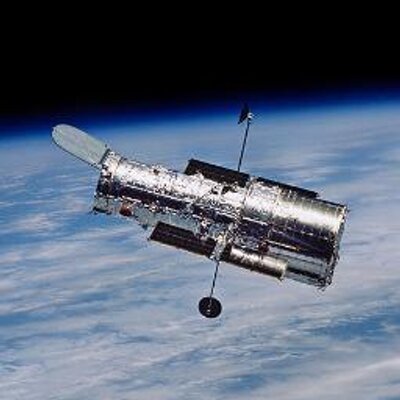

ALT Six Hubble images of distorted galaxies are organized in a two-row mosaic.



ALT Jupiter, as seen from the Hubble Space Telescope on June 27, 2019, features the Great Red Spot, a storm the size of Earth that has been raging for hundreds of years. The planet appears tilted at a 45 degree angle and its many bands of clouds encircling the planet are visible in oranges, grays, browns, and whites. Credits: NASA, ESA, A. Simon (Goddard Space Flight Center), and M.H. Wong (University of California, Berkeley)



ALT Jupiter dominates the black background of space. The image is a composite, and shows Jupiter in enhanced color, featuring the planet’s turbulent Great Red Spot, which appears white here. The planet is striated with swirling horizontal stripes of neon turquoise, periwinkle, light pink, and cream. The stripes interact and mix at their edges like cream in coffee. Along both of the poles, the planet glows in turquoise. Bright orange auroras glow just above the planet’s surface at both poles.

