

Stock market research. AI / data centers / power infra / cloud compute. NFA
Miami, FL
Joined February 2021
- Tweets6.5K
- Following321
- Followers35.2K
- Likes25.3K




Pinned Tweet
The Silicon Stack Podcast | Ep. 2 Featuring @PaulBPrager
I sat down with $WULF CEO Paul Prager. The Naval Academy grad who has transformed TeraWulf into one of the fastest-growing pure-play AI/HPC data center platforms in the U.S.
We discuss:
• The 20-year Anthropic deal
• Statewide data center moratoriums
• Power generation (BTM & FTM)
• Overseas expansion plans
UBS unchanged on $MU, $1,625 PT
“The market will reward this stock with a much higher P/E multiple as it sees a cycle
play out in which Microns gross margins probably don't go below 65-70%.”


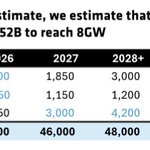
Bernstein estimates $CRWV will need $108 billion of incremental capex to reach 4.2 GW and an additional $152 billion to reach 8GW assuming $40M/MW 😳


Raymond James on $CRWV:
We generally believe CoreWeave is among best positioned neoclouds to weather a more cautious credit backdrop due to:
1. Leading GPU performance (ClusterMAX)
2. Scaling execution and contracted footprint
3. Temporarily “pace” deployment
4. Under appreciated non-GPU ARR of ~$500M


UBS on tightening credit market:
"Our point is that even if credit markets tighten, there are potential levers for CoreWeave to reduce its need for external debt and to access alternative capital sources, including private credit, vendor financing and potentially selling larger equity stakes (as CoreWeave did recently with Jane Street)."
"We recently met with executives at providers of private credit and with data center builders in search of capital and did NOT come away with a view that capital will be scarce in 2027. Put simply, in our view, this does NOT have to be a “debt spiral” story as some have suggested."
$CRWV


ANTHROPIC: OUR GROWTH STRATEGY
“Compute. We intend to secure further compute beyond our existing commitments, expand our own data center footprint to secure additional long-term compute, improve compute efficiency across our multi-chip compute architecture, and produce further algorithmic advances in model efficiency”


Morgan Stanley: Buy Powered Shell Providers
We know analyst Stephen Byrd is bullish, but is he too bullish?
$WULF $CIFR $MARA $HUT $GLXY $APLD $RIOT


BofA sees $NBIS exiting the quarter with 675 MW of connected power and ~525MW of active power, representing a meaningful step-up from the 170MW active at the start of 2026.
The primary focus will be Nebius’ ability to achieve its year-end target of 800 MW to 1 GW of connected power, particularly potential delays at Vineland.

$NVDA CEO Jensen Huang on neocloud concerns: “This is gonna get solved because demand is so good.”
He sees the real issue as multi-month lag from GPU delivery to revenue and the massive capital float required.
Huang wants to shorten the supply chain so operators can stand up data centers faster.

Morgan Stanley on $WULF - “Addressing the biggest misconceptions”
PSPs are often confused with neoclouds.
1. PSPs enter into 15-20 year leases, rather than 2-3 years for neoclouds
2. Powered shells built by PSPs are less capital-intensive ($9-14/watt, rather than $30-50/watt for the neoclouds)
3. PSPs take no chip risk, they are simply landlords
We believe it is instructive to compare PSP stocks with real estate stocks. Many real estate investors use discount rates and cap rates that are much lower than those embedded in PSP valuations.
For example, in our base case for WULF (441% upside to our price target), we use a 9% equity discount rate and 7% terminal cap rate on contracts that we expect the company to sign over the next few years.


JP. Morgan on $SPCX neocloud business:
“CEO Elon Musk addressed neocloud pricing dynamics with the belief that value of compute per watt will increase in tandem with the increase in intelligence per watt. As more compute capacity comes online and models improve, intelligence per watt will improve, ultimately leading to higher pricing on neocloud contracts.”
Current short-term neocloud contract pricing north of $50/W; pricing to increase alongside intelligence per watt; positive pricing datapoint for neoclouds but capacity build could displace other providers.

Senior Vice President at Cast believes the long-term risk for neoclouds like $CRWV is that hyperscalers are aggressively developing custom silicon (internal accelerators) and self-building at massive scale, which may eventually reduce their dependence on third-party GPU lessors after 2028.
“It's early on in the custom silicon game relative to the valuation that we're giving GPU providers in neoclouds today. I think if you're assessing how the AI inference could erode the market share, it's still the biggest long-term threat, but it shrinks CoreWeave's share of AI compute rather than the GPU market's absolute size, at least for the rest of this decade. The threat is concentrated in exactly the place that CoreWeave relies on, hyperscaler overflow demand and inference, which is both the fastest-growing workload and where older GPUs go for their second life. Frontier training for labs that don't own chips is probably the most protected part of that market.”
The expert from this post is a Vice President focused on AI ecosystem and cloud alliances at an AI infrastructure company, he has spent the past decade working in cloud and AI infrastructure, including enterprise sales roles at Amazon and Microsoft.

Small Cap Snipa retweeted

B200s are listed 39% below $AMZN AWS on GPU marketplaces. Buyers aren't getting that discount.
Executed trades sit at $9.61/hr, only 22% under the $12.36 AWS capacity block rate.
For neoclouds like $CRWV, $NBIS and $IREN, B200s are renting closer to AWS than the listings suggest.


Expert call: $NBIS
Former global strategic partnership lead at Nebius says Nscale’s AI factory is closer to $IREN than Nebius or $CRWV:
“Nscale at the moment is investing considerable amount of resources in the AI factory scale, especially if we are talking about the deployments in the U.S. as well as in Norway. By saying that, how they position themselves in comparison in the space. At the moment, they are not at the same level of CoreWeave or Nebius, they have still quite substantially time to go. They position themselves closely to IREN at the moment. Even though IREN is more specialized than, for example, Nscale with acquisition of Mirantis, this is a more complete offering for enterprise solutions, in this case. Nscale, they are moving towards their direction.
They become a fully integrated neocloud with specialized GPU as a service and probably moving forward toward inference as a service. At the moment, though, like I mentioned before, because of limited capacity, so we are still small in space, even though we have significant contracts also with Anthropic. It takes time to deploy, at least normally standardized time for deployments is going to be 18 months. It means that they are spending entire 2026 in actually preparing the facilities for the deployments, and then they are going to be start in the second half of 2027 to start to have more commercial deployments, more bare metal that's going online. A key for Nscale’s strategy was not only to secure the contracts for the capacity. We are talking about almost 500,000 GPUs, but also because of the IPOs.”