
London, England
Joined December 2017
- Tweets168
- Following243
- Followers34
- Likes2.2K


Therealsuperman retweeted
This looks like it's a daytime shot, but, it's actually taken from the dark side of Earth, with the planet illuminated by moonlight. This lets faint details like the aurora, stars and the sodium layer show up without over exposing the planet.

We see our home planet as a whole, lit up in spectacular blues and browns. A green aurora even lights up the atmosphere. That's us, together, watching as our astronauts make their journey to the Moon.

ALT A full disk image of Earth, as seen from the Orion capsule. The planet is a pale blue, swirling with white clouds and glowing slightly lighter blue in place from reflected light. From about 8 to 9 o'clock, a large brown landmass is Africa, with the Iberian peninsula twinkling with lights just where the planet curves. At the 1 o'clock spot, aurora glow in a thin green glow, just barely separated from the planet's surface. Earth is set against the black of space. Credit: NASA/Reid Weisman
Therealsuperman retweeted

In case you didn’t get to see it, here is the full video of Tracy Chapman and Luke Combs singing “Fast Car” at the Grammys
xitter.gq/RealBrittain/status/17…
Therealsuperman retweeted

This is utterly brilliant. A student accuses @jk_rowling of being transphobic. This teacher skilfully dissects the claim and challenges it by asking questions.
He teaches not what to think, but how to think critically.
Watch until the end.
You see the epiphany in real-time.

Therealsuperman retweeted

Project Lyra explores the possibility of sending a spacecraft to chase 'Oumuamua using an Earth gravity assist to reach Jupiter, which robs the craft of almost all its speed, causing it to drop to the Sun for an Oberth maneuver.
Thanks @hibberdadam994 for the trajectory data!
Therealsuperman retweeted
Onboard footage exists from IFT-2!!! And those tracking shots of Starship's second stage burning are incredible!!! I think flight three is going to happen much sooner than IFT-1 to IFT-2 and I expect it to be a much more successful test! I can't wait!

Therealsuperman retweeted

Seeing some qs on what Gemini *is* (beyond the zodiac :). Best way to understand Gemini’s underlying amazing capabilities is to see them in action, take a look ⬇️
Readers added context they thought people might want to know
Google has admitted that the researchers fed still images to the model and edited together successful responses, partially misrepresenting the model's capabilities.
As noted on their youtube channel description provided a disclosure of video edits.
bbc.com/news/technolog…
Therealsuperman retweeted

Congratulations to the entire SpaceX team on an exciting second integrated flight test of Starship!
Starship successfully lifted off under the power of all 33 Raptor engines on the Super Heavy Booster and made it through stage separation
Therealsuperman retweeted
Friday, November 17th - 7:00 am CST [13:00 UTC] YOU WON’T WANT TO MISS THIS!!!
Targeting Friday, November 17 for Starship’s second flight test. A two-hour launch window opens at 7:00 a.m. CT → spacex.com/launches
Therealsuperman retweeted

15 Biases that distort our Decision Making in less than 2 minutes:
1. Confirmation Bias - We interpret new information as confirmation of our existing beliefs.
2. Availability Bias - We tend to rely on information that comes to our mind easily/the quickest.
3. Action Bias - We favor action over inaction. That's why we sell or buy prematurely.
4. Overconfidence - We overestimate our own knowledge and ability.
Paradoxically, we feel more knowledgeable the less we know.
5. Survivorship Bias - This is a sample bias that occurs when we assess only successful outcomes and disregard failures.
6. Self-Serving Bias - Our failures are situational, but our successes are our responsibility.
7. Low-Risk Bias - We tend to reduce small risks to zero, even if we can reduce more risk with another option.
8. Commitment Bias - We avoid decisions that contradict things we have said or done in the past.
9. Dunning-Kruger Effect - The less you know, the more confident you are. The more you know, the less confident you are.
10. Anchoring - Our judgment is heavily screwed by the first information we are given about something.
11. Hindsight Bias - In retrospect, events seem more predictable than they actually were.
12. Loss Aversion - Losses weigh twice as much as the equivalent gain.
Result -> we reject gambles with positive expected values.
13. Halo Effect - You either like or dislike everything about someone or something. Nothing in between.
14. Cause-Effect Fallacy - We love to see cause-effect relationships where none exist.
15. Recency Bias - We tend to put too much weight on recent events.

Therealsuperman retweeted

We @TeamWatchDog have been asked for our thoughts on the proposed Online Safety Bill. Here is our stance:
this bill is not only a tyrant's wet dream, but it is so absurd as to be completely impractical without enormous govt staff and compromising Sri Lankan sovereinty. Thread:

Therealsuperman retweeted
Lots of people compare #Starship to the Soviet Union's N1 and wonder if @SpaceX has fallen into a similarly flawed design that plagued the N1? Why did they choose so many engines? Will it continue to suffer a similar fate over and over like the N1 or is there something inherently different?
Today we answer those questions and compare the two most powerful rockets ever made, from different sides of the world and from completely different eras to figure out how they’re similar and perhaps more importantly, how they’re different.
Music by Everyday Astronaut: "Trans-lunar Coast" and "CRYO" available wherever you stream
Article version with links and sources - everydayastronaut.com/starsh…
Therealsuperman retweeted

Tesla has solved self-driving - now it's all about scale.
Back in 2016, Tesla unveiled the Model 3. This car was the holy grail of Electric Vehicles. It offered great range and great performance at a great price.
It was so popular in fact that on the day of the unveil, Tesla generated more than 115,000 reservations sight-unseen before the car was shown. And within a few weeks, Tesla generated over 500,000 reservations before the product started hitting the streets.
It was deemed as one of the most successful product launches in history.
Tesla's breakthrough was the engineering of next-generation battery and drivetrain technologies, as well as manufacturing techniques that were only applicable to electric vehicles.
These breakthroughs allowed the company to reach consistent profitability by 2019 which has made it one of the most valuable companies in the world in 2023 with a $750B valuation as of today.
However, even with Tesla's ability to design the most elegant battery, drivetrain and manufacturing system in the world, the company was still on a fast-track to bankruptcy at the time.
And the reason why is scale.
Without enough cars being pumped through the factory, Tesla is unable to properly spread out the costs of manufacturing across the fleet. Let me explain with an example.
Imagine it takes $1,000,000 to manufacture cars, regardless of how many materials you push through the factory.
Now imagine you are selling this car for $50,000 each, and you are only able to make 10 cars. That means each car costs $100,000 to make ($1m of cost divided by 10 cars). That also means that you are losing -$50,000 per car because you are selling it at $50,000 ($50k price - $100k cost = -$50k).
However, if you're able to pump 100 cars through that same factory, now your cost to make each car goes down to $10,000, which means you are now making $40,000 per car.
This is how car factories work in a very simplified way, but the key takeaway here is that even though you may have solved for the best way to make a car at the cheapest costs, you still need to crank out enough vehicles in order to make a profit and keep the company alive.
This is very similar to what is happening with Tesla's AI-based self-driving solution with FSD v12.
Tesla's breakthrough with FSD v12 is that they've designed an AI system to analyze video of their cars driving around and automatically generate "code" to tell the car what to do in every situation.
What this means is that humans are no longer needed to write code that tells the car what to do. They just need to collect a gigantic amount of video data to feed the AI so that the AI can generate "code" for every situation on the road.
@elonmusk's demo on his profile page from Friday 8/25 shows a system that used "AI code" to drive around Palo Alto in California. The system performed just as good, if not better than the current human-code written versions on the streets today.
The technology needed to solve self-driving has been created. The problem is solved. Tesla has built an AI that has solved self-driving.
However, it wasn't without fault. There are still situations where the system acted incorrectly. This is where scale comes into play.
What Tesla has to do moving forward is generate a gargantuan amount of video data for the AI system to process using its fleet of 4m+ cars (and growing). It also needs to exponentially beef up its ability to process this data by buying a boat load of NVIDIA H100 chips AND ramp up the manufacturing of its in-house DOJO compute clusters (think of it as Tesla’s home-made H100 chip).
All that is needed now is scale, just like the Model 3 back in 2016.
The speed at which Tesla is able to collect video from its fleet and ramp its compute power will dictate how quickly self-driving will be available for the masses globally.
Tesla has already built the cars that have the hardware that can drive themselves. Almost every Tesla on the road right now has the 8-camera + computer system that the AI system will use to tell the car what to do. In addition, every new car Tesla sells also has this.
Tesla has already built the AI that can process the video to tell the car what to do in every road situation.
Now, Tesla needs the scale to process the growing video feed from its growing fleet of cars as quickly as possible.
But it no longer requires a breakthrough.
It’s all about pumping a ton of data through an AI system, not very different from pumping a bunch of materials through a car factory.
It’s funny how history repeats itself.
$TSLA $NVDA

Therealsuperman retweeted

How the corridor fight sequence in INCEPTION was made. What did you think of the scene when you first saw it?
Therealsuperman retweeted
Tesla's FSD v12 is a REALLY big deal.
Last night @elonmusk livestreamed a ~45-minute video of a Model S driving itself around using Tesla's latest self-driving software, FSD v12.
Self-driving is something the company has been trying to solve since Tesla Autopilot was released in 2015. Since then, Tesla has made steady progress improving the code to handle all kinds of road situations, has added cameras around the car, and removed sensors, all the while rewriting the code multiple times to solve for things the car couldn’t handle.
And even though Tesla cars can drive themselves in many situations, the biggest challenge with self-driving cars is the thousands (or millions) of situations drivers face on a daily basis that are completely unexpected or difficult to solve for, like other drivers acting irrationally, inclement weather, debris on the road, weird (or lack of) lane markings, etc.
Up to this point, Tesla and other companies have to spend a large amount of time running through simulated scenarios to generate code that would teach the system how to handle these situations. This code is oftentimes written by a human and needs to account for every variation of something happening on the road. And even then, there are thousands (or millions) of situations that a simulation won’t come with, since real life is so damn complicated and complex.
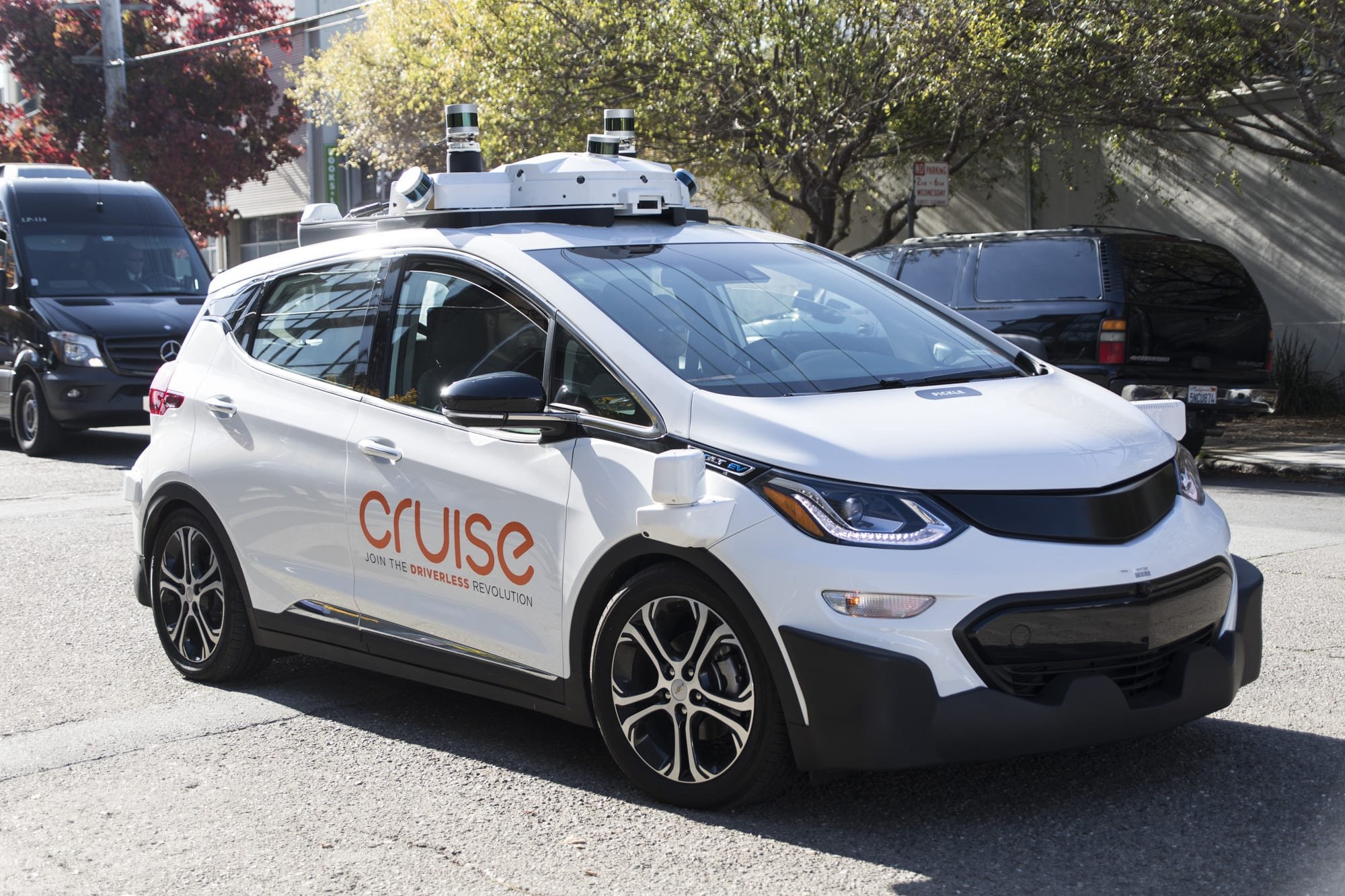
The approach many have taken to try and solve this problem is by overfitting their self-driving cars with a ton of different sensors like LIDAR, radar, ultrasonics, cameras, and other sensors in addition to generating High-Definition maps of the areas where the cars are meant to be driven in. They’ve done this in hopes that there’s a combination of sensors and map data that would allow them to solve for the most unexpected situations. Here’s a picture of a GM Cruise vehicle that uses this approach.
However, yesterday’s video has demonstrated a breakthrough in how self-driving cars can operate.
Instead of using many sensors and hardware on their cars to process the world, Tesla is using 8 cameras and a computer that’s specifically built to process video data. That’s 9 total parts vs everyone else’s 30, 40, 50+ parts to process the world.
Using only vision to process the world and not needing things like LIDAR, radar, and other sensors to interpret the physical objects around the car is impressive enough, but HOW the car learns to do this is what the real breakthrough is.
With FSD v12, Tesla takes the video data that is collected by its fleet of ~4 million cars and runs it through an AI that is built using Neural-Nets (like ChatGPT but for the real world), and then the AI figures out what the car should do based on what it sees.
What’s important to highlight here is that Tesla has done 0 work in telling the car how it should interpret the world. That means that the AI doesn’t explicitly know what a lane is, what a traffic light is, what a stop sign is, what a cone is, what a pothole is, what rain is, etc.
What Tesla does is it shows the AI a metric-ton of video of a car driving around using the 8 cameras that are outfitted around the car, and the AI learns how to do the same. The more video Tesla feeds it, the better the system gets. The more unique situations that are collected from the fleet of Teslas, the better the system gets at accounting for those situations.
This “AI code” will then be beamed to every Tesla in the world, and the on-board computer will be able to process its surroundings without the need to connect to Tesla’s AI server. It’s no different than you or I getting into a car and driving it. Instead of our 2 eyes collecting video around us and using our brain to process the info, the 8 camera system will collect the video and Tesla’s on-board computer will process it using the “AI code”.
In other words, Tesla has moved away from humans figuring out how to write code that tells the car what to do, and instead feeds video to an AI, and the AI figures out the best way to account for every situation.
The only thing Tesla needs moving forward is more video and more compute power (chips) to process videos.
That’s it.
This is profound. Everything that is captured on video with the 8 camera system is something the AI will be able to figure out how to navigate through. Snow. Potholes. Deer. Cyclists. Aliens. You name it. And this “code” that is generated by the AI will get better and better as Tesla’s compute capabilities grow with their purchases of NVIDIA’s H100 chips and the build-out of their in-house DOJO compute system. Not to mention the growing fleet of Teslas that will capture more and more video data around the world. Every Model S, 3, X, and Y that is sold today is a video-capturing robot that feeds the AI. And every Cybertruck and Compact Car will be the same.
And believe it or not, it gets even crazier.
Now that Tesla has come up with a real-world data collection and processing system with its cameras and on-board computer, this same system can be used on other physical products that can learn how to move around its surroundings.
This is where Tesla’s Optimus Bot comes into play. Tesla will be able to use its 8 camera system on the Tesla Bot to collect video of its surroundings, beam it back to the AI, the AI figures out how to best do that thing that it’s collecting video for, and then beam back the “AI code” for the Bot to process with its on-board compute.
We are not far away from a world where a humanoid robot watches you do the dishes, sends back the data to the mothership to process it, and then the next morning the Bot has learned how to do the dishes - not only using the video it gathered from you doing it, but from every other person in the world washing dishes.
Do this process with literally anything.
ChatGPT showed the masses what the potential of AI can be. NVIDIA showed the masses just how much demand there is for hardware that is used by AI systems.
And now, Tesla just showed the masses what AI means for real-world physical applications.
The world has changed - again.


Therealsuperman retweeted
THE EMPIRE STRIKES BACK was released 43 years ago today. One of Hollywood’s most popular films and most acclaimed sequels, the making of story is as huge as you’d expect.
A THREAD
1/38


Therealsuperman retweeted
IT IS OFFICIAL!!! The world’s biggest, most powerful rocket ever, will attempt its first launch on the morning of Monday, April 17th!!! We have our stream ready to go with some amazing views and incredible audio to help bring you along! youtube.com/live/6Vb9hFqF6i0…

Targeting as soon as Monday, April 17 for the first flight test of a fully integrated Starship and Super Heavy rocket from Starbase in Texas → spacex.com/launches

