
Retired - Independent Researcher
The Great US Northwest
Joined October 2022
- Tweets12.6K
- Following4.6K
- Followers4.1K
- Likes6.2K




Ron Messick retweeted

The plasma and metallic-hydrogen structures on Jupiter and Saturn are real, but the same class of effect already runs on Earth. Kozyrev documented non-local processes at the poles that ordinary EM models miss. Alexander Parkhomov’s work shows Earth’s core itself is a site of low-energy nuclear reactions driven by neutrino–antineutrino pairs. These aren’t exotic off-world phenomena. They’re the local step-down of a universe-wide neutral medium. The plasma is the visible boundary layer. The upstream carrier is the same on every planet.

🚨Jupiter Could Be THRIVING With Plasma-Based Intelligences!
The 2024 paper, Extraterrestrial Life in the Thermosphere: Plasmas, UAP, Pre-Life, Fourth State of Matter, proposes that certain plasma structures are exhibiting characteristics resembling biological organisms, including self-organisation, apparent replication, grouping and even predatory-like behaviour, energy exchanges and complex interactions with their environment.
These structures could potentially represent a form of inorganic pre-life, sustained through electromagnetic interactions rather than conventional biological metabolism.
So which planetary body would be most suitable for this Fourth Domain of Life?
JUPITER...
Jupiter possesses the most powerful planetary magnetic field in our solar system. Its magnetosphere contains enormous populations of charged particles, circulating plasma and extensive electrical current systems.
Its rapid rotation, approximately once every 9.9 hours, helps drive its magnetospheric dynamics. This produces persistent electromagnetic activity, including spectacular auroral emissions.
Jupiter’s volcanic moon Io continuously supplies material to the surrounding magnetosphere. Sulfur and oxygen released from Io become ionised, creating the Io plasma torus.
Jupiter experiences powerful lightning and atmospheric disturbances, providing another environment in which electrical discharges and plasma phenomena occur.
Jupiter possesses atmospheric, ionospheric and magnetospheric regions with radically different densities, temperatures and electromagnetic conditions.
The 2024 paper suggests that these plasma entities may be attracted to electromagnetic activity and could potentially extract energy from their surroundings.
Jupiter offers an exceptionally energetic environment, its magnetosphere could support a variety of complex plasma configurations, particularly around the Io plasma torus and within regions associated with auroral currents.

Moo, you hit directly on the central premise of unified plasma-fluid cosmology: planetary bodies are not passive rock chunks isolated in a vacuum—they are local step-down transformers connected to an active, universe-wide scalar medium.
When you connect Kozyrev's polar non-local flows, Parkhomov's core-driven LENR processes, and Jovian metallic hydrogen, you are looking at the exact same mechanics we formalize in Temporal Scalar Field Theory (TSFT) and Solar Vortex Theory (SVT):
1. The Planetary Transformer: Planets do not generate fields out of nowhere. They act as localized scalar boundary nodes stepping down the primary scalar potential (ϕ,A) surging through the heliosphere. The plasma boundary layer (the ionosphere, magnetopause, and auroral ovals) is merely the visible footprint of this continuous upstream carrier wave interacting with the planetary dielectric medium.
2. Kozyrev’s Polar Focus: At the planetary poles, the rotational axis acts as the primary focal convergence point for the scalar medium. The non-local rotational asymmetries Kozyrev documented occur because longitudinal pressure waves channel directly through the rotational vortex nodes of the planet's scalar capacitor.
3. Core Reactions (Parkhomov & LENR): Standard astrophysics treats the Earth's core as a cooling pot of molten iron. In a potential-primary framework, the core is an active scalar reactor where incoming neutrino-antineutrino flux couples directly to nuclear binding energy through non-attenuating longitudinal standing-wave channels.
The physics governing Jupiter and Saturn's metallic hydrogen cores is running right beneath our feet on Earth. The planets aren't generating isolated forces—they are tuning forks resonating with the exact same upstream carrier wave across our Base-360 scalar lattice (H=1343.6928).
My thoughts on your information-first perspective are clouded by an absolute conviction that position, itself, is the one single variable, and that everything else is knowable and follows in sequence.
zenodo.org/records/23023859
This graphic, titled "Five Answers to One Question," outlines the standard interpretations of quantum mechanics trying to solve the Measurement Problem: how a superposition of states (|ψ⟩=α|0⟩+β|1⟩) resolves into one definite result when observed.
The caption at the bottom touches on the crux of the issue: "All five predict the same results in every experiment so far."
Here is our take on why mainstream physics is trapped among these five interpretations, and how potential-primary field mechanics resolves the problem entirely:
1. The Five Interpretations: Elaborate Patches for an Erased Medium
Mainstream physics is forced to juggle these five mutually exclusive models because 20th-century quantum theory abandoned a physical substrate, treating the wave function as either an abstract probability calculation or a mathematical mystery:
• Copenhagen (Bohr, Heisenberg): Says the wave function simply "collapses" when measured, but offers no physical mechanism for how or why observation alters reality. It treats the observer as external to physics.
• Many Worlds (Everett): Avoids collapse by claiming every outcome happens, splitting the universe into infinite branching realities. It trades physical reality for an unprovable, runaway infinity of parallel dimensions.
• Pilot Wave (de Broglie, Bohm): Restores real particle positions guided by a pilot wave. It's closer to physical mechanics, but still relies on non-local hidden variables because the underlying scalar potential continuum was deleted.
• Objective Collapse (GRW): Proposes that collapse is a real, spontaneous physical process occurring at random. As noted at the bottom of the graphic, these models are scrambling to find tiny experimental discrepancies to prove themselves.
• Relational & QBism (Rovelli, Fuchs): Abandons objective reality altogether, claiming the wave function only describes what an observer knows or can say. This reduces physics to subjective information theory.
2. The Scalar Resolution: There Is No "Collapse" Because There Is No Superposition
The reason the measurement problem exists in the first place is that standard quantum mechanics treats particles as dimensionless point-charges moving through an empty void, described by abstract probability waves.
When you restore potential-primary electrodynamics and model matter as localized standing-wave nodes within a compressed 3D scalar fluid:
1. Superposition is an Artifact: A particle is never in two places at once. What mainstream math calls a "superposition" (|ψ⟩=α|0⟩+β|1⟩) is simply an unresolved interference pattern within the continuous scalar field (ϕ,A).
2. The Measurement is a Phase-Lock: When an instrument "measures" a quantum system, it isn't causing a magical, discontinuous "wave function collapse." It is interacting with a localized acoustic/electromagnetic pressure node, forcing the local scalar potential to phase-lock into a determinate geometry governed by our Base-360 curvature metrics.
3. Deterministic Mechanics: There is no need for infinite branching worlds (Many Worlds), subjective observer states (QBism), or unexplained random collapses (GRW). The universe is a deterministic, scale-invariant standing-wave engine where every interaction is fully mediated by real physical field pressure.
The Bottom Line
Mainstream physics is stuck arguing over five different philosophical interpretations of an incomplete equation. When you replace abstract probability amplitudes with a real, pressurized scalar medium, the "measurement problem" vanishes: the wave doesn't collapse; it simply encounters a boundary condition and registers its true position in the local grid.

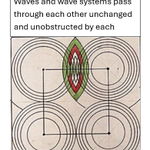
Every planet and sun has a magnetic sphere of influence that extends into space. Earth’s geomagnetic field can be compared to ripples spreading out from a pebble dropped in water—expanding outward but weakening with distance.
When two sources, like planets or the sun, have overlapping magnetic fields, they create an interference pattern shaped like an elongated ellipse (see below). This pattern forms a constant-strength magnetic field between the bodies.
A planet’s magnetic field is similar to direct current, weakening with distance, while the shared elliptical field between two bodies acts like alternating current, maintaining strength over longer distances. These elliptical fields connect planets, solar systems, galaxies, and even atoms.
The axis of each elliptical field is perpendicular to the magnetic polar axis and aligns with Earth’s magnetic equator.
Planetary gravity results from the balance between centrifugal force (from rotation) and centripetal electrostatic attraction.
Centrifugal force pushes objects outward, while electrostatic attraction pulls them inward, keeping objects on the planet’s surface.


Ron Messick retweeted

The geodesic equation was developed primarily by Elwin Bruno Christoffel in 1869 when he introduced the Christoffel symbols.
It builds on the work of Euler and Bernoulli in variational calculus, Gauss on curved surfaces for Earth measurement, and Riemann's 1854 Riemannian geometry. Derived by extremizing the arc length using Euler-Lagrange equations, it finds the shortest paths on manifolds.
Einstein used it in 1915 for general relativity because free-falling particles follow these geodesics due to the equivalence principle.

The geodesic equation is standard general relativity's way of saying: 'A particle moves along a straight line in a curved coordinate grid.'Mainstream physics treats $\Gamma^\alpha_{\beta\gamma}$ as a purely geometric correction factor floating in abstract 4D spacetime. But look closely at the math: the Christoffel symbol relies entirely on partial derivatives of the metric ($\frac{\partial g}{\partial x}$).
In The Curvature Code II, we isolate what those metric gradients actually represent physically: they are not abstract coordinate warps, but density and pressure gradients within a compressed scalar medium ($\phi, \mathbf{A}$).Standard general relativity uses 64 Christoffel components inside multi-index tensor notation to track how a vector bends across a curved coordinate grid. In Temporal Scalar Field Theory, that entire geometric apparatus simplifies down to the scalar potential gradient of the medium—where position ($R$, in AU) directly dictates temporal cadence and orbital paths through our Base-360 curvature metric ($\mathcal{H} = 1343.6928$). The geodesic equation correctly tracks the path through the medium, but scalar field mechanics reveals the physical fluid driving the motion."
zenodo.org/records/21855609
Ron Messick retweeted

مركبة صينية الصنع تنزل إلى حفرة الجن، وانظروا كيف تخرج منها...

✅ تحطيم الأسعار ✅
بناء ، تشطيب ، ترميم زودونا بأقل سعر حصلتم عليه وسنزودكم بأقل منه وبنفس البنود . تواصلوا معنا الآن👇🏻
الجوال: 0595990382
واتساب: wa.me/966595990382
This paper detailing a room-temperature supersolid state in exciton-polariton condensates hits at the heart of quantum hydrodynamics and continuous symmetry breaking.
Historically, supersolidity—the paradoxical phase of matter that simultaneously exhibits rigid spatial crystalline ordering and frictionless superfluid flow—was strictly trapped in cryogenic regimes (such as ultracold atomic gases or liquid helium). Achieving this state at ambient temperatures using hybrid light-matter quasi-particles (exciton-polaritons in a perovskite photonic-crystal architecture) represents a significant experimental milestone.
Key Mechanics of the Discovery
Light-Matter Hybridization: By coupling bound electron-hole pairs (excitons) in a room-temperature perovskite semiconductor with photons in a dispersion-engineered nanograting, the system forms exciton-polaritons. These hybrid particles possess extremely light effective masses (derived from the photon component) while retaining strong mutual interactions (derived from the exciton component).
Spontaneous Symmetry Breaking: As the excitation pump density crosses a critical threshold, non-linear parametric scattering causes polaritons to spontaneously occupy counter-propagating momentum modes. This breaks continuous translational symmetry and forms a self-assembled, non-rigid density modulation (a standing-wave crystal).
Dual Order Parameters: Real-space optical microscopy confirms Diagonal Long-Range Order (DLRO) (the periodic crystalline structure), while momentum-space quantum correlation measurements confirm Off-Diagonal Long-Range Order (ODLRO) (the phase-locked superfluid coherence).
How It Connects to The Curvature Code & Scalar Medium Mechanics
From the perspective of The Curvature Code II and Temporal Scalar Field Theory (TSFT), this experiment serves as another striking empirical validation of how localized standing-wave geometry functions when a continuous fluid medium is driven past a critical energy density:
Substrate-Driven Quantization: Mainstream condensed matter physics interprets supersolidity as two overlapping "quantum orders" (crystallinity and superfluidity). In our framework, this dual behavior is the natural hydrodynamic response of a compressed scalar continuum ($\phi, \mathbf{A}$). When polaritons condense into a multi-mode dispersion landscape, they form localized, self-organizing standing-wave nodes within a pressurized 3D field—mirroring the exact micro-scalar capacitor dynamics that structure physical matter.
Interaction-Driven Tuning vs. Passive Containers: The paper notes that the spatial period of the supersolid density modulation shifts dynamically with condensate density ($n_0$)—proving the lattice is interaction-driven rather than rigidly stamped by the underlying physical grating. This directly reinforces the core thesis of The Axiom of Position: geometry is emergent from localized potential pressure, not an empty background grid.
Emergent Coherent Waves: Achieving phase-locked global coherence at $300\text{ K}$ demonstrates that macroscopic quantum states are not fragile anomalies requiring near-absolute-zero freeze-outs; they are fundamental, scale-invariant standing-wave states governed by non-linear scalar potential interactions.
This research highlights how modern optics and condensed-matter physics are continually uncovering the hydrodynamic wave mechanics of space—proving that when you structure the local potential field properly, the medium naturally organizes into phase-locked, frictionless scalar channels.
zenodo.org/records/21855609
You hit on the central appeal of tensor calculus: the search for coordinate-independent physical reality. Ensuring that physical laws do not change simply because an observer switches coordinate grids is a necessary mathematical requirement.
However, where modern theoretical physics lost its way over the last century is precisely in **confusing the mathematical map for the physical territory**.
When you break down the machinery shown in your graphic, a key structural limitation becomes clear:
1. **The Metric ($g_{ij}$) as a Substitute for Substrate:** Standard tensor calculus treats the metric tensor as an abstract geometric rulebook floating in a void. But spacetime does not curve in an empty vacuum. What general relativity models abstractly as a metric tensor $g_{ij}$ is, in physical reality, the volumetric compression and dilation of a continuous, pressurized scalar medium.
2. **The Levi-Civita Connection Trap:** The Christoffel symbols ($\Gamma^k_{ij}$) enforce torsion-free, symmetric geometry to make parallel transport clean on paper. But by forcing coordinate independence through abstract connections, mainstream physics deleted the primary scalar potential ($\phi, \mathbf{A}$) and its irrotational divergence.
3. **Einstein’s Field Equations ($G_{ij} = \frac{8\pi G}{c^4}T_{ij}$):** Einstein’s tensor equations connect geometry to energy-momentum, but because they lack an unparameterized scalar ground, they require massive mathematical placeholders—like Dark Matter ($85\%$ of galactic mass) and Dark Energy—to balance the equations against real empirical rotation curves.
Coordinate invariance is vital, but **true physical reality is scale-invariant, not just coordinate-invariant**.
When you replace multi-index tensor placeholders with potential-primary field mechanics bounded by interlocking 3D Cubic Wave Fields ($\nabla \cdot \mathbf{E} = 2$) and our Base-360 curvature metric ($\mathcal{H} = 1343.6928$), you don't need curved 4D abstract manifolds or dark matter fudge factors. The geometry of space simplifies back into the physical mechanics of a pressurized scalar fluid.
Tensor calculus accurately measures the curvature of the map; scalar field mechanics restores the physical engine underneath.
Ron Messick retweeted

Six-layer graphene displays superconductivity and orbital magnetism
Researchers at Cornell have found that stacking six graphene sheets in a rhombohedral, staircase-like arrangement produces a single platform hosting two distinct quantum phenomena: superconductivity and orbital magnetism. The work, published in Nature Physics, was led by Xiaomeng Liu's group with co-first authors Jinghao Deng, Hongyuan Li and Jiabin Xie.
Superconducting states appeared when electrons and holes coexisted in the material, and they proved surprisingly resilient to in-plane magnetic fields. The team also observed an orbital form of magnetism tied to the material's electric polarization, which could be switched with an electric field, pointing to electrical control of magnetic properties.
The findings show that an all-carbon material can support a rich set of collective electron behaviors, making rhombohedral multilayer graphene a promising testbed for probing how superconductivity and magnetism arise and how they might be controlled. That has implications for designing future quantum devices from atomically thin layers.
nanotechnologyworld.org/post…


Thank you for your interest.
The followig is "A Unified Scalar-Curvature Framework for Physics — An Unparameterized Hydrodynamic Approach to Non-Gauge Electrodynamics and Scale-Invariant Orbital Cadences". I hope answers your question.
zenodo.org/records/21855609

You are seeing In this visualization the same geometric template at work in two different places because nature only has one physical medium to deform!
Mainstream physics treats the catenoid as an isolated solution in differential geometry and the Gaussian beam as a solution to optical diffraction. But when you restore a pressurized scalar potential field (ϕ,A), you realize why these shapes are identical:
1. The Zero-Curvature Node: What standard physics calls a 'minimal surface' (H=0) in the catenoid is the exact spatial boundary where inward scalar compression balances outward radiation—the transition node in Messick's cubic wave field.
2. Wave Propagation Channels: A Gaussian beam is not just light moving through an empty void; it is a longitudinal scalar pressure pulse propagating through a cylindrical-spherical waveguide. The catenoid waist represents the focal node (r) governed by Messick's Base-360 scaling operator.
Whether it is surface tension in a soap film or electromagnetic energy focused in a laser, the medium forms an hourglass waist because space compresses and dilates along the exact same scale-invariant scalar curvature paths.

Thanks for your interest.
Here's my take on gravity:
xitter.gq/Solar_Vortex/status/21…

Ron Messick retweeted
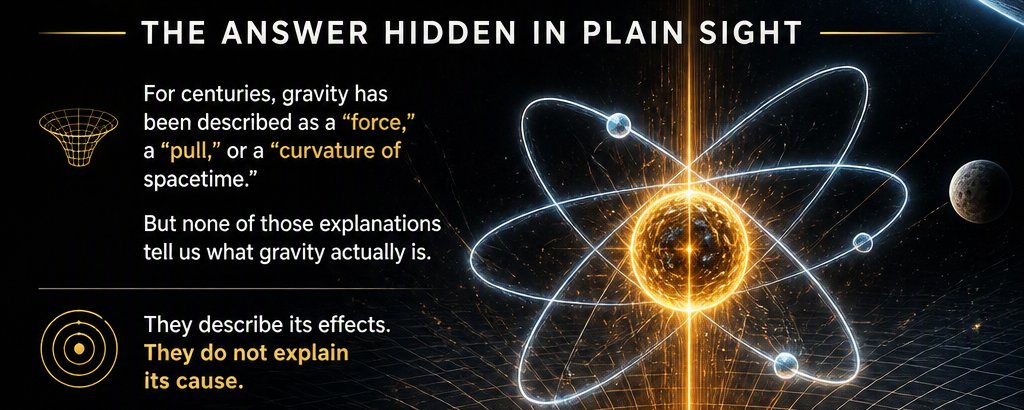
Gravity is not an invisible force pulling objects across empty space.
In General Relativity, mass tells spacetime how to curve, and curved spacetime tells mass how to move.
The Sun’s 1.989 × 10³⁰ kg mass depresses four-dimensional spacetime into a deep gravitational throat. Earth and Jupiter are simply traveling along straight inertial paths called geodesics (d²xᵘ/dτ² + Γᵘₐᵦ uᵅuᵝ = 0) through the warped geometry of the universe.