

Systems-level regulation of immune responses @UCSF @ParkerICI @czbiohub @immunox. Tweets by lab members.
San Francisco, CA
Joined January 2019
- Tweets105
- Following147
- Followers1.1K
- Likes79
Congratulations to our 4 PhD candidates who recently passed their qualifying exams (left to right): @immuno_minna, @MHCkenzie, Zach, and @happyjing97! We're so excited to see some great science from them in the next few years! 🎉🥳

More celebration is in order: Dr. Casey Burnett delivered a fantastic exit talk today! @cburnett27 has been an invaluable and impactful member of our and the @roybal_lab, and we look forward to seeing her succeed in her next steps! Congratulations! 🎉🎉

Please join us in congratulating the newly minted Dr. Rachel DeBarge! @racheldebarge has not only immensely contributed to the research conducted in the lab but also acted as a trusted mentor to many students/trainees. We will miss them but can't wait to see what they do next! 🎉


We then characterized metabolic states of human CAR T cells in DLBCL therapy. Similar to our mouse data, CAR T cells at the time of infusion exhibited a distinct metabolic profile characterized by simultaneous high glycolytic and oxidative marker expression. 7/8

We next mapped the fate of Early Activated cells by adoptive transfer into congenic recipients and found that these cells differentiated into effector and memory subsets. Rechallenging Early Activated cells led to expansion indicative of functional memory differentiation. 6/8

We further validated that expression of glycolytic and oxidative proteins were simultaneously expressed in single cells from this Early Activated state. Then we functionally validated peak glycolytic potential and mitochondrial respiration by Seahorse on sorted cells. 5/8

Intriguingly, this transient Early Activated cell state expressed the highest levels of many metabolic proteins including expression of proteins involved in glycolysis and oxidative phosphorylation and preceded the prominent expansion of effector and memory cells. 4/8

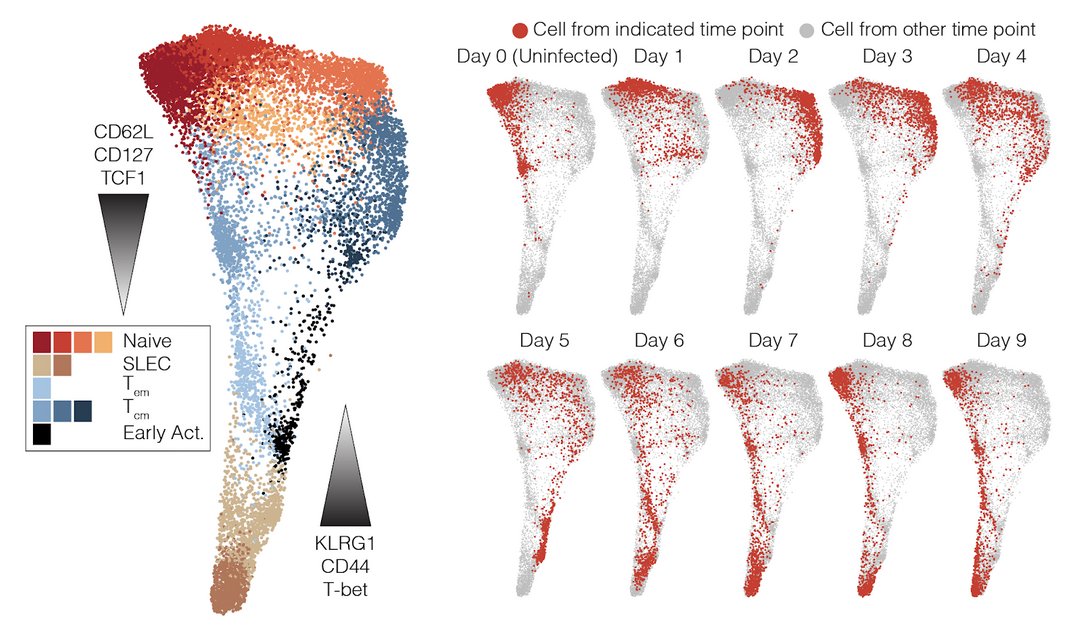
We next moved in vivo and tracked polyclonal CD8 T cell differentiation in response to infection with Listeria monocytogenes expressing ovalbumin. We found an interesting Early Activated and highly transient cell state most prominent at Day 5 post infection 3/8
We established an antibody panel to simultaneously profile T cell fate and metabolic landscape by CyTOF. Dimensionality reduction using only metabolic protein expression clearly separated unstimulated mouse OT1 T cells from in vitro IL-2 and IL-7 polarized cells. 2/8

Finally, we found that surgical resection of the tumor was sufficient to completely reverse all peripheral changes in immune composition and response to orthogonal pathogen challenges, suggesting remarkable plasticity of the tumor burdened immune state. 6/7

Interestingly, we found that T cells from the periphery of tumor bearing mice were not defective, but instead splenic dendritic cell activation is attenuated. Stimulating dendritic cells with anti-CD40 agonist was sufficient to rescue the T cell proliferation defect. 5/7

De novo immune responses are critical for anti tumor immunity. To model the development of a new response in the altered tumor immune macroenvironment, we challenged tumor bearing mice with LCMV or Listeria. T cell differentiation and proliferation was significantly impaired. 4/7

While the peripheral expansion of monocytes and neutrophils has been described in many mouse models of cancers, we found that T cells also undergo dramatic shifts in composition shown here in a heatmap of frequencies for 29 clusters across tissues. 3/7

