https://xitter.cf/t.co/FoWL95rtbn (guides, models, tools) | https://xitter.cf/t.co/1ZVB9Zuyqa (EDGAR reader) | Write-ups on AI infra, rocks, spec sits, SaaS, new 52w lows 👇

StableBread
Joined August 2020
If you're still using EDGAR to read SEC filings, you're wasting your time! Just use SECSift: secsift.com It's the obvious solution if you want to cut down the time spent reading filings by more than half and better understand any business.
1
1
8
2,460
From September 2016 to September 2026, Nvidia turned $1 into $136. With $1 in each of the 466 S&P 500 stocks that traded the whole time, the 10 best produced 28% of the total gain, and only 136 of the 466 beat SPY, the S&P 500 ETF. So owning fewer stocks only pays off if you can find those winners. → Full video: youtu.be/m6VkEi1CvaI
1
254
I built 5,000 random portfolios of each size from the 466 S&P 500 stocks that traded from September 2016 to September 2026. A single stock carried 30% risk per year on average, 20 stocks cut that to roughly 17%, and all 466 only cut it to roughly 16%. That fits the common rule of thumb that 20 stocks are enough to diversify a portfolio. → Full video: youtu.be/m6VkEi1CvaI
1
1
308
A solar manufacturer that grew revenue 141.5% in 2025 now trades at 2.0x TTM earnings, after falling 77.5% from its June peak. U.S. customs (CBP) has been detaining its Ethiopian cells since May, and Commerce is deciding whether they should pay the duties on Chinese cells, with a first ruling due around December 14. That company is TOYO Co., Ltd $TOYO, now at $3.83/share. $TOYO’s closest comps are four other listed solar manufacturers selling into the U.S., and all four are down from their 2026 highs too, as of the October 26 close: → First Solar $FSLR: Down 47.2% to $168.15/share. → Canadian Solar $CSIQ: Down 65.2% to $8.85/share. → JinkoSolar $JKS: Down 72.7% to $8.17/share. → T1 Energy $TE: Down 82.4% to $2.12/share. Only $TE has fallen further from its 2026 high. Besides CBP’s detentions and the Ethiopia inquiry, four more overhangs landed after the June peak: 1) Discounted stock sale: $TOYO sold $50M of stock and warrants at $11.00 on June 24, a 14.9% discount to the prior close, and the stock fell 38.8% that day to $7.91. 2) New tariff: An August 6 proclamation set a 15% U.S. tariff on imported solar cells and panels, including $TOYO’s cells from Ethiopia, starting December 4. 3) Guidance dropped: $TOYO didn’t reaffirm its 2026 targets with its H1 results on August 19, when the stock fell 24.2%, and on September 28 only said it expects positive EBITDA for H2 2026. 4) Parent delisted: The Tokyo Stock Exchange delisted Abalance, the Japanese group that controls $TOYO, on September 26. Still, $TOYO is profitable and has net cash: → Earnings: $156.4M of TTM EBITDA and $80.5M of TTM net income. → Cash flow: $61.4M from operations in H1 2026, less $27.8M of capex, for $33.7M of FCF. → Balance sheet: Went from a going-concern warning to positive working capital in six months, with $26.4M of net cash as of June 30. → Texas: Doubled its Texas module capacity to 2 GW and signed ~$240M of binding module contracts since mid-June. → Tax credits: Management expects $140M/year of U.S. manufacturing tax credits at full Texas output, 85.6% of $TOYO’s market cap, and leaves those credits out of its forecasts. $TOYO’s EV of $137.2M is just 0.9x its TTM EBITDA. So is $TOYO a profitable non-Chinese cell maker on sale, or is the market right that Ethiopia’s U.S. sales won’t last?
3
3
455
Anthropic's Q2 2026 (June 30, 2026) revenue of $11.6B was 2.5x what it made in all of FY2025 (ended Dec. 31, 2025). Anthropic also flipped to a $974M operating profit, from a $1.7B operating loss in Q1 2026 (March 31, 2026). Yet it posted a $66.3B net loss for the quarter. Here's what Anthropic's S-1 (the IPO filing), filed on October 26, 2026, says about the loss, the last private round's implied ~$1T valuation, ~$850B of compute commitments, the dilution ahead, and who controls the company after the IPO ↓
1
2
336
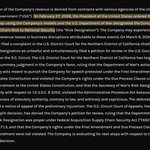
Anthropic also had three run-ins with the U.S. government in 2026: 1) On February 27, the President ordered federal agencies to stop using Anthropic's models, and the Department of War designated the company a supply-chain risk to national security. Anthropic largely won its district court case, but lost a separate 2-1 ruling at the D.C. Circuit on September 25, 2026, and has asked the full court to rehear the case. 2) In June, Anthropic disabled its Fable 5 and Mythos 5 models for all customers when the Commerce Department restricted their export worldwide (since lifted). 3) In October, the FTC sent Anthropic a civil investigative demand (a formal request for information) on its consumer protection, data protection, and privacy practices, and the safety and security of its products. Anthropic also still owed $1.2B of its $1.5B Bartz settlement with book authors as of June 30, 2026, and faces training-data suits from music publishers, Canadian authors and news publishers, and Reddit $RDDT.
1
1
95
The IPO price, share count, and run-rate revenue as of October 31, 2026 are still blank, and so is how much cash Anthropic will spend on employees' taxes for RSUs that settle at the IPO. Anthropic plans to list on Nasdaq as $ANT, with $GS and $MS leading the deal. Five of Anthropic's co-founders are also selling shares in the IPO, although the S-1 leaves the number blank. Anthropic's lock-ups release shares in stages, with 23 scheduled release dates over its first year as a public company, starting on its first trading day. So instead of one lock-up expiration, insider shares can hit the market every few weeks for a year. Read the S-1 yourself on SECSift: Read the S-1 yourself on SECSift: secsift.com/?t=2130357&a=000…
92
My bear, base, and bull cases value Boost Run’s $BRUN stock on year-end 2026 ARR (on the same basis as the multiples of CoreWeave $CRWV, Nebius $NBIS, and $IREN), which $BRUN will report with its Q4 results in March 2027. None of the three cases adds the $160.7M/year from the July order and Cohere, since both start in 2027. The peers’ contracts that start after 2026 aren’t in their year-end ARR either, so they’re priced into the multiples instead. Since the peers’ multiples leave out the debt they’ll take on to reach year-end ARR, I hold $BRUN’s net debt at today’s $244.3M, rather than adding the lease debt from its H2 2026 build. Each case’s value is year-end ARR times the multiple, minus the $244.3M of net debt, divided by the 88.8M fully diluted shares plus any new shares from a stock sale. I start with the $231.4M of ARR from contracts already running, then add (1) the June order’s $69.2M/year if it starts by December 31 and (2) however much of the $99.4M from contracts without disclosed terms is running by then. Bear case ($4.76, -46%) The bear case assumes $BRUN has no new financing to show by its Q3 report, lessors fund 70% of the H2 2026 build instead of 79.5% (below the 72.0% lessors funded in 2025), and the June order’s November 30 start slips into 2027, so 2026 GPU spending stays at the $1.0B low end of management’s range. That implies year-end ARR of $280M, 30% short of the target, a $62.2M stock sale at $8.89/share (7.0M new shares) to cover the funding gap and three months of 2027 payments, and today’s 2.5x, for a value of $4.76/share. I give the bear case about a 20% chance. Base case ($16.17, +82%) The base case assumes $BRUN lands new lease or asset-backed financing by year-end, starts the June order on November 30, and reaches its $400M target without selling stock. That implies $400M of year-end ARR at CoreWeave’s 4.2x, the median of the three peers, for a value of $16.17/share. I use today’s median, since the base case only solves $BRUN’s own financing problem. It assumes no relief on rates or borrowing costs, which would lift the peers’ multiples too. Bull case ($19.78, +122%) The bull case assumes everything in the base case, plus relief on rates and borrowing costs that lifts the peers’ multiples. That implies $400M of year-end ARR at 5.0x, still below Nebius’s 5.9x, for a value of $19.78/share. So the bull case is really a bet on the market, not on anything more from $BRUN. From $8.89/share, you’re risking a $4.13 loss (-46%) in the unlikely bear case for a $10.89 gain (+122%) in the more likely bull case. P.S. These cases use the October 16 close and predate $BRUN’s October 26 release, which says it has closed more than $600M of non-dilutive project financing in 2026.
4
1
9
1,108