

Dev Ashish, Founder https://xitter.gq/t.co/UjEvJiQg2Q | SEBI RIA No. INA100005241 | Fee-Only Investment Advisory & Financial Planning | Services - https://xitter.gq/t.co/RlTHDRWbl8
India
Joined October 2012
- Tweets25.8K
- Following218
- Followers66.7K
- Likes8.7K






Pinned Tweet
I am a SEBI Registered Fee-Only Investment Advisor (RIA). Details of the advisory services below:
Financial Planning:
bit.ly/StableFinancialPlanni…
HNI Portfolio Advisory:
bit.ly/StableHNIAdvisory
Use the forms in these pages to contact for advisory/planning services

Nifty50 CAGR for the last 1 to 5 years.
Data (up to 30-Oct-2026)
Note - Investments in the securities market are subject to market risks. Read all the related documents carefully before investing.
Disclaimer - The funds shown are for illustration only. It is not a recommendation to buy/sell/hold. Please get in touch with your investment advisor to get customised investment advice based on your risk profile and unique requirements.

Silver is down -60% from its highs of Rs 4.2 lakh to almost Rs 1.7 lakh, and from $121 to $49 now since this tweet. What had happened in January 2026 (earlier this year) was a perfect parabolic up move, and these don’t come often. And when they do, what happens afterwards (like the current 60% fall) is also not easy for everyone. Those who rushed and got in at higher prices due to fomo, are now learning the old lessons: that markets can be humbling, irrespective of the asset class.
Disc. - Please don’t consider this as investment advice of any kind or my view of what silver would do next. It may go up or down. Stick to your personal (and proper) asset allocation as everyone’s risk appetite is different and hence, you should act accordingly. Or talk to your investment advisor about what needs to be done.

Silver 2026 & Beyond – Thoughts
While silver’s bull case (till 1-2 years back) was built on the combination of factors like rising industrial use, supply deficit, undervaluation vs gold, growing geopolitical instability and possibility of precious metals regaining the lost respect vs paper/fiat currency (debasement thesis), things are a little different now with silver already up more than 200% in recent times.
In INR terms its up from Rs 1 lakh/kg in Apr-2025 to almost Rs 3.25+ lakh in Jan-2026! In USD terms too, it's up from $32-33 to $110-115 in the same period.
My view about Silver (was, and still) is that given its historically unreliable nature, it does NOT have a case for making it a large or core part of a long-term portfolio, no matter how confident you are. It is true that last year has been crazy.
Even those of us who were bullish about silver’s long term multi-year prospects, have been shocked by this accelerated and parabolic up move. It’s like the return expectations of several years from silver have already achieved in just a year! Like the Silver God decided to bless early movers and decided to ‘front’ load the majority of the expected potential gains, if you understand what I mean here.
The thesis of commodity supercycle and silver correcting its perennial undervaluation (vs gold) still stands true to an extent. But it’s also true that huge rallies tend to attract speculation and more and more people then start giving into their FOMO. And most dangerous moments are often when the confidence is highest driven by such fomo. This kind of sharp parabolic move generally tends to happen towards the end. I am not saying this is the end or the top. I don’t know. All I am saying is that when prices move up at such sharp angles, the risk-reward no longer remains favourable for at least the new entrants.
If you zoom out and look back a few decades, then it becomes clear why silver is notoriously famous for getting deep cuts after big rallies (definitely read what happened in 1980 Hunt Brother’s episode and then in 2011 one too). It may not seem obvious now, but when the speculative demand disappears, it disappears fast, leading to painful falls followed by long periods of no returns.
I am coming across people who normally find it even difficult to save money (let alone invest properly), looking to buy silver for a quick doubling of their money! Signs of the times.
And even if it may not be right to call it a bubble yet, it is and will definitely remain volatile. And while multiple factors may still support a thesis for higher silver prices, irrespective of the past market cycles, it's honestly best to be careful now. And it won’t be bad to remind ourselves what Warren Buffett once said – Be fearful when others are greedy.
PS – I am no expert. But I am curious and interested in Silver and what’s happening. The above are just my general thoughts. I may be proven completely wrong in times to come. So read the above in that spirit. Please don’t consider this as investment advice. Everyone’s risk appetite is different and hence, you should act accordingly. Or talk to your investment advisor about what needs to be done.

Stable Investor retweeted
A few people asked Why shouldn't they do SWP (for income) from pure equity funds when I wrote an earlier post on SWP.
While one can do anything, doing SWP from an equity fund can backfire if the market starts falling sharply (and remains that way for a slightly longer time) and you too keep withdrawing money via SWP. So your portfolio falls pretty quickly.
Case in point - Suppose you put Rs 1 crore in a Nifty index fund in January 2020. And then you started your monthly SWP of Rs 50,000 from next month onwards.
We all know how markets tanked around March 2020. So here is how your portfolio would have looked in April after just 3 monthly withdrawals of Rs 50,000:
So in just 4 months, your Rs 1 crore portfolio was down to Rs 66 lakh (due to a sharp fall in the market) and you only withdrew a total of Rs 1.5 lakh via SWP.
You see how you would feel back then - Emotionally and mentally?
This is the reason you need to be careful via picking fund categories to do SWP from.
Ofcourse markets recovered later as they always do and the current situation is much better and something like this (image below) with the portfolio back up to Rs 1.4 Cr.
But it can be very tough emotionally for most investors to see their portfolio going down sharply, even temporarily, when they themselves are withdrawing from it. This is a more scary situation for retirees dependent on such corpus and SWP for income.


Stable Investor retweeted
'Trying' to Optimize SWP for Income
If you started in January 2013 with Rs 1 Crore in Liquid Fund (say for example - ICICI Pru Liquid Fund) and did a SWP of Rs 50,000 monthly, then to date, you would have withdrawn a total of Rs 65+ lakh but your liquid fund portfolio will still have Rs 1.13 Crore.
Neat. Isn't it? That is how basically SWP is supposed to work. And ideally, SWP should be done from debt instruments only.
But can this be further optimized?
In situations where you don't exactly need the full Rs 50,000 every month but it's more like you definitely need Rs 35-40K but it will be good to have an extra 10-15K more each month (at least in a few months of the year when expenses shoot up). So basically your core requirement is 35-40K and the remaining 10-15K is good to have.
In such a situation, can you rethink the initial deployment for better portfolio outcomes?
Yes, it is possible, at least in some cases and for some (and not all) investors based on risk appetite and expense profile.
Let's give it a try:
Note - This is not investment advice. The funds/categories chosen for this example are just for illustration purposes. Also, changes in starting dates will impact the results. Please talk to your investment advisor to discuss your investment requirements to help chart out a solid plan for chosen portfolio outcomes.
So let's change the initial allocation a bit now.
Say now, you started in January 2013 with Rs 70 lakh in ICICI Pru Liquid Fund and did a SWP of Rs 35,000 monthly and another Rs 30 lakh in ICICI Pru Equity & Debt fund (Hybrid) and did a SWP of Rs 15,000 monthly.
Result - To date, you would have withdrawn a total of about Rs 46 lakh from the Liquid fund and Rs 19.6 lakh from the hybrid fund. But your liquid fund portfolio will still have Rs 79 lakh and the hybrid fund will still have Rs 1.20 crore!
Not bad isn't it?
Compared to a pure Liquid fund scenario where you ended up with a residual Rs 1.13 Cr after Rs 65-66 lakh withdrawals over 11 years, in this case, you have almost Rs 1.99 Cr leftover after the same Rs 65-66 lakh withdrawals.
Reminder - This is just a simulation based on past data, without taking taxes or inflation-increasing expenses into account (for simplicity). So absorb this example with that in mind please.
So as you can see, if you are a bit flexible with your expenses and income requirements, i.e. meaning that you are okay to pause the hybrid fund SWP occasionally as the 15K anyways was not part of your core expenses and you could cut down your expenses a bit in case markets were going down a bit. If you can do that then you can better optimize your portfolio returns/outcomes for the same given SWP requirements. Easier said than done but still seems interesting.
Now the above combination of 70% in Liquid Fund and 30% in Aggressive Hybrid Fund is just one example. Depending on the individual's situation and the market scenario when deploying initial lumpsum, the percentages may have to be changed. That said, never try to rely on fully doing SWP from pure equity funds if you require regular income and don't have a very large initial corpus to begin with.
Thanks


Need to Increase the No. Large & Midcap Stocks by Widening Categorisation?
For some time now, I have maintained that there is a need to relook at the way large/mid/small-cap stocks are classified. Currently, the Top-100 stocks by avg. marketcap during the last 6-month period qualify as Largecap stocks. The Top 100 is split into Nifty50 (with stocks ranked 1 to 50) and the Nifty Next50 (stocks ranked 51 to 100). After this, the next 150 stocks, i.e. ranked 101 to 250 by marketcap, are considered as Midcap Stocks. And everything else is considered Smallcaps.
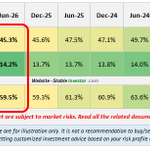
Here is what the % share of Top-100 Largecap stocks has been over the last 4 years. So, as per the Jun-2026 semi-annual update published by AMFI, the Largecaps now form about 59.5% of the overall listed market cap.
If you notice, the share of largecap stocks has reduced steadily in the last 4 years. From 69.4% in Dec-2022 to about 59.5% in Jun-2026 (and probably lower now). And even if we split the largecaps into two parts of Nifty50 and Next50, it is clear that the share of Nifty50 stocks has reduced substantially from 57% to 45.3%, while that of Next50 has inched up slightly from 12.5% to 14.2%.
Let’s look at Midcaps and Smallcaps now: Currently, the share of Midcap and Smallcap stocks in the overall marketcap is about 20.3% and 20.5%, respectively. Over the last 4 years, the run-up in Midcaps & Smallcaps has increased this from 30-31% to almost 41% now, if considered together.
What is now happening is that, given the increased participation in stock markets and more money chasing just a handful of stocks, it is slowly but surely being felt that the current limits of 100 stocks as largecaps and 150 stocks as midcaps are getting slightly restrictive. The smallcaps (at least theoretically) already have a huge pool to themselves, as all stocks beyond the 250th are considered smallcaps.
So as more and more money pours into the stock markets, maybe there is a need to relook at the marketcap bucketing definitions. This will increase the breathing space within the largecap and smallcap universe of stocks.
While the current approach is a fixed one (top 100 as largecaps and next 150 as midcaps and so on), an alternative may be to bring in a percentile approach to make the list dynamic (though it may have its own set of operational issues when implemented). If a dynamic approach isn’t feasible (for any reason whatsoever), then at least, one can expand the current fixed definitions slightly. For example, instead of just having the first 100 stocks as Largecaps, one increases it to (say) the first 150 stocks. A side effect of such a move will be that while Nifty50 will still have 50 stocks, the index Nifty Next50 will have to be relaunched as Nifty Next100 (sorry Next50 lovers!). Similarly, the next 200 stocks from rank 150 to 350 can be categorized as Midcaps.
Also, the categorization is now pretty well understood by investors since it has been in place for several years. So, there may not be a need to tinker with it and create new doubts. Only the marketcap-based bucketing of stocks is something that needs to be reassessed now even more than earlier.


Why are so many countries issuing advisories to stock up food, water and other essentials? What do they fear simultaneously but not saying openly?

Stable Investor retweeted
LTCG Taxation is in the news again. And the reason is that our finance minister has said the government is open to feedback on capital gains taxation.
I am no one, but I have feedback on it too. 😊
While personally, I would love to see pre-2018 taxation where LTCG was taxed at 0%, I am still fine if Long-Term Capital Gains tax on Equities is removed (or at least reduced*) and the holding period for LTCG qualification is increased to 3 years. It kind of aligns with what equities as an asset class demands - staying invested for the long term for best results.
My point is simple. If the aim is to promote long-term behaviour, give incentives like bringing LTCG down to 0% and redefining long-term for equities as 3 years.
*Scrapping the long-term capital gains tax on equities may be difficult for the govt. as LTCG tax on equities brings in decent revenues and, in all fairness, no government would want to give that up easily. So rather than full elimination, reducing it to a small percentage of say 1-5% (from the current 12.5%) may also send the right message.
Another option might be to make a tiered approach where LTCG tax from 1-3 years is 10%, and for holding periods above 3 years, it is removed completely (0%). But this will again make things complex, though desirable and better than what we have today.
Demands to remove LTCG come up every now and then. But the direction so far has been one way only: 0% before 2018, 10% from 2018 to 2024, 12.5% since. Let’s see what comes out of this episode of Bring-LTCG-Down-To-Zero.
But I really hope our govt. does something so that we can forget those infamous lines - Capital gains don't accrue from any effort (iykyk), and someone finally thinks about rewarding long-term investors by rationalizing/reducing LTCG taxes, if not eliminating them fully.

Stable Investor retweeted
A lot of people are highlighting how equity markets have done poorly compared to even Fixed Deposits giving 6-8% annual returns. And while they are right when it comes to the data, it is also not the best way to look at things when you have come to equity markets for the long term.
It is true that Indian equity markets have done poorly for the last couple of years. The mood is no doubt terrible, more so for new investors who are going through this pain for the first time.
Look at the table which shows how the last 1/2/3 years' Nifty50 returns are -9.7%, -6.8% and 4.7%, respectively. And boring Fixed deposits, on the other hand, have quietly done much better. Put the two side by side today, and the FD looks like the smarter choice. But this is just a present day snapshot. And it is taken at the most uncomfortable point.
Measured from a market peak, and especially mid-drawdown, an FD will often look better than equities. Sometimes for longer than feels reasonable (like today when 1/2/3 year returns of equity vs FD strangely show FD winning vs equities). Investors who made this comparison during past falls reached the same conclusion. The FD was ‘winning’ back then also. But run it after the recovery that followed, and the conclusion flipped. Which one is right depends on the return you actually realise over a full horizon, not on how the market has behaved in the last two years.
You can’t benefit from long-term investing if you can’t accept that long term is made up of ‘good’ short terms as well as ‘bad’ short terms. History and maths support this, even if it may not seem obvious right now. But keeping the faith during the dark moments of equity markets is what benefits you the most when the tide turns. It is not easy I know. But it is simple and what works. History shows recoveries have followed past drawdowns. It does not tell you when this one ends.
The costly mistake is treating a mid-drawdown scoreboard as a reason to act. Stopping the SIP, or exiting because the FD currently looks ahead, converts a paper loss into a permanent one. In most such episodes, that is what separated investors who eventually came out ahead from those who locked in the worst of the fall.
This is not an argument that the ongoing brutal phase of the markets is over or that equities would bounce next week or next month or next quarter. They may. They may not. The useful question here is - Are you judging a long-term allocation on a comparison that looks decisive only because you stopped the clock at the painful moment? If yes, the FD is not winning. You are just looking too early.
Now to be fair, adding money when markets are falling feels deeply uncomfortable, and almost irrational, if not scary. You will always wonder what if markets fall a little more? And if they fall another 5-10% after you have invested, that pain aggravates enormously. Remember, markets don’t do what you want them to do on your demand. But from whatever experience I have in markets, it pays to stay calm and remain objective. It helps to believe that Remember God in Good Times & Equities in Bad Times, and that Cash + Courage + Crisis makes real Wealth. Easier said than done, but that is how it is.
Equity investing should be done for the long term only. And in the long term, there will always be short phases when the markets will be volatile and give negative returns. This is completely normal, and you should accept it.
So if your goals are long-term and still several years away, then ideally you should be investing more as markets fall. Or you can stagger your surplus over a few months for better peace of mind. You can even rebalance your existing portfolio if you don’t have fresh surplus to invest. Instead of fearing a falling market, view it as an opportunity to invest at lower levels so that your future profits increase. A consolidating or falling market is not a disappointment. Rather, it is a market that is quietly doing the most important work for investors: rebalancing the risk-reward equation back in favour of them. So it is precisely the setup that resilient long-term investors should welcome!

Stable Investor retweeted

Human being is a depreciating assets- after u cross 40 yrs of age.
In your balance sheet, you may increase the value of cash and stocks.
But, the most important asset- your body- itself is depreciating every year.
The total value is going down every year- no matter- what you do!
Stable Investor retweeted
How Much Have Markets Fallen from All-Time-Highs?
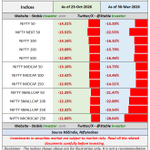
23-Oct-2026 (Now) vs 30-March-2026
The table compares the fall % from respective All-Time-Highs (intraday) for major indices on the above-mentioned two dates. The latter date being approx when Indian markets made the most recent bottom.
Note - Investments in the securities market are subject to market risks. Read all the related documents carefully before investing.
Disclaimer - The indices shown are for illustration only. It is not a recommendation to buy/sell/hold. Please get in touch with your investment advisor to get customised investment advice based on your risk profile and unique requirements.

There have been way too many stock market related podcasts and episodes in recent months. Some are good but a vast majority aren’t. I am sure soon podcasters will start running out of guests to bring to their podcasts.
PS - I rarely listen to podcasts but this is the trend I see these days.
How Much Have Markets Fallen from All-Time-Highs?
23-Oct-2026 (Now) vs 30-March-2026
The table compares the fall % from respective All-Time-Highs (intraday) for major indices on the above-mentioned two dates. The latter date being approx when Indian markets made the most recent bottom.
Note - Investments in the securities market are subject to market risks. Read all the related documents carefully before investing.
Disclaimer - The indices shown are for illustration only. It is not a recommendation to buy/sell/hold. Please get in touch with your investment advisor to get customised investment advice based on your risk profile and unique requirements.
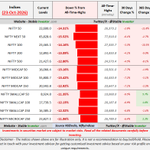
Current State of Indian Markets (23-Oct-2026)
The table shows the % Fall of Indices (closing values) from their respective All-Time-Highs (intraday).
Note - Investments in the securities market are subject to market risks. Read all the related documents carefully before investing.
Disclaimer - The indices shown are for illustration only. It is not a recommendation to buy/sell/hold. Please get in touch with your investment advisor to get customised investment advice based on your risk profile and unique requirements.

Stable Investor retweeted
Current State of Indian Markets (21-Oct-2026)
The table shows the % Fall of Indices (closing values) from their respective All-Time-Highs (intraday).
Note - Investments in the securities market are subject to market risks. Read all the related documents carefully before investing.
Disclaimer - The indices shown are for illustration only. It is not a recommendation to buy/sell/hold. Please get in touch with your investment advisor to get customised investment advice based on your risk profile and unique requirements.

Pain leaves once it’s done teaching you. Or maybe it just doesn’t get easier. You just get stronger.
Current State of Indian Markets (21-Oct-2026)
The table shows the % Fall of Indices (closing values) from their respective All-Time-Highs (intraday).
Note - Investments in the securities market are subject to market risks. Read all the related documents carefully before investing.
Disclaimer - The indices shown are for illustration only. It is not a recommendation to buy/sell/hold. Please get in touch with your investment advisor to get customised investment advice based on your risk profile and unique requirements.
Stable Investor retweeted
If your home loan is complete and you don’t want to take another loan again and repeat the Earn-EMI cycle (to purchase the next property), then what should you do next? You now have surplus money left over each month, as there is no home loan to service EMIs.
So how best to use that extra/surplus money now?
I wrote about this in my latest column in Economic Times Wealth @ET_Wealth - 19Oct2026 edition.