




Pinned Tweet
1. Boy, Amazon is in a heap of trouble. Evidence made public today by California AG @AGRobBonta shows blatant price fixing. And there are so many examples. Here's Amazon scheming with a pet food supplier to get Chewy to raise its prices.

Stacy Mitchell retweeted

This is insanely brazen. A railroad behemoth with the power to bully entire industries into shutting up and falling in line should not exist in this country.

This is the right approach. If you go back to the pre-Gingrich Congressional Record, it's remarkable: the depth of investigation, learning & expertise Congress used to develop. It created the will to legislate. The House Big Tech investigation was a model of how to revive that.

Why should Congressional Democrats investigate corporate America if their mandate is to deliver real economic change? Because investigations are a key catalyst for securing reform and legislation. For much of the last century, Congress used to be the main institutional player working to secure an economy that serves working people. A key tool was oversight. Lawmakers routinely investigated complex markets and major corporations, identifying problems and exposing wrongdoing. A major goal of these investigations was to learn what was driving certain problems and figure out how to fix them.
After Democrats took back the House during the first Trump administration in 2019, I joined the House Judiciary Committee as a staffer on the Antitrust Subcommittee. Under the terrific leadership of @RepJerryNadler and then-Rep @davidcicilline, we pursued an 18-month investigation into Amazon, Apple, Facebook, and Google, securing key evidence of how their business practices were undermining competition and harming people, setting the basis for both lawsuits and proposed legislation.
A few lessons from that experience:
1. The quality of legislative oversight depends on the staff and the support of top members to confront power. Committee and Subcommittee Chairs that are focused on getting answers and unafraid to take on powerful corporate interests will make the difference between oversight that doesn’t surrender to their evasion tactics and oversight that aims low or flames out.
Even a relatively small number of dogged, talented lawyers ready to dive in can make a big impact. In the 1930s a single congressional lawyer, Ferdinand Pecora, helped reshape our entire banking system by subpoenaing records and interrogating top financiers, including J.P Morgan. The investigation exposed self-dealing, market manipulation, and tax avoidance, and laid the groundwork for foundational New Deal legislation, including the Glass-Steagall Act and the Securities Exchange Act.
2. Eliminating bottlenecks to moving investigations forward is key. For example, the House should make sure that Subcommittee Chairs can issue subpoenas rather than needing the sign-off of the full Committee or its Chair. A credible threat of sending subpoenas is critical for credible oversight.
3. Ensuring that members can develop the muscle to effectively interrogate CEOs requires investing in real preparation. In the lead up to the hearing with Bezos, Pichai, Cook, and Zuckerberg, the Antitrust Subcommittee spent months reviewing millions of documents collected from the firms, interviewing affected parties, briefing members on key evidence, and conducting practice hearings. Members came into the hearing deeply informed and able to rebut and call out CEO dissembling. The result was some of the most effective member questioning of executives we’ve seen in decades. @TheProspect wrote up a great overview: prospect.org/2020/07/30/triu…
4. For decades, institutional capacity in Congress has been extremely weak. Much of this traces back to the Gingrich Revolution, which was effectively the 1995 DOGE-ing of Congress. Republican leadership fired over 600 professional staffers, eliminated the Office of Technology Assessment, and gutted research capacity. None of that capacity was ever meaningfully restored.
As a result, members have way fewer resources to develop serious expertise or go deep on a new topic. Members should start rebuilding that capacity so the institution can fully play its Article I role, where Congress can again do serious policy development and legislating and serve as a real check on the executive and judicial branches.
5. AI markets should be high on the list of investigations. The business decisions of the major AI firms have huge public ramifications, yet the public is at a severe informational disadvantage when it comes to how these markets work and the choices these firms are making. A congressional investigation will help ensure future legislative action is based on a more complete view of what is going on rather than selective and partial corporate disclosures.

Stacy Mitchell retweeted
CVS says it's going to break itself up. After more than a decade of calls to separate its retail pharmacies from its PBM/insurance business, that's big news. But here's the thing: CVS's breakup has two major loopholes. Both are designed to preserve its power.
First, CVS Health would keep its specialty pharmacy business. These pharmacies dispense expensive, often complex medications. They account for 40+% of the pharmacy market by revenue. They're a major site of anticompetitive practices that squeeze independent pharmacies.
Second, CVS says the ties between the two new companies will be "preserved in commercial agreements." In other words, separate ownership, but keep the arrangements that create conflicts of interest and enable anticompetitive practices. A real (government-led) breakup would sever those ties.
CVS didn't arrive here all on its own. Tennessee and Arkansas passed laws forcing a breakup of vertically integrated pharmacy giants like CVS. CVS is fighting the laws in court. Senators Warren and Hawley have a federal bill. Antitrust scrutiny has grown, both at the state level and when @linamkhan ran the FTC.
Trying to sidestep these efforts is one motivation here.
But CVS also has business reasons to jettison its struggling retail stores. Amazon's growing pharmacy business is one. The perils of running an overbuilt retail chain when you haven't invested in workers is another. Anyone who's been inside a CVS lately knows these stores suck.
For more than a decade, I've been working with independent pharmacies and my colleagues here at @ilsr to expose the anticompetitive structures and practices that have driven so many local pharmacies out of business, and calling for a breakup of CVS.
But CVS shouldn't get to decide what counts as an effective breakup. Policymakers need to ensure that it actually dismantles its power.

CVS is splitting into two companies in a major reversal of the mergers that created its $117 billion healthcare empire cnn.it/4z45oWd

Stacy Mitchell retweeted

This is a great analysis of the CVS breakup. And also, this >>
"Anyone who's been inside a CVS lately knows these stores suck."
Who's been in a CVS store recently that didn't have AC? 🙋♀️

CVS says it's going to break itself up. After more than a decade of calls to separate its retail pharmacies from its PBM/insurance business, that's big news. But here's the thing: CVS's breakup has two major loopholes. Both are designed to preserve its power.
First, CVS Health would keep its specialty pharmacy business. These pharmacies dispense expensive, often complex medications. They account for 40+% of the pharmacy market by revenue. They're a major site of anticompetitive practices that squeeze independent pharmacies.
Second, CVS says the ties between the two new companies will be "preserved in commercial agreements." In other words, separate ownership, but keep the arrangements that create conflicts of interest and enable anticompetitive practices. A real (government-led) breakup would sever those ties.
CVS didn't arrive here all on its own. Tennessee and Arkansas passed laws forcing a breakup of vertically integrated pharmacy giants like CVS. CVS is fighting the laws in court. Senators Warren and Hawley have a federal bill. Antitrust scrutiny has grown, both at the state level and when @linamkhan ran the FTC.
Trying to sidestep these efforts is one motivation here.
But CVS also has business reasons to jettison its struggling retail stores. Amazon's growing pharmacy business is one. The perils of running an overbuilt retail chain when you haven't invested in workers is another. Anyone who's been inside a CVS lately knows these stores suck.
For more than a decade, I've been working with independent pharmacies and my colleagues here at @ilsr to expose the anticompetitive structures and practices that have driven so many local pharmacies out of business, and calling for a breakup of CVS.
But CVS shouldn't get to decide what counts as an effective breakup. Policymakers need to ensure that it actually dismantles its power.
Stacy Mitchell retweeted

Bernie Sanders lost the fight in 2016. A decade later, he won the war. politi.co/4ekGIS5

Readers added context they thought people might want to know
Candidates who were endorsed by Bernie Sanders in the 2026 midterms overwhelmingly did worse than those who were not.
imightbewrong.org/p/how-leftists…
CVS says it's going to break itself up. After more than a decade of calls to separate its retail pharmacies from its PBM/insurance business, that's big news. But here's the thing: CVS's breakup has two major loopholes. Both are designed to preserve its power.
First, CVS Health would keep its specialty pharmacy business. These pharmacies dispense expensive, often complex medications. They account for 40+% of the pharmacy market by revenue. They're a major site of anticompetitive practices that squeeze independent pharmacies.
Second, CVS says the ties between the two new companies will be "preserved in commercial agreements." In other words, separate ownership, but keep the arrangements that create conflicts of interest and enable anticompetitive practices. A real (government-led) breakup would sever those ties.
CVS didn't arrive here all on its own. Tennessee and Arkansas passed laws forcing a breakup of vertically integrated pharmacy giants like CVS. CVS is fighting the laws in court. Senators Warren and Hawley have a federal bill. Antitrust scrutiny has grown, both at the state level and when @linamkhan ran the FTC.
Trying to sidestep these efforts is one motivation here.
But CVS also has business reasons to jettison its struggling retail stores. Amazon's growing pharmacy business is one. The perils of running an overbuilt retail chain when you haven't invested in workers is another. Anyone who's been inside a CVS lately knows these stores suck.
For more than a decade, I've been working with independent pharmacies and my colleagues here at @ilsr to expose the anticompetitive structures and practices that have driven so many local pharmacies out of business, and calling for a breakup of CVS.
But CVS shouldn't get to decide what counts as an effective breakup. Policymakers need to ensure that it actually dismantles its power.
CVS is splitting into two companies in a major reversal of the mergers that created its $117 billion healthcare empire cnn.it/4z45oWd
Stacy Mitchell retweeted

Donald Trump and the billionaires need to understand one thing very clearly: I don't owe them a damn thing. And I owe Mainers everything.
Thank you, Maine. I will never forget last night.
Stacy Mitchell retweeted

This is the Mississippi County where Elon Musk is building xAI's Colossus 2 data center.
Looks like a D+30 swing.

The Democratic wins in Kansas, Texas, and elsewhere suggest that economic populism — a politics of that sees economic power as the one fight — has the potential to reorganize the country's political map.

This contentious interchange between the NY Times and @GinaHinojosaTX was truly amazing. Hinojosa offered one of the best explanations of populism I've ever seen. Her comments were a total rejection of Corporate Dems' neoliberal formula. Her Texas victory is a game changer.
Hard to imagine a more populist message from voters. There were 41 local ballot measures on data centers across 10 states yesterday. Early returns show voters overwhelmingly rejecting data-center development and approving restrictions, often by landslide margins.

Stacy Mitchell retweeted

As you catch up on Annie Andrews: she had a really interesting health platform, with items like ending prior authorization, banning private equity firms from owning hospitals, shutting down the gaming of Medicare Advantage and more.
prospect.org/2026/10/08/sout…

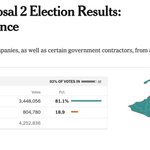
Another big deal for getting money out of politics: Michigan voters have — by 81%! — approved a ban on campaign contributions from electric and gas utilities. Companies whose profits depend on government decisions will no longer be able to bankroll the politicians making them.

We've largely forgotten that states define what corporations can do. Yesterday, Montana voters overwhelmingly stripped corporations of the power to spend money influencing elections. Hawaii did the same in May. Both face court fights. Our nascent citizen muscle is coming to life.

Stacy Mitchell retweeted

We’ve seen a lot of videos about big news outlets preparing for tonight and while the NYT says it has more than 100 staffers on duty, we at the @MaineVillager are proud to announce we have MORE THAN 4 reporters on duty. instagram.com/reel/DfSc_J_JP…

Stacy Mitchell retweeted

Google is using its search monopoly to coerce schools into adopting AI. This highlights the danger of allowing an unregulated monopolist to control an essential service.
Multiple courts have found Google liable for violating antitrust laws, and this latest move shows it remains unchastened.
As the public increasingly pushes back against the use of AI in schools, Google is making clear it will punish those who don’t fall in line.

Breaking: Google will turn off web search for schools that opt out of A.I. for kids.
nytimes.com/2026/11/03/us/go…

Stacy Mitchell retweeted

When I was at the FTC, one of my jobs was to build our first interdisciplinary team to look at the impact of tech on kids' mental health. I remember to this day a study that asked 6 to 10 year olds if they could be "friends" with Alexa.
Two out of three said "Yes."
This was Alexa in 2021, pre-AI. Children are trusting, and they trust us to take care of them. They have a very hard time distinguishing between what is real and what is not, especially with things that they cannot see or touch.
Children won't just over-rely on Gemini. They will think it is their friend, and they will grow emotionally dependent on it. Look at the research on Replika and Character AI: Fully grown adults are falling in love with chatbots, they are "marrying" and "having kids" with these chatbots. And again, those are adults.
Google is often portrayed as being more "mature" or "grown up" than other tech companies because they have more lawyers and policy staff. This decision is as dark and irresponsible as anything we've seen from any tech company, including Meta, Open AI or Anthropic.

Stacy Mitchell retweeted

Wow, well what’s not to trust about this AI initiative “for workers” that’s funded by Google and Amazon!

I’m pleased to welcome new partners @Apple, @ATT, the Bezos family, @Google and @Walmart to our broad-based and growing coalition, which spans the private sector, labor, governors from both parties, philanthropies, and educational institutions.
We need to make sure American workers come out ahead in an AI economy. That won’t happen on its own. We launched @raiseus_ai because we need to stop simply talking about the challenges workers will face as AI transforms our economy, and actually do something about it. Just four months since our launch, we’re already rolling up our sleeves and getting to work.
Read the full announcement: raiseus.ai/news/apple-at-t-t…
#FutureOfWork #AI #Workforce

If we want faster antitrust, we need enforcers to read the @TheProspect. This reporting powerhouse is always way ahead of the game. I believe this may have been the first national expose on Dollar General's overcharging way back in January 2024.

I got my wish! "The scope of Dollar General’s pricing misconduct is staggering," the complaint notes. "Dollar General is well aware it routinely charges consumers more at the register than the price... on the shelf." 🧵


The complaint details the 29,000+ customer complaints of overcharging received by Dollar General, the huge number of state enforcement actions for repeatedly failing price inspections, and the company's routine internal acknowledgment of the problem and unwillingness to act.
Hats off to @MorePerfectUS and the @guardian for their terrific investigations, which alongside the work of advocates like @ilsr, helped spotlight this predatory corporate abuse. youtube.com/watch?v=uE5THiD-…