

Our mission of discovery and learning is energized by a spirit of optimism and possibility that dates to our founding.
Stanford, CA
Joined December 2008
- Tweets21.7K
- Following583
- Followers1M
- Likes262







In a new paper, @StanfordEng engineers detail how to harness the vibrations of electrons to relay data without needing an energy-intensive signal carrier.
stanford.io/4iwOLO0

In a yearlong @StanfordDoerr experiment, satellites designed to monitor methane detected 92-100% of controlled releases on clear days. The results could inform efforts to identify major methane sources and reduce emissions.
news.stanford.edu/stories/20…

Nina Zhao is working to map the drugs, pesticides, and pollutants we encounter in daily life – often unknowingly – and to understand how they shape human and ecosystem health. #ResearchMatters
news.stanford.edu/stories/20…

A @StanfordMed large-scale study of gene activity in immune cells could help researchers identify potential targets for treating autoimmune diseases.
news.stanford.edu/stories/20…

An interactive quiz developed by scholars at Stanford’s @HooverInst helps participants understand their civic identity and values, free from political labels and partisanship.
news.stanford.edu/stories/20…

Using @SLAClab’s Linac Coherent Light Source, researchers created “molecular movies” of an enzyme linked to cancer and another essential to penicillin production. The findings could inform future drug development.
news.stanford.edu/stories/20…

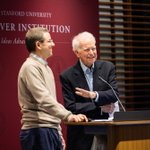
Robert E. Hall, professor of economics and senior fellow at the @HooverInst, emeritus, celebrated with his sons Jonathan and Andy on campus after winning the 2026 Nobel Memorial Prize in Economic Sciences.
“This is a wonderful surprise,” he wrote in a statement earlier Monday.
“I’ve spent my career trying to understand how the economy works, following interesting questions wherever they led. When I thought I had a new idea, the next step was to find out whether it was actually new, whether it was right, and whether it mattered. I’ve been fortunate to have extraordinary colleagues and coauthors to help me sort that out, and working with them has been the greatest pleasure of my career.
Stanford’s Economics Department and the Hoover Institution gave me a dream job: the freedom and time to do the research I wanted to do.
The taxpayers of California gave me an excellent education in the public schools and at @UCBerkeley, and the federal government paid for my graduate education at @MIT.
I hope they will regard this as a satisfactory return on their investment.
I thank my family, especially my wonderful wife and coauthor, Susan, and congratulate Michael Woodford, whose work has taught me a great deal.”

Stanford University retweeted

2026 economic sciences laureate Robert E. Hall’s hypothesis was that changes in consumption could not be predicted because they depend on new – and thus unpredictable – information.
Hall presented his results in an article in 1978, which was something of a eureka moment for research. His work became key to the development of modern research on consumption.
#NobelPrize

Robert E. Hall has been awarded the 2026 Nobel Memorial Prize in Economic Sciences.
The professor of economics and senior fellow at the @HooverInst, emeritus, was honored for his joint work with Michael Woodford on the “micro foundations” that form the basis of macroeconomic stability.
“Bob Hall’s creative and impactful work ... [has] changed how governments and central banks respond to economic volatility,” said Stanford President Jon Levin. “I’m thrilled that he has been honored.”
news.stanford.edu/stories/20…

Congratulations to Robert E. Hall, winner of the 2026 Nobel Memorial Prize in Economic Sciences. The professor emeritus of economics and @HooverInst senior fellow emeritus shares the prize with Michael Woodford for developing macroeconomic models built on how households and businesses actually make decisions. Those models have helped governments and central banks time their policies to soften economic shocks.
📸: Patrick Beaudouin

Stanford University retweeted
BREAKING NEWS
The Royal Swedish Academy of Sciences has decided to award the 2026 Sveriges Riksbank Prize in Economic Sciences in Memory of Alfred Nobel to Robert E. Hall and Michael Woodford “for microeconomic foundations of macroeconomic stabilisation.”
#NobelPrize

An RNA-based urine test shows promise for detecting bladder cancer, predicting treatment response, and identifying cancer remaining after treatment.
news.stanford.edu/stories/20…

A new @stanfordmed study suggests gut microbes traveled with humans out of Africa. Many of these microbes are now rare or absent in industrialized populations.
news.stanford.edu/stories/20…

A @bioe_stanford study reveals how changes in DNA packaging can help immune cells burst, shedding light on a defense process implicated in autoimmune diseases.
news.stanford.edu/stories/20…

On Tuesday, the entire Stanford Bioengineering community gathered at the Shriram Center to celebrate Karl Deisseroth, winner of the 2026 Nobel Prize in physiology or medicine, before he headed off to teach his undergraduate class: "Principles and Practice of Optogenetics for Optical Control of Biological Tissues."
“We love you. We love your work,” said fellow faculty member Russ Altman, who’s known the laureate since 1992.
“Wisdom, devotion to your work, seriousness of purpose, sense of humor, and then your status as a father, husband, physician. What a model.”
“In many ways, we’re just getting going.”
Karl Deisseroth, professor of bioengineering and of psychiatry and behavioral sciences, shares the 2026 Nobel Prize in physiology or medicine with two other researchers for their work in optogenetics, which makes it possible to switch on, or off, the activity of individual nerve cells in a living brain.
youtube.com/watch?v=LiiKmHpo…

Karl Deisseroth’s first day as a Nobel laureate 📷
The Stanford professor won the Nobel Prize in physiology or medicine for discoveries leading to optogenetics. His next move? Getting back to work.
“We have a lot of things still to discover, and a lot of people to help.”


The most important briefings of the day.
Karl Deisseroth, professor of bioengineering and of psychiatry and behavioral sciences, shares the news of his Nobel Prize with his kids.
Karl Deisseroth awarded 2026 Nobel Prize in physiology or medicine 🔬
The professor of bioengineering and of psychiatry and behavioral sciences shares the prize with two other researchers for their work in optogenetics.
news.stanford.edu/stories/20…
