

Founder & CEO @ Mindbeam | AI scientist solving the puzzle of intelligence and consciousness | Forbes 30 under 30
New York, USA
Joined May 2015
- Tweets434
- Following2.4K
- Followers831
- Likes695






Pinned Tweet
I am thrilled to formally introduce Mindbeam as we emerge from stealth.
We have built the fastest AI training framework to date, achieving groundbreaking performance benchmarks and an 86% reduction in energy
consumption.
This milestone reflects our core mission to accelerate the future of AI while significantly reducing the environmental impact of large-scale model training.
We are proud to be working closely with the amazing team at @awscloud to deploy this amazing product to thousands of customers across AI research labs and Fortune 100 Enterprises.
Our flagship product, Litespark, is now available on the AWS Marketplace. Visit mindbeam.ai to learn more.


🚀 BREAKING: We just revolutionized AI pre-training
We are excited to come out of stealth and launch our revolutionary product: Litespark, a language model framework which utilizes advanced algorithms to speed up training and inference workloads for generative AI applications.
Litespark reduces training time from months to days.
With just 16 H100s, you can train your own billion-parameter foundation model from scratch in 26 hours. Fortune 100 companies are already transforming their AI workflows with our breakthrough framework on AWS.

Our collaboration with @NVIDIAAI has been amazing! Looking forward to many more to come.
Today, we are thrilled to announce that Mindbeam has collaborated with @NVIDIAAI to optimise the speed and efficiency of open source models.
We post-trained NVIDIA’s Nemotron 3.5 Super VL to translate PyTorch modules directly into raw CUDA kernels, moving KernelBench Level 2 accuracy from 22.8% to 82.1% and outperforming GPT 5.6 Sol's 57%.
To ensure the serving layer keeps pace, the Litespark Inference Engine delivers Day-0 support, with 962 tokens per second per user on just two NVIDIA H200 GPUs, delivering a 6.9x improvement over vLLM.
Generating performance-critical systems code is only half the battle; running it efficiently in production is the other. We are proud to be building both sides of that equation alongside NVIDIA.
Learn more: mindbeam.ai/research/mindbea…

Our support for the AI developer ecosystem is growing rapidly. This is bolstered by Litespark’s compatibility across multiple hardware types and accelerators. The @Arm Developer team has reviewed Litespark-Inference and added it to their official developer documentation guide, recognising its speedup gains and memory efficiency. This is the first step in a broader vision to democratise AI and compute efficiency for the ecosystem.
Learn more: learn.arm.com/learning-paths…

Today, we are announcing our latest research in applied AI for drug discovery.
We have incorporated our technology into drug discovery research to develop novel pain therapeutics with enhanced efficacy and superior safety profiles compared to acetaminophen.
In the U.S. alone, patients consume an estimated 25 billion doses of acetaminophen annually. Yet, this massive reliance comes with a steep cost, as acetaminophen over-dependence remains the leading cause of acute liver failure nationwide.
Through our in silico work, we are accelerating the discovery and design of novel, next-generation therapeutics to solve this problem. Using generative AI, we’ve developed safer alternatives to acetaminophen, providing a safer option for vulnerable populations long threatened by the risk of liver toxicity.
This breakthrough marks a clear path forward for low-risk pain management. By successfully developing therapeutic candidates for one of drug discovery’s most intractable targets, the TRPV1 receptor, we are laying the foundation for a robust pipeline with many more AI-designed therapeutics to come.
Learn more about our work here: mindbeam.ai/research/discove…
Extraordinary performance for best in class AI inference 🚀🚀🚀
Today, we are excited to unveil Litespark Inference: our ultra-fast matmul-free inference framework for ternary (1.58 bit) language models.
The inference demand in the era of agentic AI is increasing dramatically and this compelled us to build an inference framework with high-thoughput, low-latency and significant reduction in memory usage.
The results speak for themselves: over 90x throughput speedup on @intel and @AMD along with 1,900 tokens per second running Bonsai 1.7B on @awscloud Inferentia2.
Litespark Inference supports a wide range of hardware types including consumer CPUs running on @Arm for low-latency agentic workflows and applications.
We are also releasing an open-source repository for local LLM deployment.
Github: github.com/Mindbeam-AI/Lites…
Paper: arxiv.org/abs/2605.06485
Blog: mindbeam.ai/research/litespa…

1
2
170
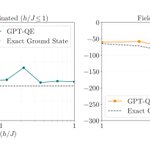
We are thrilled to share our latest innovation, SpinGQE, a generative quantum eingensolver for spin hamiltonians.
Ground state search is fundamental to quantum computing but VQE suffers from barren plateaus and limited expressivity.
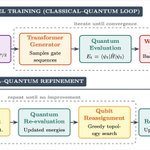
In our solution, we reframe circuit design as generative modelling where a transformer learns distributions over quantum circuits by matching logits to energies at each gate subsequence.
Paper: arxiv.org/abs/2603.24298
Code: github.com/Mindbeam-AI/SpinG…


We are bringing unprecedented AI training speed to enterprises on @awscloud 🚀

💡 @MindbeamAI helps Fortune 500 companies pre-train LLMs on #AWS. We caught up with Nii Osae, the company’s Founder & CEO, at the AWS NYC Summit to learn more about the future of #AI infrastructure.
Find us at AWS Summit LA to connect. 🚀 go.aws/45TUAyC
Super excited to share @MindbeamAI Litespark record-breaking benchmarks!
With Litespark, you can train a 3 billion-parameter model with 16 H200 GPUs in less than 2 days, reducing training costs from millions of dollars to under $20K.
Bigger models experience improved performance up to 6x in training speed!
This marks an inflection point in AI model training and we are happy to share this with the world. 🚀🚀🚀

This will be the sign of true AGI

The first AGI system will be much worse than previous AI systems at pretty much everything -- except for tests that focus on measuring general intelligence (e.g. ARC).
Like a baby, it will be generally intelligent -- able to learn efficiently and adapt -- but will lack any specialized competence.
However, it will be able to learn using much less data, and the capabilities it picks up will generalize much more strongly to the variability and unpredictability of the real world. As a result, after a few years, it will beat previous AI systems at absolutely everything -- including many problems that were completely out of reach before.
2
777
Biologically-inspired AI architecture is the way to go 🦾

OpenAI is about to blow your mind with Active Inference... So what is it?
> First introduced in the early 2000s in a series of papers by neuroscientist and theoretical neurobiologist, Karl Friston - active inference is a theory of how the brain uses statistical inference and generative world models to predict sensory inputs and guide actions to minimize prediction errors - helping explain human perception, action and learning
> Perception updates our generative world model to reduce errors in prediction while actions change our environment to align with our predictions - minimizing the probability of errors in our predictions
> It is likely that with a combination of enough compute, advancements in continuous learning / information retrieval with causal grounding and layers of active inference methods like GoT, AoT, CoV and MCTS - we may be inching closer and closer to a generative, continually learning model that operates at near-human levels of cognition ✨
I suspect that we might start to see the emergence of “energy-based” models (EBM) that operate more dynamically and continuously learn with hot-swappable memory partitions that evolve over time.
They will intelligently route and adjust the level of compute needed for more sophisticated means of active inference based on the complexity of a given query. These models will also allow users to explicitly define how much energy / reasoning strength is needed at inference time.
I'll be posting more on how this works under the hood soon with layered graphs-of-thought (GoT) and algos like monte-carlo tree search (MCTS)... For more on active inference check out these incredible papers:
> Friston, K. (2003). "Learning and inference in the brain."
> Friston, K. (2005). "A theory of cortical responses."
> Friston, K. (2006). "Free-energy principle for perception and action."
2
7
381
Very good explainer video of Diffusion models without the complex maths

Video: An attempt to explain Diffusion LMs in 15 minutes.
Several people have noted that they have bounced off this topic before because the math felt a bit perplexing. Think it's a good time to revisit.
youtu.be/WjAUX23vgfg

2
193
Amazingly comprehensive and detailed breakdown of the pipeline and pre-training processes used by @DbrxMosaicAI to train their DBRX model.

At @DbrxMosaicAI, we (and our customers! we actually make money) train custom LLMs for specific use cases. Today, we're sharing a large part of our infra stack and many of the tricks we use to get reliable performance at scale. (1/N)

1
277

Research should be at the heart of any forward-thinking AI startup. @Michael_J_Black has made some very intriguing points about this in his latest blog post and I recommend it to all AI founders 🦾

Should you do research in a AI startup? Does it burn someone else's money and your equity? Or is it the key to success? If you do it, how do you manage it? Drawing on experiences at Xerox PARC, Amazon, Body Labs, & @meshcapade, I try to shed some light: medium.com/@black_51980/star…

The technical detail here is absolutely incredible! This will definitely inspire open source GPU design. Maybe we might soon have AI-assisted chip design 🦾


Fine-tuning an LLM on a mobile device is literally the frontier of AI on edge computing

Next level: QLoRA fine-tuning 4-bit Llama 3 8B on iPhone 15 pro.
Incoming (Q)LoRA MLX Swift example by David Koski: github.com/ml-explore/mlx-sw… works with lot's of models (Mistral, Gemma, Phi-2, etc)
224
Excellent thread for AI researchers in the era where there are tons of papers being published everyday without much adoption
Build what you need and use what you build. This is a core philosophy of my research. It shifts the focus away from publishing “papers” to what really matters — impact. This thread unpacks why I think this is a successful approach to science. 1/10 Or see:
perceiving-systems.blog/en/p…

6
451