
Senator ! “ You can have my answer now . nothing “ ( Michael Corleone )
Toronto, Ontario
Joined January 2022
- Tweets329
- Following253
- Followers363
- Likes1.6K


Pinned Tweet
$QS @QuantumScapeCo @ironmantimholme Intel's early investors (1971-1980) saw a 100x return not because Intel was a good company, but because it laid the groundwork for the future of an entire industry. Quantumscape is trying the same thing for batteries. QS isn't just making a better lithium-ion battery; it's inventing a solid-state lithium-metal platform. That's exactly what Intel did with its microprocessor platform. QS is trying to do the same with its solid-state battery platform. Intel didn't make computers (Dell, HP, IBM), it sold chips. Quantumscape won't make EVs; it licenses or sells the battery cores (separators/IPs/cells) to OEMs. I'm investing in Quantumscape not because I want to invest in a battery company, but because I want to invest in a platform layer for a whole new wave of electrification. Quantumscape isn't aiming for mass production; it wants to be the brains behind the battery by licensing the Cobra separator + lithium-metal cell architecture.
$QS @QuantumScapeCo Quantumscape has updated its webpage nicely; I like it. quantumscape.com/ecosystem

Hakan Gunes 🇨🇦 retweeted

After years of frontier R&D, meet Osprey: our open all-solid-state platform for battery development.
youtube.com/watch?v=XpRSBAJI…


$QS @QuantumScapeCo @ironmantimholme In my view, PowerCo has recognized that, thanks to QuantumScape’s "PowerBlock" product, it could potentially serve data centers even sooner than it serves the electric vehicle (EV) market. This is the rationale behind the SOW-3 (Statement of Work 3) agreement signed between the two companies. PowerCo aims to leverage QuantumScape to tap into the data center and robotics sectors—markets that may reach commercialization faster than the EV sector. QuantumScape has already demonstrated this capability with its "Eagle" line and plans to further scale production, notably through a partnership with Mühlbauer. (On September 16, Morgan Stanley analyst Andrew Percoco asked Kevin whether QuantumScape had a manufacturing partner—akin to PowerCo—for these new markets.
Kevin responded:
“Our existing PowerCo contract allows them to be a producer.”
He then confirmed that discussions regarding cell supply were taking place behind the scenes.) Subsequently, on October 21, the signed amendment to the agreement explicitly included provisions for data centers and robotics within the proposed SOW-3.
This presents a significant sequence of events:
September 16: Kevin identifies PowerCo as a potential manufacturer for new markets.
October 8: QuantumScape launches "PowerBlock."
October 21: QuantumScape and PowerCo agree to negotiate new milestones, with the potential to incorporate data centers and robotics.
I don’t believe we should overlook this sequence. However, it reflects a strategic exploration—it does not mean that PowerCo has officially approved a production program specifically for data centers.
$QS @QuantumScapeCo @ironmantimholme PowerCo and QS are broadening their partnership from the original QSE-5 program to a more versatile technology platform, potentially increasing its long-term commercial value. ( the de facto operating system for the solid-state battery industry. 
These statements suggest something broader than an incremental improvement to QSE-5 ) My central interpretation is that Siva wants to establish QuantumScape as a foundational battery-technology provider to multiple automakers, allowing them to develop different batteries and vehicles around a common QS technology platform.
This would be particularly significant for its existing relationships with PowerCo and Honda—and possibly its other unnamed automotive partners. The biggest clue is the phrase "cathode-agnostic"
Siva specifically emphasized this characteristic while discussing Kyoto.
It means QS's ceramic-separator and anode-free architecture is designed to work with different cathode chemistries, rather than being limited to the cathode composition used in the existing QSE-5 cell.
QuantumScape's technical materials already discuss compatibility with both nickel-manganese-cobalt (NMC) and lithium-iron-phosphate (LFP) chemistries. This could allow manufacturers to adopt a common QS technology foundation while choosing the cell specifications suited to their vehicles. I therefore think Kyoto may explain how QS intends to coordinate its technology roadmap among several manufacturers with different needs, rather than negotiating a completely different technology development program with each one.  I see Kyoto as a possible turning point in how QuantumScape communicates its long-term business model. Siva appears to be moving the discussion from a single QSE-5 product toward a multi-customer technology platform.
The biggest potential opportunity is standardization: multiple automakers using the same underlying QS separator technology and benefiting from improvements developed across the ecosystem.
$QS @QuantumScapeCo @ironmantimholme QuantumScape plans to build a mini-cell production facility—faster than its "Eagle" line and at a cost of less than $100 million—to meet the needs of all its customers (excluding the automotive sector). This facility is expected to be completed by 2028. Siva states that the engineering work is already underway. The real question is: how can a company with no revenue yet justify an expenditure of nearly $100 million? As I understand it, Siva must have secured certain agreements or commitments with customers for 2027; otherwise, I doubt they would undertake such an investment. I expect we will hear about several agreements in 2027. (I am pleased with the balance sheet; the company is making solid progress—though I also understand those who were hoping for an even stronger balance sheet.)
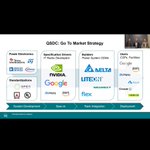
$QS @QuantumScapeCo @ironmantimholme After watching this video, I can offer the following observations. Nvidia has a direct relationship with QuantumScape, and it was Nvidia that steered the company Megmeet toward QuantumScape. From what I gather from Shahar Noy, they also have ties with Delta, Lite-On, and Flex. In fact, they have relationships with every company shown in the image—including Google. The same applies to QSAS. George stated that they are engaged with companies across all the segments depicted in the image. Both George and Shahar touched upon the space sector, indicating that there is definitely progress being made there as well. Shahar noted that they have very few competitors in battery innovation, that they are highly valued by their customers, and that they face no difficulty in selling their products. If you watch the video repeatedly, you can spot a great many positive points. I am downloading and uploading the video for you; you can watch it.


$QS @QuantumScapeCo @ironmantimholme Three questions caught my attention: 1 -) Did QS manufacture PowerBlock completely itself?
We cannot confirm that, and I suspect not every component was internally manufactured. QS clearly owns/developed the battery technology and reference architecture, but it is intentionally designed to work with external power-system components and ODM integration.
2-) What is an “adaptable reference design”?
A working prototype/engineering blueprint demonstrating how QSE-5 can be used in AI-rack energy storage, which partners can modify for their own electrical, mechanical and power requirements rather than buying one immutable box.
3-) What does “module, shelf and rack formats” mean?
PowerBlock can be scaled and packaged at multiple levels—from individual battery building blocks, to several modules in a BBU shelf, to multiple shelves/blocks integrated into an entire rack or sidecar power system.
And this is actually more attractive to me than QS trying to build one complete proprietary rack itself. It potentially allows QuantumScape to become the battery platform inside many different NVIDIA, Google, Meta, AWS and future AI architectures, while companies already expert in power electronics handle much of the surrounding hardware.
That is far more scalable if QS can produce the cells in sufficient volume. youtu.be/R7mxToJM9LA?si=JDYG…

Hakan Gunes 🇨🇦 retweeted
Introducing the QS PowerBlock for AI data centers: 4x the power density and 5x the runtime of current industry standards.
Batteries are moving from backup power to critical infrastructure.
youtube.com/watch?v=R7mxToJM…
$QS @ironmantimholme @QuantumScapeCo Some of my predictions have come true and more will come. For now, QuantumScape is not trying to become a data-center power-equipment manufacturer like Delta or Megmeet. It is trying to make QSE-5/PowerBlock the battery platform embedded inside next-generation rack power systems built by those companies. The rack increasingly becomes a repeatable compute + power + energy-storage unit, and the transition to 800 VDC creates a new architecture in which QS can potentially be designed in from the beginning rather than displacing a mature battery solution later. Do not take stock movements seriously. Everything is going very well

$QS @QuantumScapeCo @ironmantimholme
Imagine an AI rack that will have its own power supply and its own battery. Quantumscape is aiming for a battery sold bundled with the rack. This will be a replicable business model for Quantumscape. It's a QSDC model (hence the spare tire and shock absorber analogy) as opposed to the old UPS model. They will build a first-of-its-kind integrated PSU+BBU rack. Quantumscape says it wants to use solid-state batteries and integrate them into a single high-density rack power platform. They even specified which companies they will compete with in the job posting (Delta and Liteon). Quantumscape is apparently not just trying to sell battery cells to others; they are building a real rack power product/platform that can compete in the same category as established data center power equipment companies, and this is a much bigger value capture. This could allow Quantumscape to generate significantly more revenue per rack. It's likely that Quantumscape is designing a product that can participate in the transition period, rather than waiting until every data center is natively 800V. This potentially expands the addressable market.
youtu.be/TkUsu-6tdD0?si=0Ska…

$QS Added to the QuantumScape page today. You can check the webpage; for some reason, I can't add the link right now—there's a problem.

$QS @ironmantimholme @QuantumScapeCo stockanalysis.com/stocks/qs/… Another reason for my optimism: The PowerCo agreement states that PowerCo can produce up to an additional 5 GWh of QS cells annually based on the QSE-5 platform—including for customers outside the Volkswagen Group. This is separate from the 40 GWh primarily associated with automotive applications (plus a potential additional 40 GWh), bringing PowerCo's total potential capacity to 85 GWh per year.
And yes—at the Morgan Stanley conference, Kevin Hettrich effectively linked this capability to QSDC and QSAS.
Morgan Stanley analyst Andrew Percoco asked if there was a "PowerCo equivalent"—something investors should consider regarding cell production—specifically for data centers and Advanced Solutions.
Kevin replied:
"Regarding cell supply for these new areas, our existing PowerCo agreement allows them to act as the manufacturer."
He added that QS has been holding discussions regarding additional supply sources in the background, as the company aims to move quickly into these new markets.
Confirmed: PowerCo is contractually authorized to produce an additional 5 GWh/year of cells, including for customers outside Volkswagen.
Confirmed: When specifically asked about QSDC and QSAS/Advanced Solutions, Kevin stated that the existing PowerCo agreement permits PowerCo to manufacture cells for these new areas.
Not Confirmed: QS never stated that "the entire extra 5 GWh is allocated exclusively for QSDC and QSAS."
The 5 GWh provision was added in July 2025, whereas QSDC and QSAS were publicly announced at a later date. Therefore, we cannot prove that QuantumScape specifically negotiated this 5 GWh capacity at the outset because it already knew it would launch QSDC and QSAS.
However, Kevin's response regarding September 2026 tells us that QS now views PowerCo's capacity as an available production pathway for new verticals.
And that is far more significant than mere speculation.
In fact, it fills a major gap in the narrative.
The production pathway might now look like this:
Today
Eagle Line → produces QSE-5 samples → QSDC ODM testing → QSAS defense/aviation testing
If a customer moves to commercialization and the Raptor Line is no longer sufficient, PowerCo’s extra 5 GWh capacity would be used to produce QS cells for non-VW customers.
And I think Kevin's next sentence is almost as important. Kevin did not say that PowerCo would be their sole manufacturer. Instead, he mentioned a "series of ongoing conversations" regarding the supply source.
This strongly suggests that QS is thinking along these lines:
Eagle → initial cells
PowerCo → the first available multi-GWh bridge
Another manufacturer/licensee → dedicated QSDC or QSAS capacity later on.
This could be Panasonic, another battery manufacturer, a US defense-focused manufacturer, a joint venture, or some other structure—there is no evidence yet to identify exactly who it might be.
Why might 5 GWh be significant for QSDC/QSAS?
This is something easily overlooked.
For the automotive sector, 5 GWh isn't a huge amount.
If an EV has an 80 kWh battery:
5 GWh ÷ 80 kWh ≈ 62,500 vehicles. However, QSDC and QSAS applications might require much smaller packages.
For example:
● 100-kWh AI rack battery → 50,000 rack systems/year
● 50-kWh system → 100,000 systems/year
● 10-kWh defense/robotics system → 500,000 systems/year
These are merely arithmetic examples, not QS product specifications.
When someone says, "We want commercial quantities,"
QS already has at least one potential avenue: PowerCo.
And if demand turns out to be much greater, management is already discussing additional production resources.
Note: The additional 5 GWh was not publicly designated solely for QSDC/QSAS, but Kevin Hettrich has now explicitly confirmed that the existing PowerCo agreement could be used to supply these new markets.

$QS @ironmantimholme @QuantumScapeCo There is no reason for QuantumScape's stock to fall. In fact, upon closer examination, not only are there no negatives, but there are also numerous positive aspects. While QuantumScape does not currently have a second official partner for cell production—like PowerCo—that does not mean one won't emerge; perhaps the Eagle Line and PowerCo are sufficient for the time being. There are no issues regarding the ceramic separator, thanks to partners like Corning and Murata. In reality, the Eagle Line might initially suffice for QSDC and QSAS cell production. Logically, when customers demand massive quantities of cells, either the customer would need to replicate the Eagle Line at their own facility, or QuantumScape would need to replicate it—or enter into a licensing agreement with a manufacturer like PowerCo—to supply those batteries. For instance, QuantumScape recently shipped cells to a major defense contractor; how would cell production be handled in an agreement with such a company? Both parties have likely considered this: either the defense company would replicate the Eagle Line, or QuantumScape would need to secure a licensing deal with a manufacturer—similar to the PowerCo arrangement—to fulfill customer orders. How exactly did QuantumScape convince OEMs regarding QSDC? If cell production couldn't be scaled up, why would these companies engage with one another? For example, would an AI-focused energy company working with QSDC enter into an agreement or partnership if they believed QuantumScape couldn't supply the necessary cells? Would an experienced professional like Shahar Noy establish relationships with these companies if he weren't confident that QuantumScape had secured its supply chain? This implies that the Eagle Line is far superior to what was initially thought and capable of convincing companies—who likely believe they could replicate it—or that QuantumScape needs a partner like PowerCo; alternatively, both scenarios could be true, as many of these recent developments would not have occurred otherwise.
$QS @ironmantimholme @QuantumScapeCo The possibility I mentioned earlier is becoming increasingly likely. It looks like Panasonic is about to make a move. Samsung SDI and LG won't miss this opportunity either.
news.panasonic.com/global/pr…

$QS @QuantumScapeCo I think Quantumscape will eventually become involved in this ecosystem through Corning. So, Corning and Fluence alone don't form a complete ecosystem; they need a battery manufacturer, ( because Fluence is a downstream system integrator, not a battery manufacturer. And Corning will produce ceramic separators for ) . and the real question is, who will produce the batteries for this amazing ecosystem? Powerco might be able to meet this demand to some extent; otherwise, a future deal with another battery manufacturer like LG, Panasonic, or Samsung SDI wouldn't be surprising.


Hakan Gunes 🇨🇦 retweeted
I see only a few EV chargers around Japan. That is one barrier to EV adoption, along with the price being too high [1]. Better batteries should help unlock the 2-sided market of chargers and cars by lowering price, increasing adoption, and creating demand for chargers.
[1] nikkei.com/article/DGXZQOUC1…

Hakan Gunes 🇨🇦 retweeted
We believe our solid-state technology can reach beyond automotive. George Hart leads QSAS to target new high-value applications including aviation, robotics and defense.
Learn more about this $75B market opportunity. youtu.be/tU62YT_KzdI
