

Ben Davidson, Founder of SpaceWeatherNews, Suspicious0bservers, Observer Ranch - Our YouTube: https://xitter.cf/t.co/lVKh0SLrAU
Colorado
Joined November 2022
- Tweets24K
- Following99
- Followers221K
- Likes4.4K





SpaceWeatherNews retweeted

In Japan, "American" isn't just a nationality.
It's an adjective.
A quick Japanese dictionary:
American Dog (n.)
A corn dog. We had to name it after you. It was too good to be anything else.
American Size (adj.)
Extremely large. Used as a warning.
American Coffee (n.)
Lighter coffee, so you can keep drinking it all day. We assume this is how you get so much done.
Amekaji (n.)
"American casual." Jeans, flannel, work boots. Tokyo shops sell it like fine art. Japanese men pay serious money to look like they just fixed a fence in Montana.
Amesha (n.)
"American car." There are Japanese clubs devoted to driving enormous American trucks down streets designed for bicycles. They have never been happier.
So in Japan, when something is bigger, bolder, more generous, or more fun than it needs to be…
we just call it "American."
It's always a compliment.


SpaceWeatherNews retweeted

Evidence for the Galactic Current Sheet: youtube.com/watch?v=_0MXv1vu…

SpaceWeatherNews retweeted
My friends called me crazy for saying that CO₂ is good for the planet.
My friends called me crazy for refusing the COVID vaccine.
My friends called me crazy for predicting that Ukraine wouldn’t win the war.
Now my friends call me crazy for moving to the top of a mountain and preparing for a potential pole shift.
At this point, I’m starting to think being called crazy is a compliment.
Time will tell who’s laughing last.
SpaceWeatherNews retweeted
The Babylonians recorded an event of an entire library being buried before the Great Flood.
In the third century BCE, a Babylonian priest named Berossus wrote an account of his civilization's history. His original work is lost, but portions survive through later historians.
According to Berossus, a god identified in the Greek account as Cronus, associated with the Mesopotamian Ea or Enki, appeared to a man named Xisuthrus in a dream.
He warned him that a catastrophic flood was coming and that humanity would be destroyed.
Xisuthrus was ordered to gather the written records of his civilization, including its history from the beginning, and bury them securely at Sippar, the ancient city associated with the sun god Shamash.
Before the destruction of humanity, the preservation of knowledge was specifically ordered.
The Flood eventually came and Xisuthrus survived. After leaving the vessel, he disappeared and was said to have joined the gods.
The remaining survivors then heard a voice instructing them to return to Babylonia, excavate the buried writings, and restore that knowledge to humanity.
According to the text, they did exactly that.
They recovered the tablets, rebuilt cities, erected temples, and reestablished Babylonian civilization.
I've studied quite a few ancient flood traditions, but this particular detail pops out.
The objective was to preserve a civilization's accumulated knowledge so that society could be reconstructed after its destruction.
Remember, the better known Atrahasis flood narrative doesn't contain this buried archive episode.
We have no archaeological evidence confirming that this particular collection was buried and recovered. Berossus was also writing way after the period his story describes.
But I find the underlying account cool as all hell.
The Babylonians preserved a tradition in which a god like being knew a flood was coming, identified what humanity needed to preserve, selected a location to protect it, and arranged for its recovery after the destruction.
Very deliberate sequence of events isn't it?
It gets me wondering what knowledge did the Babylonians believe existed before the Flood?
Why was it important enough for the gods themselves to order its safety and renewal?

SpaceWeatherNews retweeted

This quote from the head of excavations at Gobekli Tepe is CRAZY work 🤯
QUOTE: “Why would I be so selfish as to dig the entire site just to say, I've dug it and look what I found, and take away these possibilities from future generations of archaeologists?”
Excuse us, what?? The whole world is waiting for you to hurry up and excavate the site so we can learn what the hell it is… BUT, Dr. Lee Clare wants to save it for archaeologists in the future???
In what world do we *not* excavate a mysterious prehistoric site to learn from it? Since when do we kick knowledge of our lost ancient origins down the road?? This madness has to stop.


SpaceWeatherNews retweeted
EM Solver Update 08: We're getting close..
The low degree part of the solver is now stable (!), but the physical response doesn’t stay there, it spreads strongly into higher magnetic field modes.
So, I built a correction that uses that extra mode structure and that correction is now fully qualified.
My next 12 hour test will be to run the real reduced solver side by side, with and without it, and see if it actually improves convergence.
If it does, we’re finally getting very close to the part I’ve wanted to calculate from the beginning: currents -> Joule heating -> the 4- 6 km ocean layer.
details: stephanieskystory.com/resear…
SpaceWeatherNews retweeted

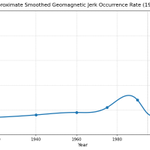
Serrano, Campuzano and Pavón-Carrasco (2026) examine geomagnetic secular acceleration (SA) and its temporal changes at the core-mantle boundary over the past 125 years, and they find that "SA activity is strongly localized within a limited number of low-latitude regions organized in paired structures of opposite polarity," mainly beneath the Atlantic, Pacific, Caribbean and Indian sectors, as seen in CHAOS-8.5 for 2000-2025, where the regions "exhibit persistent anti-correlated temporal behaviour" and concentrate the rapid field changes tied to recent jerks, while a regional principal component analysis shows the Atlantic, Pacific and Caribbean sectors are each "largely dominated by a single regional dipolar mode," and the Indian sector needs two modes of comparable importance. Extending back with Kalmag and COV-OBS-x2, and despite larger pre-satellite uncertainties, they find the same recurrent structures through the 20th century, with "a dominant Caribbean-North America paired structure" characterizing much of the first half and the Pacific and Indian sectors becoming "increasingly important after the 1970s, anticipating the spatial patterns observed during the 21st century," which leads them to conclude that SA variability "is organized around a small number of long-lived regional dipolar structures whose relative amplitudes evolve through time."
Movie S2 (supplementary material to the paper): Temporal evolution of ΔSA at the CMB derived from the COV-OBS-x2 model truncated at Nmax = 6.
Serrano et al. (2026) sciencedirect.com/science/ar…
SpaceWeatherNews retweeted
Livestream in 100 minutes
Pole Shift - Tsunamis & Extinction Risk
youtube.com/live/GGwEyw656co…


SpaceWeatherNews retweeted

P*rn is destroying modern men.
It:
• Messes with your sex life
• Destroys your dopamine receptors
• Ruins your appreciation for real women
Here’s how to break free, step by step:

SpaceWeatherNews retweeted
Meeting up with @SunWeatherMan to discuss cool things and life.
SpaceWeatherNews retweeted
As before, it will happen again!
Genesis 7:11 needs a lot more attention! 😬


SpaceWeatherNews retweeted
We're done!
EM Solver Update 04: The production baseline is done! The realistic operator works, and the physical solution formally converged.
Now we can FINALLY answer the question we started this whole thing for... does EM induction explain the abyssal ocean warming acceleration pattern?
Details: stephanieskystory.com/resear…
SpaceWeatherNews retweeted
Flint Dibble shamelessly uses a photo of the Casa Grande Ruins (located well over 100 miles from the Mexico border) while making the case that President Trump is “obliterating” archaeology as part of the border wall construction.
This is some sleazy PhD propaganda clickbait… @FlintDibble

