

× Neurosurgeon. I analyze stocks like I read scans: find what's wrong first 🩻 × Fundamental investor × No AI, my own thoughts only
Joined April 2022
- Tweets1.9K
- Following126
- Followers231
- Likes373



Pinned Tweet
🧵 Starting a new series:
UNDERSTANDING BROOKFIELD CORPORATION'S ECOSYSTEM
$BN
PART 1: Distributable Earnings (DE)
Anyone who's even briefly looked at Brookfield's filings, watched a presentation or listened to an earnings call immediately stumbles on what management calls Distributable Earnings.
This is not a GAAP or IFRS metric, meaning it is not a generally accepted to evaluate business performance.
So what is it?
It is a metric that the management thinks represents earnings of the Brookfield ecosystem the best.
Why do they use it?
$BN owns an insurance business, an asset manager, toll roads, power plants, data centers. These generate completely different types of income under IFRS accounting.
DE cuts through that. It's management asking: what did each business actually earn for us this year? Add it all up. That's DE.
Now since the management defines what DE is, two things here are worth scrutinizing:
⚠️ — the Wealth Solutions business generated $1.7B of DE in 2025. But that money didn't actually arrive at $BN 's bank account. It stayed inside the insurance business to fund growth and regulatory capital requirements. It's real value. Just not directly FCF.
The management has been repeatedly asked about the future perspective.
Sachin Shah and Bruce Flatt argue that once BWS scales to a sufficient size (aiming toward their $400 billion target), the ratio of new capital needed to back organic sales relative to total earnings drops.
At that point, BWS becomes self-funding, and excess cash flow above statutory reserve needs will naturally begin flowing up to BN as quarterly dividends.
It remains to be seen if it materializes
⚠️ — equity-based compensation gets added back. Real economic dilution to shareholders, quietly excluded.
Here the numbers are far away from gut wrenching - about 110mil in 2025.
CONCLUSION
So DE is not fraud. It's not free cashflow and not adjusted EBITDA either. It's somewhere in between. The DE from operating businesses and asset management components are genuine cash that flows into $BN every quarter.
The insurance component is genuine value creation that just hasn't converted to cash flow yet.
I believe this somewhat confusing reporting is one of the reasons why $BN is trading at $36.
We will dive deep in each of the underlying businesses in the following parts of our series UNDERSTANDING THE BROOKFIELD CORPORATION'S ECOSYSTEM
Follow to not miss it 💰

$SOFI Q3
⚠️⚠️⚠️
First of all - where the hell is the cash flow statement?
Making it difficult to locate on the released document speaks for itself...
For the rest of report
👇👇
🟢
Revenue $1.39B, +44%
Net income $241M, +73%
EPS $0.18 vs $0.11
Deposits $51.3B, up $5.8B in the quarter
2027 EPS guide is $0.90. At ~$15 that's 17x.
🔴 What I don't like:
Shares outstanding up 7.6% in a year
Stock comp $220M in nine months
Sales and marketing 32% of revenue, up from 30%
Financial Services revenue per product $90, down from $104
Since a stable or preferably decreasing number of shares outstanding is one of the key metrics for a decades long compounder (for my personal portfolio) - it's not a buy in my book

🧵 UNDERSTANDING BROOKFIELD
CORPORATION'S ECOSYSTEM
$BN
PART 6: The Lock-Up
The Problem
Most money managers face the same problem.
Their job is to make investment decisions. What they don't control is the "the market is red, I'm panicking, give me my money back" button. That's reserved for their clients.
No matter how long-term their investment thesis is, they're ultimately at the mercy of their clients' emotions.
📌 Example
Plumber Joe gives a money manager his hard-earned $10k to invest and make him rich.
The manager does his research and buys 100 shares of Company X at $100 each. That's $10k invested.
He tells Joe that, in his view, Company X is worth at least $200 per share.
For the sake of this example, let's assume he's right.
The plan is simple: hold for around 3 years, sell at $200, return Joe's initial $10k plus a nice 100% profit, minus fees.
Joe reinvests, recommends the manager to his friends, and everyone's happy.
But tomorrow, the US bombs Iran. Markets tank.
During his lunch break, Joe checks CNN, sees the carnage and panics.
Joe: Hey, how much of my $10k is still there?
Manager: $7.5k.
Joe: SELL IT. I don't want it going any lower.
Manager: Joe, relax. This Iran situation has nothing to do with our US logistics business. In fact, it might even improve margins and profits. Just give it time. This could be short-term noise.
Joe: I CAN'T TAKE IT. I'm checking the market every 5 minutes. It's falling. GET ME OUT!
Manager: Okay, Joe. We'll process your withdrawal according to the terms of your account.
The dust eventually settles. The conflict drags on for a while, then ends.
Three years later, Company X is trading at $250.
Joe, afraid of the next crash, is still sitting on his $7.5k. Inflation has eroded its purchasing power, the manager has lost a client, and the capital generating fees for the manager is gone.
All because Joe couldn't stomach the volatility.
Sounds ridiculous?
This is a fundamental problem in money management. And yes, even wealthy individuals and institutional investors can make emotional decisions when the pressure gets high enough.
Enter Brookfield. $BN / $BAM
Brookfield's asset-management model is structured to reduce this problem.
At year-end 2025, Brookfield Asset Management ($BAM) reported $603B in fee-bearing capital, of which 87% was long-dated or perpetual.
Many of its flagship private funds are closed-end vehicles with capital commitments typically lasting 10 years, often with extension options.
Investors generally can't demand their money back whenever markets turn ugly.
Why does this matter?
🟢 Less forced selling: Brookfield is less vulnerable to having to sell attractive assets simply because investors panic and demand their money back.
🟢 More predictable fees: Long-term commitments provide greater visibility into management fees, even when markets are volatile.
🟢 The ability to play offense: When others are under pressure, Brookfield can use its available capital and uncalled commitments to pursue opportunities that distressed sellers might have to abandon.
Of course, lockups don't eliminate every liquidity risk, and not all of Brookfield's capital is locked up. But the structure gives it a meaningful advantage.
Bottom line
The real beauty of this model isn't that Brookfield is immune to market crashes. It isn't.
It's that Brookfield doesn't have to rely on every investor keeping their nerve when markets fall apart.
In a business where time and patience can make all the difference, having capital that stays put can be a serious competitive advantage.
Long $BN / $BAM. NFA.

Chech part 7 here 👇👇👇
xitter.cf/SurgeonInvests1/status…

🧵 UNDERSTANDING BROOKFIELD
CORPORATION'S ECOSYSTEM
$BN
PART 7: Carried interest
The single most controversial and broadly criticized aspect of the $BN's / $BAM's business which at the same time is the most lucrative word in alternative asset management - Carry
Here is how it works, why it’s a hidden goldmine for Brookfield ($BN) shareholders, and the crucial warning about how it’s estimated 👇
📌 Imagine you give a home flipper Joe $100,000 to buy and renovate a house.
You agree to a clear split: you get your $100k principal back first, plus a guaranteed 8% return ($108k total).
Anything made above $108k is split: 80% to you, and 20% to Joe.
If Joe sells the house for $158,000, you take your $108k plus $40k of the upside. Joe walks away with $10,000 as his profit-share—despite risking zero of his own dollars.
That 20% slice is Carried Interest ("Carry").
In private equity, managers charge a ~1% base fee to pay salaries and keep the lights on, but Carry is where actual fortunes are built.
Generate a 15% return on a $10B fund, and the manager takes home 20% of all profits above the hurdle rate.
The "not so obvious" part
Because Brookfield locks up private funds for 10 to 12 years, their assets grow in value over years.
Unrealized Carry sits on their balance sheet as an increasing pile of future cash waiting for assets to be sold.
⚠️ The Catch: Marking Your Own Homework
Skeptics are quick to point out: unrealized carry isn't cash in the bank.
Unlike public stocks with live tickers, private real estate and infrastructure assets don't trade daily, so their prices aren't really publicly seen.
Brookfield estimates its unrealized carry based on internal valuations.
If management marks assets too optimistically, that carried interest balance is artificially inflated.
If asset values drop before a sale, those paper profits evaporate without generating a dime.
The Real Track Record
In order to trust the $BN 's management with your money, one should be able to trust their judgment. Trust comes from track record:
Over 30+ years, Brookfield's flagship funds have targeted 12–15% net internal rate of return but delivered ~19% annualized returns, beating hurdle rates and consistently turning paper estimates into hard cash.
Recent performance
Recently, total accumulated unrealized carry sat at roughly $12.5 Billion, while quarterly cash realizations slowed down ($88M in Q4 '25 and $121M in Q2 '26).
Why the lag?
Higher interest rates cooled global M&A markets. Rather than fire-sale world-class assets just to book quick carry, management is sitting tight and letting them compound.
The bottom line
Unrealized carry isn't fake, but it requires patience.
$BN/ $BAM shareholders are sitting on a massive, delayed cash wave that will unload as global transaction markets fully reopen.
Long $BN. NFA.
Is $MELI a buy now after communists won the election?
-14% definitely gets me salivating
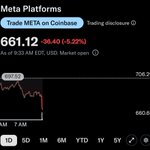
I really hate this new stock issuance of $META
This smells to me of a kindergartner behavior
He wants something, and he wants it now!
They tried being somewhat patient and tactical in creating new class shares for economic dilution without dilution of @finkd control, which is bad enough
Now they can't even wait for the time to come and are just blasting out new shares...
And all that with a questionable ROI, that they can't definitely see or at least explain to the shareholders themselves. Ridiculous
What is so time sensitive so it had to be now? @alexandr_wang
I'm out
🧵 UNDERSTANDING BROOKFIELD
CORPORATION'S ECOSYSTEM
$BN
Part 5: Oaktree
Brookfield's management loves to talk about countercyclicality. In that context Oaktree gets mentioned alot.
What is it exactly?
Let's unpack it:
When economy is good, asset prices are booming, their real estate, infrastructure, and private equity machines rake it in.
Brookfield corporation is making money hand over fist.
But what happens when the economy breaks, interest rates spike, and everyone else is panicking? These are admittedly not the optimal conditions for most of Brookfield's businesses.
That’s where Oaktree Capital comes in.
Management presents Oaktree as their ultimate all-weather hedge. While most asset managers get crushed in a downturn, Oaktree thrives on chaos.
📌 To see how they pull it off, let’s look at Joe and a Honda Civic.
Imagine Joe buys a $30,000 car with $3,000 of own cash and a $27,000 bank loan. Then bad times hit, Joe loses his job and stops paying.
The bank panics. They don't want to repossess cars or run auctions, so they dump Joe’s $27,000 "bad debt" to an investor for just $10,000 cash.
Enter Oaktree.
Oaktree buys Joe's loan for $10,000, knowing the car is still physically worth $20,000. They repossess it, sell it, and double their money.
Now scale Joe up to a $1 Billion corporation.
When high interest rates hit, companies can't service their loans. Panicked bondholders dump $800M of corporate debt for 50 cents on the dollar ($400M) just to escape.
Oaktree steps in, buys that $800M debt block for $400M, and takes the company straight to bankruptcy court.
Instead of demanding cash, Oaktree tells the judge: "Cancel the debt and give us 100% ownership of the business."
Pulling this off requires serious expertise. Navigating bankruptcy courts, restructuring defaulted balance sheets, and executing debt-for-equity swaps takes decades of specialized practice.
At the helm is Howard Marks @hmarksofficial , the undisputed master of distressed debt whose memos even Warren Buffett reads.
The ultimate "buyer when others are fearful"
Bottom line
When markets roar, Brookfield builds and sells real assets. When markets crash and defaults spike, Oaktree buys great businesses at half-price.
That’s why the partnership is such a powerful engine.
Long $BN. NFA.
Check out other parts of our series UNDERSTANDING BROOKFIELD CORPORATION'S ECOSYSTEM
👇👇👇

Check part 6 here
👇👇👇
xitter.cf/SurgeonInvests1/status…
🧵 UNDERSTANDING BROOKFIELD
CORPORATION'S ECOSYSTEM
$BN
PART 6: The Lock-Up
The Problem
Most money managers face the same problem.
Their job is to make investment decisions. What they don't control is the "the market is red, I'm panicking, give me my money back" button. That's reserved for their clients.
No matter how long-term their investment thesis is, they're ultimately at the mercy of their clients' emotions.
📌 Example
Plumber Joe gives a money manager his hard-earned $10k to invest and make him rich.
The manager does his research and buys 100 shares of Company X at $100 each. That's $10k invested.
He tells Joe that, in his view, Company X is worth at least $200 per share.
For the sake of this example, let's assume he's right.
The plan is simple: hold for around 3 years, sell at $200, return Joe's initial $10k plus a nice 100% profit, minus fees.
Joe reinvests, recommends the manager to his friends, and everyone's happy.
But tomorrow, the US bombs Iran. Markets tank.
During his lunch break, Joe checks CNN, sees the carnage and panics.
Joe: Hey, how much of my $10k is still there?
Manager: $7.5k.
Joe: SELL IT. I don't want it going any lower.
Manager: Joe, relax. This Iran situation has nothing to do with our US logistics business. In fact, it might even improve margins and profits. Just give it time. This could be short-term noise.
Joe: I CAN'T TAKE IT. I'm checking the market every 5 minutes. It's falling. GET ME OUT!
Manager: Okay, Joe. We'll process your withdrawal according to the terms of your account.
The dust eventually settles. The conflict drags on for a while, then ends.
Three years later, Company X is trading at $250.
Joe, afraid of the next crash, is still sitting on his $7.5k. Inflation has eroded its purchasing power, the manager has lost a client, and the capital generating fees for the manager is gone.
All because Joe couldn't stomach the volatility.
Sounds ridiculous?
This is a fundamental problem in money management. And yes, even wealthy individuals and institutional investors can make emotional decisions when the pressure gets high enough.
Enter Brookfield. $BN / $BAM
Brookfield's asset-management model is structured to reduce this problem.
At year-end 2025, Brookfield Asset Management ($BAM) reported $603B in fee-bearing capital, of which 87% was long-dated or perpetual.
Many of its flagship private funds are closed-end vehicles with capital commitments typically lasting 10 years, often with extension options.
Investors generally can't demand their money back whenever markets turn ugly.
Why does this matter?
🟢 Less forced selling: Brookfield is less vulnerable to having to sell attractive assets simply because investors panic and demand their money back.
🟢 More predictable fees: Long-term commitments provide greater visibility into management fees, even when markets are volatile.
🟢 The ability to play offense: When others are under pressure, Brookfield can use its available capital and uncalled commitments to pursue opportunities that distressed sellers might have to abandon.
Of course, lockups don't eliminate every liquidity risk, and not all of Brookfield's capital is locked up. But the structure gives it a meaningful advantage.
Bottom line
The real beauty of this model isn't that Brookfield is immune to market crashes. It isn't.
It's that Brookfield doesn't have to rely on every investor keeping their nerve when markets fall apart.
In a business where time and patience can make all the difference, having capital that stays put can be a serious competitive advantage.
Long $BN / $BAM. NFA.
I'd like to blow some fresh air into the " $NAUT is gonna be bigger than Earth" narrative that seems to be dominating the feed.
Yes, it's been a good run.
But a word of caution: no matter how groundbreaking the technology, a company is more than just its tech.
Turning it into a commercially viable business, building production and distribution capabilities, securing partners and customers, navigating the regulatory landscape and scaling everything to billions takes an insane amount of skill, time, drive, and, not least, luck.
This is far from a guaranteed slam dunk, despite what the consensus on X seems to suggest.

🧵 UNDERSTANDING BROOKFIELD
CORPORATION'S ECOSYSTEM
$BN
Part 4: The Debt Situation
Something that confused me about $BN for a long time: the balance sheet shows over $250B in total debt, yet management insists it isn't really "theirs." How does that work?
A SIMPLIFIED EXAMPLE
Think of a landlord with 100 properties, each held in its own shell company with its own mortgage. If one property tanks and the owner stops paying, the bank takes that property. It can’t touch the other 99 houses or the landlord’s personal savings.
That’s non-recourse debt, and Brookfield runs the whole empire this way.
Every toll road, wind farm, and office tower has its own isolated debt, secured strictly by its own cash flows.
PAST CASES
Brookfield walked away from a distressed Chicago office tower and a health business, letting them go to foreclosure/receivership. The equity was wiped out, but the parent company stayed clean.
SHORTCOMINGS
However, "no legal recourse" doesn't mean "zero risk."
⚠️ Leverage cuts both ways: Debt multiplies movement. If an asset carrying 60% debt drops 10% in value, 25% of the underlying equity is instantly wiped out.
Since a lot of Brookfield's reporting relies on asset valuations, drawdowns sting.
⚠️ Refinancing risk: Sub-entities carry massive floating or maturing debt loads. Higher interest rates for longer mean higher interest expenses, choking off the cash distributions that flow up to the parent.
⚠️ Reputational cost: While lenders can't touch BN legally, handing back keys to major global banks repeatedly makes future financing more expensive.
THE BOTTOM LINE
The non-recourse structure doesn't eliminate debt risk—it redirects it. It guarantees that a bad investment will only kill that specific deal, not the parent company.
You aren't taking on corporate bankruptcy risk with $BN, but you are taking on the risk of asset-level equity write-offs when high interest rates bite.
Long $BN. NFA.

Check out part 5 about Oaktree
👇👇👇
xitter.cf/SurgeonInvests1/status…
🧵 UNDERSTANDING BROOKFIELD
CORPORATION'S ECOSYSTEM
$BN
Part 5: Oaktree
Brookfield's management loves to talk about countercyclicality. In that context Oaktree gets mentioned alot.
What is it exactly?
Let's unpack it:
When economy is good, asset prices are booming, their real estate, infrastructure, and private equity machines rake it in.
Brookfield corporation is making money hand over fist.
But what happens when the economy breaks, interest rates spike, and everyone else is panicking? These are admittedly not the optimal conditions for most of Brookfield's businesses.
That’s where Oaktree Capital comes in.
Management presents Oaktree as their ultimate all-weather hedge. While most asset managers get crushed in a downturn, Oaktree thrives on chaos.
📌 To see how they pull it off, let’s look at Joe and a Honda Civic.
Imagine Joe buys a $30,000 car with $3,000 of own cash and a $27,000 bank loan. Then bad times hit, Joe loses his job and stops paying.
The bank panics. They don't want to repossess cars or run auctions, so they dump Joe’s $27,000 "bad debt" to an investor for just $10,000 cash.
Enter Oaktree.
Oaktree buys Joe's loan for $10,000, knowing the car is still physically worth $20,000. They repossess it, sell it, and double their money.
Now scale Joe up to a $1 Billion corporation.
When high interest rates hit, companies can't service their loans. Panicked bondholders dump $800M of corporate debt for 50 cents on the dollar ($400M) just to escape.
Oaktree steps in, buys that $800M debt block for $400M, and takes the company straight to bankruptcy court.
Instead of demanding cash, Oaktree tells the judge: "Cancel the debt and give us 100% ownership of the business."
Pulling this off requires serious expertise. Navigating bankruptcy courts, restructuring defaulted balance sheets, and executing debt-for-equity swaps takes decades of specialized practice.
At the helm is Howard Marks @hmarksofficial , the undisputed master of distressed debt whose memos even Warren Buffett reads.
The ultimate "buyer when others are fearful"
Bottom line
When markets roar, Brookfield builds and sells real assets. When markets crash and defaults spike, Oaktree buys great businesses at half-price.
That’s why the partnership is such a powerful engine.
Long $BN. NFA.
Check out other parts of our series UNDERSTANDING BROOKFIELD CORPORATION'S ECOSYSTEM
👇👇👇
That's actually an amazing take.
Explains it all $META

What they aren't saying on $META call about the new class shares:
"We will be diluting you like there is no tomorrow"
Really makes me rethink my investment

My prediction for $META earnings tonight:
Beats on everything, still red 4% cause of slightly increased planned CapEx
🧵 UNDERSTANDING BROOKFIELD
CORPORATION'S ECOSYSTEM
$BN
Part 3: The Wealth Solutions (BWS) business
THE DEMOGRAPHIC REALITY
Every single day, 11,000 Americans turn 65. They spent 40 years saving, but as medical science extends life expectancy to 85+, they face one terrifying question: "What if I outlive my money?"
Enter annuities—a contract where a retiree trades a lump sum today for a guaranteed monthly check for life.
HOW BWS MAKES MONEY?
When a retiree hands over $300k, BWS promises to pay out a ~3.5% yield every year in annuity payments.
Instead of parking that money in low-yielding government bonds like a traditional insurer, BWS invests it through Brookfield's asset manager $BAM ($1T+ AUM) into infrastructure, private credit, and data centers yielding ~5.7%.
That 2.2% difference is the net spread. On ~$191B of insurance assets, that spread generates ~$4.2B in gross annual profit.
THE STRUCTURAL MOAT
Why can't other insurance companies just do this?
Traditional insurers are restricted to public markets. BWS gets direct access to Brookfield's proprietary deal pipeline—earning over 1% more yield than public bond markets on the exact same liability base.
To replicate this, a competitor would have to build a global $1T infrastructure platform. That took Brookfield 125 years.
REINVESTMENT & JUST GROUP PLAY
Growth isn't just new annuity sales—it's organic compounding.
Profits stay inside BWS and get plowed back into writing new business at 15%+ ROEs.
They’re also buying legacy portfolios like the UK’s Just Group (~$45B in assets).
Brookfield’s playbook is simple: take conservative, low-yielding UK bond portfolios, rotate them into higher-yielding private credit, cut overhead, and expand the spread.
WHY ISN'T THIS CASH HITTING $BN
TODAY?
BWS generated $1.7B in Distributable Earnings (DE) for BN, but sent virtually $0 in cash dividends upstream.
Why? Because BWS is in hyper-growth mode.
Insurance regulators require statutory reserve cushions for every new policy written. Every dollar earned today is absorbed back into the capital buffer to fund expansion toward $400B in assets.
THE CORPORATE SIMPLIFICATION
The $BN + $BNT corporate unification in Bermuda simplifies the capital structure, eliminates tax friction, and aligns the balance sheet.
It doesn't magically bypass insurance regulators overnight, but as BWS matures and asset growth stabilizes relative to earnings, those reinvestment needs drop.
THE BIG PICTURE
Management targets $5.8B in annual DE from Wealth Solutions by 2031.
When BWS shifts from expanding its capital base to a mature, self-sustaining model, it transitions from a cash absorber into a dividend machine. That’s when "economic" DE turns into physical cash hitting BN’s treasury.
At current valuations, the market is pricing BWS as an opaque, non-cash-generating black box—completely ignoring the demographic tailwind and the compounding spread engine underneath.
Long $BN. NFA.
Check out other parts of the UNDERSTANDING THE BROOKFIELD CORPORATION'S ECOSYSTEM series
🧵 Starting a new series:
UNDERSTANDING BROOKFIELD CORPORATION'S ECOSYSTEM
$BN
PART 1: Distributable Earnings (DE)
Anyone who's even briefly looked at Brookfield's filings, watched a presentation or listened to an earnings call immediately stumbles on what management calls Distributable Earnings.
This is not a GAAP or IFRS metric, meaning it is not a generally accepted to evaluate business performance.
So what is it?
It is a metric that the management thinks represents earnings of the Brookfield ecosystem the best.
Why do they use it?
$BN owns an insurance business, an asset manager, toll roads, power plants, data centers. These generate completely different types of income under IFRS accounting.
DE cuts through that. It's management asking: what did each business actually earn for us this year? Add it all up. That's DE.
Now since the management defines what DE is, two things here are worth scrutinizing:
⚠️ — the Wealth Solutions business generated $1.7B of DE in 2025. But that money didn't actually arrive at $BN 's bank account. It stayed inside the insurance business to fund growth and regulatory capital requirements. It's real value. Just not directly FCF.
The management has been repeatedly asked about the future perspective.
Sachin Shah and Bruce Flatt argue that once BWS scales to a sufficient size (aiming toward their $400 billion target), the ratio of new capital needed to back organic sales relative to total earnings drops.
At that point, BWS becomes self-funding, and excess cash flow above statutory reserve needs will naturally begin flowing up to BN as quarterly dividends.
It remains to be seen if it materializes
⚠️ — equity-based compensation gets added back. Real economic dilution to shareholders, quietly excluded.
Here the numbers are far away from gut wrenching - about 110mil in 2025.
CONCLUSION
So DE is not fraud. It's not free cashflow and not adjusted EBITDA either. It's somewhere in between. The DE from operating businesses and asset management components are genuine cash that flows into $BN every quarter.
The insurance component is genuine value creation that just hasn't converted to cash flow yet.
I believe this somewhat confusing reporting is one of the reasons why $BN is trading at $36.
We will dive deep in each of the underlying businesses in the following parts of our series UNDERSTANDING THE BROOKFIELD CORPORATION'S ECOSYSTEM
Follow to not miss it 💰
xitter.cf/SurgeonInvests1/status…
Check part 4 about the debt situation here 👇👇👇
🧵 UNDERSTANDING BROOKFIELD
CORPORATION'S ECOSYSTEM
$BN
Part 4: The Debt Situation
Something that confused me about $BN for a long time: the balance sheet shows over $250B in total debt, yet management insists it isn't really "theirs." How does that work?
A SIMPLIFIED EXAMPLE
Think of a landlord with 100 properties, each held in its own shell company with its own mortgage. If one property tanks and the owner stops paying, the bank takes that property. It can’t touch the other 99 houses or the landlord’s personal savings.
That’s non-recourse debt, and Brookfield runs the whole empire this way.
Every toll road, wind farm, and office tower has its own isolated debt, secured strictly by its own cash flows.
PAST CASES
Brookfield walked away from a distressed Chicago office tower and a health business, letting them go to foreclosure/receivership. The equity was wiped out, but the parent company stayed clean.
SHORTCOMINGS
However, "no legal recourse" doesn't mean "zero risk."
⚠️ Leverage cuts both ways: Debt multiplies movement. If an asset carrying 60% debt drops 10% in value, 25% of the underlying equity is instantly wiped out.
Since a lot of Brookfield's reporting relies on asset valuations, drawdowns sting.
⚠️ Refinancing risk: Sub-entities carry massive floating or maturing debt loads. Higher interest rates for longer mean higher interest expenses, choking off the cash distributions that flow up to the parent.
⚠️ Reputational cost: While lenders can't touch BN legally, handing back keys to major global banks repeatedly makes future financing more expensive.
THE BOTTOM LINE
The non-recourse structure doesn't eliminate debt risk—it redirects it. It guarantees that a bad investment will only kill that specific deal, not the parent company.
You aren't taking on corporate bankruptcy risk with $BN, but you are taking on the risk of asset-level equity write-offs when high interest rates bite.
Long $BN. NFA.