

Documentary filmmaker & photographer based between Thailand & Cambodia. Co-founder of @RuomCollective - 📷 on @NYTimes - @SCMPNews - @DerSpiegel - Bloomberg
Bangkok, Thailand
Joined June 2009
- Tweets6.6K
- Following1.5K
- Followers3K
- Likes12.7K



Thomas Cristofoletti retweeted

The destruction of the Kerch Bridge’s arch and the blockage of the shipping channel by its debris affect far more than Russia’s transport links with occupied Crimea. It triggers a chain of disruptions to maritime and river transport, grain and oil exports, military logistics, and the economies of entire Russian regions. Debris from the bridge blocks the Kerch–Yenikale Canal, cutting off direct access to the Black Sea for the ports of Rostov-on-Don, Azov, Taganrog, Yeysk and Temryuk, as well as occupied Mariupol and Berdiansk. But the consequences extend further. Through the Don and the Volga–Don Canal, the Sea of Azov is connected to the Volga, the Caspian Sea and Russia’s vast network of inland waterways.
The main target of the Ukrainian strike is the military logistics network supplying occupied Crimea. The Kerch Bridge remains an important supply route for Russian forces, and Ukraine will seek to put it permanently out of service. Moscow cannot count on restoring the bridge and shipping through the Kerch Strait without interference while the war continues. The loss of road and rail links forces Russia to reroute cargo through occupied southern Ukraine, where transport routes are already supplying the front. Crimea will not be completely isolated, but Russia will lose an important fallback option for its military logistics. The fewer supply routes remain, the harder it becomes for Russia to supply its troops and hold occupied territory.
The second major blow is to Russian grain exports. According to S&P Global estimates, the route through the Kerch Strait and the Azov–Don system accounted for around 28% of Russian wheat exports in August 2026. This puts more than a quarter of exports of one of Russia’s main agricultural commodities at risk. Some grain can be rerouted through other ports, but this requires rail capacity, freight wagons, grain storage facilities and available terminals. All of this costs money and takes time. Grain will accumulate in storage, export contracts will go unfulfilled, transport costs will rise, and the prices paid to Russian agricultural producers will come under pressure.
It was Russia that blockaded Ukraine’s Black Sea ports in 2022, withdrew from the grain deal in 2023, and continued destroying Ukrainian grain silos, terminals and port infrastructure. It is now also systematically targeting production facilities themselves: in November 2026, Russian strikes shut down Astarta’s soybean processing plant and damaged Kernel’s oilseed crushing plant. The destruction of the power grid further paralyses the processing and storage of agricultural products. Russia is systematically destroying Ukraine’s agricultural supply chain, from production to exports, while trying to push Ukraine out of global food markets. If Moscow now loses the ability to ship its own grain through Kerch, along with grain stolen from occupied Ukrainian territories, this is a direct consequence of the war it launched.
The third blow is to Russian petroleum product exports. Some fuel from refining centres in the Volga region and the Kama basin reaches Black Sea export routes via the Volga, the Volga–Don Canal and the Sea of Azov. Blocking passage through Kerch severs this transport chain. Russian carriers will have to find alternative ports or shift cargo to rail. This means additional costs, delays and competition for transport capacity. All of this comes against the backdrop of Ukrainian strikes on Russian refineries, which have already reduced fuel production and shipment capacity. Novorossiysk’s major oil terminals do not depend directly on the Kerch Strait, but access through the Sea of Azov has been an important export route for some producers in Russia’s interior.
The fourth blow is to the freight transport system as a whole. The problem extends beyond vessels unable to pass through the canal. A ship stuck in port cannot make its next voyage. Grain that cannot be shipped out fills storage facilities. A terminal at capacity stops accepting new cargo. A producer loses a buyer, a carrier loses revenue, and an exporter loses a contract. Even after passage is restored, these losses will not automatically disappear: accumulated cargo will have to be moved, and disrupted schedules will have to be reorganised. In this way, a single blocked canal creates problems for businesses and transport companies far beyond the Sea of Azov.
The fifth blow is to Russia’s railways. Cargo previously transported by water will have to be shifted to overland routes. But the rail network does not have unlimited spare capacity. Moving additional millions of tonnes of grain, petroleum products and other goods requires freight wagons, locomotives, track capacity and port terminals. This additional cargo will compete with existing freight flows, including military shipments. Russian Railways will be able to absorb some of these volumes, but at the cost of delays, higher logistics costs and the displacement of other freight.
The sixth blow is to naval logistics. Through the Volga, the Volga–Don Canal, the Don and the Sea of Azov, Russia has been able to transfer certain small warships and auxiliary vessels between the Caspian Flotilla and the Black Sea Fleet. Blocking the Kerch–Yenikale Canal deprives it of this direct route. The Caspian Flotilla, of course, retains its ability to operate in the Caspian Sea, while other inland waterways maintain connections to northern maritime basins. But the usual route from the Caspian to the Black Sea through the Sea of Azov becomes unavailable to these vessels. Russia loses another means of rapidly redeploying part of its naval forces between theatres of operations.
The seventh blow is to occupied Mariupol and Berdiansk. Russia is trying to incorporate these Ukrainian ports into its own transport system, using them for cargo shipments, military logistics and the removal of resources from occupied territories. Without access to the Black Sea, their role is sharply diminished. Russia will therefore lose the benefits it derives from the port infrastructure it seized during the war.
Moscow must recognise that Ukraine is unlikely to allow it to restore, without interference, transport infrastructure used to sustain Russian aggression. The Kerch Bridge supports Russian military logistics, giving Ukraine every reason to continue strikes aimed at putting it permanently out of service.
This is the central irony: the Kremlin built the bridge as a symbol of Crimea’s annexation, only to create a critical and highly vulnerable transport hub whose damage can paralyse routes deep inside Russian territory. The bridge Putin intended to bind Crimea to Russia forever may now cut off a substantial part of Russia itself from direct access to the Black Sea.


Thomas Cristofoletti retweeted

4 years of the Russian Invasion of Ukraine in 60 seconds
Credit: mapsinanutshell (YT)


Thomas Cristofoletti retweeted

Humans trolling these ridiculous AI job interview bots is the kind of entertainment I didn't know I needed. Pure perfection. 🤣
Thomas Cristofoletti retweeted

A thread 🧵If you wanted to watch seven hours of Fox News personalities losing their ever-loving minds on election night but don't want to waste seven hours of your life I've condensed it for you. Hour 1 - DENIAL - They had no idea what was coming 1/7

Thomas Cristofoletti retweeted

BREAKING: Israel's election commission says it has found no fraud in polls conducted on Oct. 27, dealing a blow to Israeli Prime Minister Benjamin Netanyahu, who has repeatedly made unsubstantiated claims that Arab-led parties "stole" the vote. apnews.com/article/israel-el…


Thomas Cristofoletti retweeted

Democrat Deb Haaland has won the New Mexico Governor's race.
She will make history as the nation's first Native American governor.


Readers added context they thought people might want to know
Haaland, a member of the Laguna Pueblo, will be the first female Native American governor of any U.S. state, not the first overall. Johnston Murray was the first Native American to be elected governor in the U.S.
nbc26.com/politics/ameri…
en.wikipedia.org/wiki/Johnston_…
Thomas Cristofoletti retweeted

JUST IN: Adam Hamawy, a surgeon who became a hero of the pro-Palestine movement after treating patients in Gaza, is heading to Congress after officially winning his election in New Jersey.
huffpost.com/entry/adam-hama…

Thomas Cristofoletti retweeted

A young Cambodian woman lost her job at an online scam operation and ended up working in a bar.
Now she wants her old scam job back.
A reader's account of what happens to some local workers when Cambodia's scam compounds close.
My latest story: huangyan.substack.com/p/she-…

Thomas Cristofoletti retweeted

This is possibly the reason the White House stopped posting the transcripts of Trump's remarks.
If you read them, you realize very quickly that he is out of his mind.

Thomas Cristofoletti retweeted

Here’s another clip of a woman reading Trump’s words verbatim from a recent rally in Mississippi that puts a giant magnifying glass over how gone he is cognitively and unfit he is for office.
Thomas Cristofoletti retweeted

Fox: Why are you here this morning?
Trump rally attendee: Well, in the late 70s, I was a little too young to go to South America for the Jonestown Massacre. But this is as close as I'll ever get, so that's why I'm here. There's nothing like seeing a cult right up front.
Thomas Cristofoletti retweeted

Breaking News: Luiz Inácio Lula da Silva defeated Flávio Bolsonaro to stay president of Brazil, halting the right’s march in Latin America. Follow live updates. nyti.ms/4iFMwIg

Thomas Cristofoletti retweeted

“Where would the Palestinians go?”
“Honestly to any other Arab country except Jordan, Lebanon and Syria because they’re ours. Or we kill them”
This is Zionism. This is Jewish supremacy.

Thomas Cristofoletti retweeted

A young blonde woman with an American accent in Israel says that all the Arabs must be kicked out of Gaza because it is "our land" since "God commanded us to take it."
The Palestinians should be kicked out to any other Arab state, she continues, except Jordan, Lebanon, and Syria, "because they are ours."
"Or we will kill them," she adds
Can we stop pretending that this is a marginal view in Israel? That these are the comments of a fringe minority?
They are not. Israel has been on this path for quite some time.
Western governments know it fully - yet they continue to fund and enable Israel's genocidal policies.
Thomas Cristofoletti retweeted

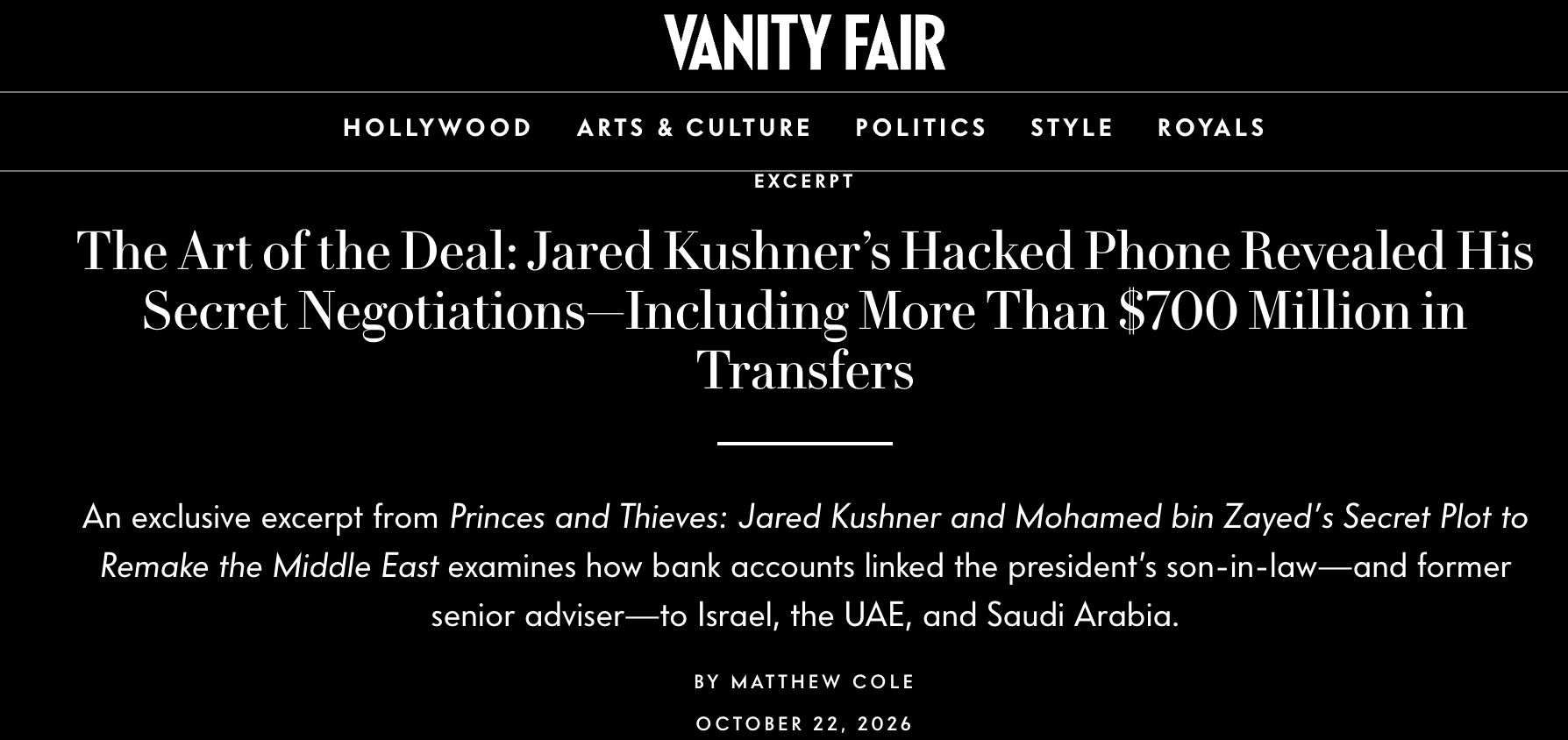
Aside from the shocking substance of this story, what's amazing is how it was unearthed by Cole. The short version: The Russians were able to penetrate Jared Kushner's iPhone and extract screenshots and data. Then, a Russian intel official was captured by Dutch intelligence (!) and flipped. The Dutch believed Kushner may have been acting on behalf of Russia, so pursued him as an intel target and were able to get into his phone.
They did not find any evidence of Russian collusion, instead they watched him moving hundreds of millions of dollars from slush funds created by Saudi Arabia and the UAE, one of them housed in Israel's central bank.
Incredible reporting, and if Democrats have any sense, they will pull on these threads and learn a lot more about this money.

Explosive story many years in the making, now out in Vanity Fair by Matthew Cole (who will be on Breaking Points next week, and publishing soon in @DropSiteNews):
Saudi Arabia and the UAE set up multi-billion slush funds for Jared Kushner to use.
Iran-Contra 2 here (except with Iran-Contra, at least the US got some hostages released. Not clear what we got out of this one.)
Thomas Cristofoletti retweeted

The GRU hacked into Jared Kushner's iPhone. Dutch military intelligence (MIVD) then recruited a GRU spy who gave them access to the hacked phone. What MIVD discovered was that Kushner had access to two bank accounts --one Azerbaijani, the other Israeli --where Saudi Crown Prince Mohammed bin Salman and Emirati ruler Mohammed bin Zayed deposited money. It sounds like a slightly far-fetched episode of "Slow Horses," but it's real. And it proves just how eye-poppingly corrupt this administration was and continues to be as its "special envoy" decides the fate of tens of millions in Europe in the Middle East. Simply incredible reporting by Matthew Cole, drawn from his new book on Kushner. vanityfair.com/story/jared-k…
