
tweet or retweet =\= endorsement or employer view. 🇺🇸🇮🇳
Joined January 2021
- Tweets13.5K
- Following3K
- Followers3K
- Likes88K


The_Peshwa retweeted

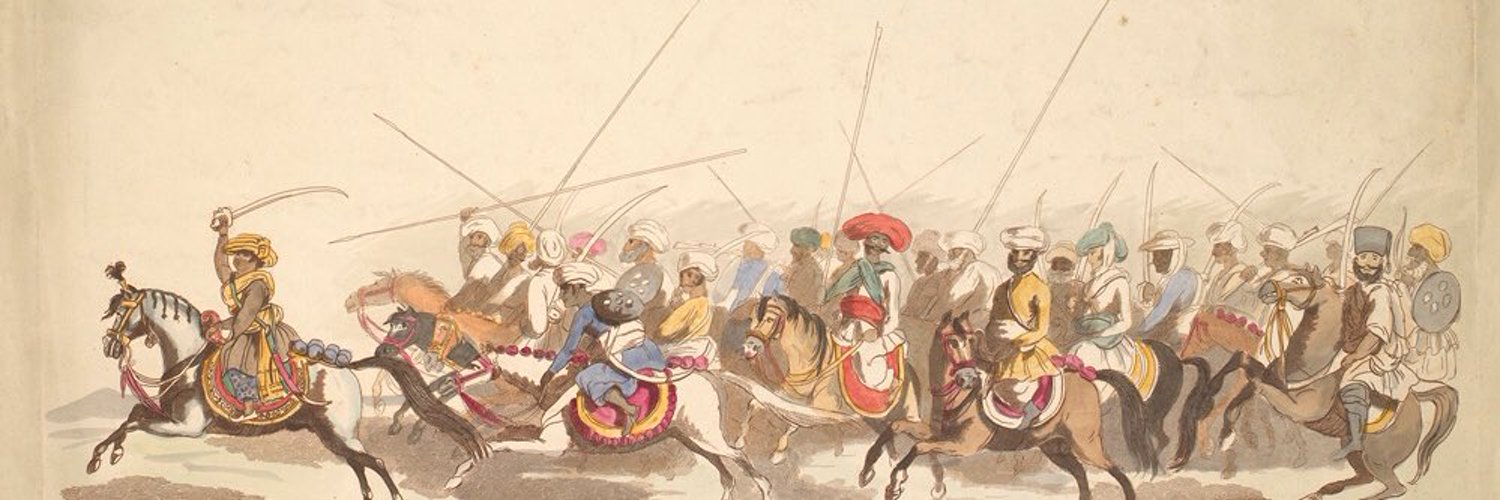
A rare paintings from 1650s showing the Maratha lance. Painted by the Adilshahis, it shows their army surrounded by the Maratha army.
The Adilshahi survivors have formed a circle, firing arrows from their composite bows. Maratha cavalry preparing for a second charge.


The photo shows the original 18th century Maratha cavalry "bhala" that was often 12 feet long. Made from hollow bamboo, they were light enough for one hand and flexible enough not shatter on contact. This is what made them deadly. Tactical use: A small squadron of Maratha horsemen would ride rapidly toward the enemy line, brandishing their ultra-long bhalas. They would deliberately stir up massive clouds of dust to obscure their true numbers.Just as they drew close to the enemy's musket fire range, the Marathas would abruptly turn their horses and flee in apparent panic and disorder. Seeing the enemy run, opposing commanders or overeager cavalry would often break their disciplined formation to give chase. The moment the enemy line fractured, the Marathas would instantly wheel their highly agile horses around and counter-attack. The British eventually developed packed musket formations (such as squares) to beat cavalry. This was then used against Napoleon at Waterloo by Wellington
The_Peshwa retweeted

The photo shows the original 18th century Maratha cavalry "bhala" that was often 12 feet long. Made from hollow bamboo, they were light enough for one hand and flexible enough not shatter on contact. This is what made them deadly. Tactical use: A small squadron of Maratha horsemen would ride rapidly toward the enemy line, brandishing their ultra-long bhalas. They would deliberately stir up massive clouds of dust to obscure their true numbers.Just as they drew close to the enemy's musket fire range, the Marathas would abruptly turn their horses and flee in apparent panic and disorder. Seeing the enemy run, opposing commanders or overeager cavalry would often break their disciplined formation to give chase. The moment the enemy line fractured, the Marathas would instantly wheel their highly agile horses around and counter-attack. The British eventually developed packed musket formations (such as squares) to beat cavalry. This was then used against Napoleon at Waterloo by Wellington

State Elephant, Benares (Varanasi). Photograph circa 1880s.The Maharajas of Benares (known as the Kashi Naresh) maintained a lavish royal household and fleet of state elephants used for ceremonial processions, durbars, and festivals.
State elephants were draped in heavy, gold-embroidered silk, brocade cloths, and jewelled body paint. They carried ornate metal or silver howdahs (riding seats) where the Maharaja or high officials sat.
The elephant was guided by a mahout (elephant controller), whose official uniform often reflected his status within the royal cavalry or household staff.
A prominent context for these elephants was the grand annual inauguration of the Ramnagar Ramlila. Started in the mid-19th century by Maharaja Udit Narayan Singh, the Kashi Naresh traditionally led the opening pageantry of the 31-day folk-theatre cycle riding atop a ceremonial state elephant. #Varanasi #royalty #elephant #history


I like the Winged Hussar armor. It is a unique blend of both the west and the east. And the wings add a nice touch

🇹🇷⚔️🇪🇺POLL: Do you prefer 15th-17th C. Ottoman Arms & Armor or 15th-17th C. European Arms & Armor?
Why or why not? To me there is no comparison; European arms and armor are infinitely cooler, more effective, and more interesting, just by the variety alone. Also much more technically impressive.
(Think Sipahi vs Knight or Hussar…)


The_Peshwa retweeted

« Native Troops in East India Company's Service, A Sergeant and a Private Grenadier Sepoy of the Bengal Army »
Artwork by Lieutenant-Colonel Charles Hamilton Smith
Hand-coloured etching and aquataint engraved by Joseph Constantine Stadler
1815

The_Peshwa retweeted

🖼️🇨🇿16th C. Portrait of Jan Zizka (Trocznowski) owned by Archduke Ferdinand II of Austria & Tyrol (1529-1595)
Archduke Ferdinand II appreciated Zizka because he had made up an effective Army from farmers and townsfolk (according to Ferdinand’s records).
Ferdinand owned another small format triangle portrait in his armouries and a sword (which is now lost unfortunately).
The inscription on the top of the portrait names the shown person as »Joanes Zisska Trocznow Superbie Simulet Avariciae Clericorum Severus Ultor«.

Pontus is a pretty cool kingdom. Very kino with lots of cool units


The Many Schemes of Mithridates the Great at Cappadocia.
For a long while, the Kingdom of Pontus wanted to expand its control in Anatolia, especially in the southern region of Cappadocia. This was problematic as, already in the 2nd century BC, the Romans were a Mediterranean hegemon, and strictly speaking, nothing went without their say-so.
But by God, they were going to try.
The first major success came when Mithridates' father took advantage of a moment of instability in Anatolia—an anti-Roman rebellion—to invade Cappadocia and basically force a marriage alliance between the king and his eldest daughter (Laodice), which he used to gain direct control over the kingdom. Since this was not a conquest but merely a marriage "alliance," and he was also helping the Romans to restore order in Anatolia, this scheme faced no real objection from them.
Unfortunately, after the death of the father, the Cappadocian king (Ariarathes), wife or not, decided to reassert his independence. So, our son and protagonist, Mithridates VI Eupator (the Great)—also known as the "Poison King"—had him poisoned and had Cappadocia ruled by his wife, with strict encouragement from his liaison, Gordius.
Yet for some bizarre reason, Mithridates' sister did not take kindly to the murder of her husband and to the new order of things. So, after some scheming of her own, she had the king Nicomedes of the neighboring kingdom of Bithynia invade and marry her, driving Mithridates' men out.
Mithridates of course decided to help against this "unjust" invasion by Bithynia into Cappadocia by sending his own army to preserve the "independence" of the kingdom. And so he did just that, driving out the invading king and effectively removing his sister (the rightful queen) from power (and the country). He then placed her young son from her previous marriage, Ariarathes VII Philometor (meaning "mother-loving"), on the throne as his new puppet.
Yet showing perhaps a family tendency, the young son did not take kindly to the murder of his father and the exile of his mother. Philometor as he is, he reasserted his independence against the uncle.
Mithridates responded to this unexpected turn of affairs by requesting a diplomatic meeting between the two kings, hoping that a non-military solution might be found. At the start of the meeting, as Mithridates was being searched for weaponry by the young king's guard, the guard felt around his groin area. Mithridates joked that the guard might find a different weapon than what he was looking for if this continued. The guard relented, and as the historian Justin tells us, Mithridates "having thus covered his treachery with a joke," drew his nephew aside. As the two kings faced each other, Mithridates pulled a hidden dagger from his groin and killed his nephew.
After which, he placed his 8 year old child on the throne of Cappadocia instead, thus finally securing control of it.
Except not. For now the Romans arrived on the scene, requesting very firmly that attempts to take control of Cappadocia stop immediately, with Gaius Marius himself stating that Mithridates had two options: either to become stronger than Rome or to do what it commands.
Mithridates, not being actually stronger than Rome, despondently relented and backed out of Cappadocia, with the locals electing a new king for themselves, some local noble named Ariobarzanes.
Knowing that in politics the shortest distance between two points is rarely a straight line, Mithridates turned to the east in order to expand west. He married his daughter, Cleopatra of Pontus, to the up-and-coming king of Armenia, Tigranes the Great. Together, they planned to have Armenia invade Cappadocia with covert Pontic assistance.
The Armenian armies successfully overran Cappadocia and drove Ariobarzanes out, installing the previous king (Mithridates' young son) in his place. Mithridates, in turn, could face the Romans and plead complete innocence to the whole affair. After all, it was not him, but a completely unrelated Armenian invasion that caused this turn of events and just happened to install the previous monarch, who was, coincidentally, his son.
Unfortunately, the Romans were not having this. They sent an army to push back against the new Cappadocian puppet, causing things to snowball for Mithridates and leading directly to a confrontation with Rome. The Mithridatic Wars.

The_Peshwa retweeted
Various Knives, daggers and elephant goads from Northern India
Salar Jung Museum, Hyderabad, India

The_Peshwa retweeted

Kunwar Bhimsinh Sisodiya, son of Maharana Raj Singh invaded Gujarat & destroyed a large mosque and 300 trivial ones.
Thus, the destruction of Hindu temples was avenged by the Rajput prince.
एका महामसीवि विखंडिता लघुमसीविसुत्रिशती ।
[बा]लयपातरुषः प्रकाशित(ता) भीमसिंहवीरेण ॥२९॥


The_Peshwa retweeted

The Celtic Litavi- is the basis of the name of two Aeduan chieftains of the Gallic war :
Convictolitavis and Litavicos (depicted on this coin).
Litavicos, cognate with Welsh Llydewig ('pertaining to Brittany') may come from Proto Celtic *Litauīkos ("sovereign, of the land").


The_Peshwa retweeted

Theres quite a few Mulan movie adaptations now, but it is funny that Disney added a whole element of misogyny to the plot and a death penalty for joining the army when the original story(and later versions) didnt have these features at all.

The_Peshwa retweeted

Batalla de Maloyaroslavets, 24 de Octubre de 1812, al poco de iniciarse la retirada desde Moscú, y que concluyó en victoria francesa tras un duro combate en el que la ciudad cambió de manos hasta en ocho ocasiones. No sirvió de nada porque tras la batalla Napoleón decidió ⬇️

The_Peshwa retweeted

El ejército del Cardenal Infante, en muestra de agosto de 1634, llevaba “3.000 infantes españoles, dejándolos 1.800 al maestre de campo don Martín de Idiáquez, y formó de los 1.200 restantes otro tercio, del que hizo maestre a don Enrique de Alagón, conde de Fuenclara…

The_Peshwa retweeted
🇮🇹⚔️ Today in 1364 the Battle of Cascina between Florence & Pisa took place.
Sir John Hawkwood, an English condottiere and veteran of the 100 Years War led the Pisan troops; he had a core of English veteran Men at arms loyal to him (around 800), and around 4,000 Pisan levies. The Florentine commander Galeotto Malatesta had around 15,000 men in total, including 4,000 knights!
Hawkwood and his army were riding a high off of a string of recent victories, having grown fat from the loot in the lucrative Mugello region, & had decided to advance towards Florence, riding the wave of confidence. This is what Hawkwood and his mercs came to Italy for! His overconfidence would cost him…
Hawkwoods spies had reported that the Florentine commander was sick and unprepared for battle; even though he was outnumbered 3:1, Hawkwood decided on a surprise attack, thinking it was the only way to victory, as the heat had also caused the Florentines to discard their armor and swim in the river; perfect time for an attack!
Hawkwood had miscalculated the distance of the road to the Florentine defences, and so it gave time for Florentine preparations-the attack also came at the hottest time of the day, & the German/English mercs, not used to this heat, began to be cooked alive in their heavy armor.
By the time they reached the Florentine camp they were exhausted, but managed to punch through the Florentine outer defences..the Florentines held fast, and Hawkwood was forced to retreat with his English core to the Abbey of San Savino, many of his men dying from their wounds. The Pisan levies were scattered and killed or captured over the next few days, and Florence won the day.
Hawkwood survived and continued to fight for all sides in these Italian conflicts; he was bound by coin and not land or allegiances. A true condottiere! He would go on to become a rich nobleman in Italy, a survivor of countless battles like this!


