




Tupl is a sponsor at FYUZ 2026, Telecom Infra Project’s meeting point for operators, vendors and builders working on open, AI-driven networks. Our focus this year: closing the loop between what happens in the network and what the customer actually experiences.
Two sessions, both on Wednesday, 4 November:
08:10 | TIP Data & AI Foundations breakout on Network Language Models and agentic systems, with Pablo Tapia: “From Reactive to Real-Time: How AI Systems Close the Loop Between the Network and the Customer”
15:00 | “Closing the network-to-customer gap: why customer experience is now the operator’s business case,” with Petri Hautakangas and Pablo Tapia
Before the doors open, our builder team, led by Luis Ortega, joins the Breaking Barriers Hackathon (1–3 November) to work on building, scaling and operationalizing NLMs.
See you in Seattle.
📷 fyuz.org/agenda


A customer calls about a spotty connection. The agent has no view of what is happening in the network, so the call follows the script. Restart the phone, check the device, run a speed test. When nothing explains it, a ticket goes to the network team and the customer waits.
Tupl's AI Care Suite shows the agent what is going on while the customer is still on the line, and what to do about it. It could be congestion or a device problem. In this case, a nearby site is being upgraded: the work will be finished within 24 hours, and the customer will get better coverage and speed afterwards.
The agent explains it on the spot, and the case is closed on the first call.
See how it works: tupl.com/solutions/customer-…
Dallas, day two. Back at @tmforumorg Innovate Americas, where a big part of the agenda is about moving autonomy beyond pilots and into live networks. The part we care about most: scaling it without losing control of what it does.
That's the work we do every day with operators in production. Closed-loop automation that cuts MTTR and OPEX, with a governance layer that keeps engineers in command of every action.
Kishore Bobbarjung and Jose Manuel Cangas are on site today. If you're working out how to give AI more autonomy in your live network while keeping every action governed and reliable, reach out to them.
#TMForum #InnovateAmericas2026

Energy Efficiency Day is a good moment to look past the hardware.
Most conversations about energy in mobile networks focus on more efficient radios and new equipment, but a big part of the savings depends on deciding when each cell can power down and when it needs to stay on.
Many networks still make that call with broad, cautious settings, because nobody wants to risk the customer experience. That's understandable, but it also means a lot of energy goes into keeping cells awake when traffic doesn't need them.
The real savings come when those decisions are made cell by cell, based on what's actually happening in the network. That's what we work on with operators every day.

AI is moving fast in telecom, but very little of it has made it into network operations. Only 16% of GenAI deployments have reached that point, and 79% of operators are still at TM Forum AN Level 0–1.
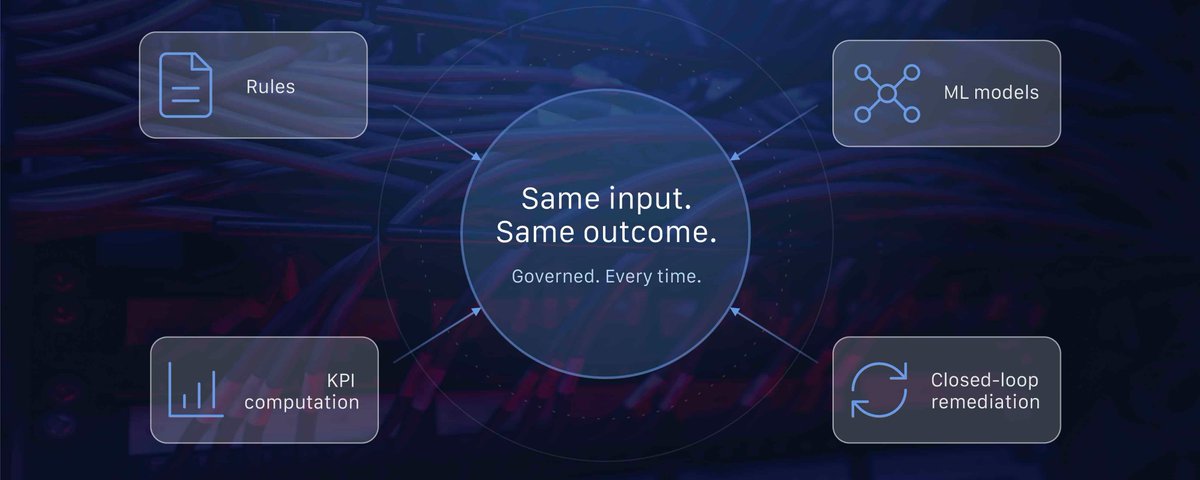
The reason is simple: every change on a live network has real consequences, so operators need systems that behave the same way every time. Generative AI wasn't designed for that, and operations teams are right to be cautious.
The way forward is to keep execution deterministic and let AI agents do the reasoning. At one Tier-1 operator, this approach now closes 60% of issues automatically.
Our new article for @FierceNetwork_ explains how it works: fierce-network.com/sponsored…

Tupl Innovation Week is back with its third edition.
Once a year, we open the floor to new product ideas from everyone at Tupl. Every Tupler gets to answer the same question: what would you build if it were up to you?
We've had small fixes that ended up mattering more than anyone expected, and ideas that changed how we thought about a problem entirely.
A jury picks the strongest ones, which get built into working prototypes. The best of those get shown to our customers.


Most "AI agent" pitches dodge one question: what happens when it's wrong, and who's watching when it acts?
The agent behind AI Care Suite, our customer care automation solution, works the way a senior engineer would: investigate, verify, report. Give it a task and it runs the process end to end, so your team can focus on what needs their judgment.
→ Plans the right approach for the job
→ Selects the systems and data it needs
→ Runs the investigation through a governed, deterministic process
→ Returns a clear, actionable answer
The agent explores and reasons. It doesn't get to execute on a guess. Every step runs the same way, in the same order, with a record of what it looked at and why, whether it's the first case or the ten-thousandth. That consistency is the guardrail, and it's what makes the answer safe to act on.
The result: workflows that used to take hours or days now run in minutes.
Governed hyperautomation: the agent explores, a deterministic process executes.
See how it works: tupl.com/solutions/customer-…

Service Assurance teams have dashboards, alarms, and probes. What they don't have is the customer's voice.
Complaints go to customer care. Network health goes to service assurance. Two pipelines, no link between them. An engineer sees a KPI dip with no idea it's already flooding a call center. A care agent logs ten "my service keeps dropping" tickets with no visibility into the incident causing them.
Tupl's AI Care Suite closes that gap. It pulls from 40+ data sources across the network and customer stack, classifies each complaint as network-related or not, and maps it straight to the customers actually affected.
Incidents now get worked by customer impact, not just technical severity:
- Faster fixes where they actually matter
- Care and engineering pulling from the same data
- Optimization grounded in what customers experience, not just what the dashboard shows
See how to prioritize by customer impact: tupl.com/solutions/customer-…
Billions invested in automation, and network OPEX is still growing, while MTTR has barely moved.
Engineers still spend their days on repetitive diagnostics instead of optimization.
The promise was simple: deploy enough scripts, rules engines and vendor tools, and the NOC would run itself. It didn't work out that way. Scripts break the moment network context shifts. Tools only see their own domain. And the troubleshooting knowledge that actually matters walks out the door with the expert who has it.
Zero-touch asks for something different: AI that understands network context, engineering knowledge digitized at scale, closed loops that learn and adapt. TM Forum has already done the hard part of naming this, the AN Levels, the reference architecture, the assessment methodology. What's still being worked out across the industry is the harder part: getting a real network to operate at that level, with humans still in control of every action.
That's the gap that actually matters for anyone building an autonomous-network roadmap right now, not the maturity model itself, but the operational and governance work to get a live network to trust it.
We talked through exactly that earlier this year. Still holds up. Watch the conversation: youtube.com/watch?v=JNJhyBvr…


Behind every autonomous network, there's a team building the automation that makes it possible.
This Labor Day, we're thinking of the people at Tupl who keep telecom moving forward: the engineers, product managers, data scientists, and all the people who turn ambitious ideas into automation that works.
To the whole Tupl team: thank you. 💙

The path to autonomous operations isn't a one-off project, it's a loop, and every pass through it earns more trust.
• Identify a high-value use case
• Deploy it in a focused scope, open-loop: the system recommends, engineers decide
• Measure the business impact, then close the loop as confidence builds
• Expand across domains, carrying that trust forward
Each pass through the loop doesn't just add automation, it earns the right to act on more of it.

A US Tier-1 operator had a national footprint to manage, a major network transformation underway, and hundreds of KPIs to review daily across a multi-vendor environment.
Growing the engineering team wasn't an option, and outsourcing wasn't either.
Results depended on who ran the analysis. Engineers were stuck in repetitive triage instead of the work that actually moves the needle.
We deployed Network Advisor for daily performance management across their markets. The impact:
• 67% reduction in analysis time
• 60% of reported issues auto-closed, cutting the noise before it reached engineers
• 30% faster resolution on actionable incidents through AI-driven root cause analysis
• Automated action plans at cell level, so optimization scales without adding headcount
The team didn't lose scope. They moved up to higher-value work, and network quality improved with them.
Read the full case study here: tupl.com/case-studies/smart-…

When automation projects stall, the algorithm is rarely the reason. It's usually something nobody planned for: an integration nobody budgeted time for, a workflow nobody mapped.
Across years building autonomous operations with Tier-1 operators, a few things keep separating the deployments that hold up from the ones that don't:
• Built and integrated directly into the operator's real OSS/BSS, data, and workflows, never a sandbox version
• Co-designed with the operator's own engineering teams
• Continuous adaptation as vendors, tech, and configs shift
• Engineering knowledge encoded, so it scales and survives turnover
• Governed execution, every outcome auditable, no black-box decisions
The systems that hold up are the ones that adapted to the team running the network, not the other way around.

At #DTW26, David (our Telco Product Director) told us why AI pilots stall: operators try to curate every data source before they start, when the better strategy is to scope narrow, run it, and let data readiness catch up as the pilot evolves
The bigger gap isn't data though. It's who's accountable, how a decision traces back, and how fast you can roll back if something breaks.
That's the real line between TM Forum AN Level 3 and Level 4: approving actions vs. approving the policies that govern them.
Watch the full conversation with David: youtu.be/vpuSTj4Pepg
Agentic for discovery, deterministic for execution. That's what closes the trust chasm: operations still run by experts need systems that are traceable, auditable, and predictable.
Watch the full conversation on our YouTube channel, including what actually separates operators who move fast from the ones who stall: youtu.be/Pa6V0TDjIOE
