


Talpi retweeted

You already know what time it is.
Congrats to our last week’s #BitstackDCA winner,
@boutin_lola 🤝
As promised, we’ve got a surprise for you this week!
To celebrate our new brand, we’re picking 5 winners instead of 1!
Ready to try your luck? 👇
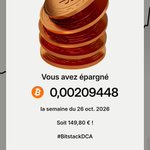
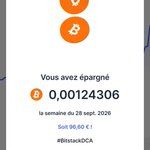
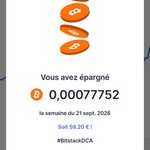
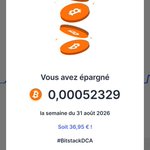
Share a screenshot of last week’s savings summary, which appears when you first open the Bitstack app every Monday, and post it on X with #BitstackDCA.
You have until 4 p.m. tomorrow to enter. Good luck!
bitstack-app.com/blog/gagnez…


Talpi retweeted

A card payment can be reversed months later. A bank transfer can be recalled. Both feel safe because someone can undo them.
$BTC works the other way. Once a transaction is in a block, it stays there.
For the person paying, that's a reason to be careful. For the person being paid, it's the whole point: no chargebacks, no funds pulled back weeks after the goods have gone.
Same property, opposite feeling, depending on which side of the counter you're on.
Which side would you rather be?

Talpi retweeted
THE SUPPLY IS ALREADY GONE
Everyone talks about 2140.
But the more interesting milestone has already happened.
By March 2026, more than 95% of all the $BTC that will ever exist was already in circulation. What's left will be released gradually over roughly 114 years, taking the issued supply to around 99% by 2035.
And even "circulating supply" doesn't tell the whole story.
Chainalysis estimates that 2.78 to 3.79 million BTC may be permanently lost, including roughly 1 million BTC in early wallets attributed to Satoshi that have never moved.
So Bitcoin's available supply is being squeezed from both ends.
New coins enter the market more slowly, while some existing coins effectively disappear from it.

Talpi retweeted
You hold a miner, it earns $BTC every day, and that is that. Nothing else happens.
Miner Wars is what happens when you put it to work somewhere else. Your mining power becomes your score, you join a clan, and clans compete for a prize fund across the cycle.
The miner keeps mining the whole time. You are using the same hashrate twice.
Our latest Hotel GoMining checks in a guest who wants more out of theirs.
Talpi retweeted
The team at this GoMining data center gets a list of jobs from clients. They have usually done most of it before the list arrives.
Power cycling, fan changes, swapping power supplies. The dull work that keeps a machine earning instead of sitting idle.
The one thing they leave alone is hash boards and motherboards. Most of these ASIC miners are still under warranty, and repairing those in-house would void it, so those go back to the manufacturer.
Knowing what to fix matters as much as knowing how.
What would you forget to check if these were in your garage?
Talpi retweeted
Tomorrow at 12pm UTC, 150 ghost miners arrive at GoMining. 🎃
Each glass ghost miner comes with 31 TH of hashrate and an energy efficiency of 13 W/TH.
The specs are worth a closer look. The primary market moved to 15 W/TH this week, making this collection more energy-efficient than the new miners currently listed there. Lower W/TH means less power consumed for the same hashrate, which can mean lower electricity costs over time.
$599 each. Fixed price. Just 150 available.
Our Christmas collection went fast. Let's see how long these ghosts stick around. 👻
Which design should we bring out next?


Talpi retweeted
THE CAP IS NOT IN THE CODE
There's no line in Bitcoin's code that simply says "21 million."
The number comes from two rules working together.
Bitcoin started with a 50 $BTC block subsidy, and that reward is cut in half every 210,000 blocks. Keep following that schedule and the total supply approaches 21 million.
The actual maximum is 20,999,999.9769 BTC, slightly below 21 million because Bitcoin counts in satoshis and drops fractions that can't be represented.
That's why Bitcoin holders treat the cap as fixed.
Not because someone promised it.
Because changing it would require the network to agree to change the rules.

Talpi retweeted
This is what 3,000 ASIC miners looks like at GoMining West Texas data center.
Shelves stacked twelve high, four rows deep. Six machines to a shelf, five in the back rows where the XP models sit, because those are too wide to fit a sixth.
Somebody walks these aisles every day checking fans and swapping filters. Your digital miner is a share of what this room produces.
How many did you picture before seeing this?
Talpi retweeted
Converting in the GoMining app is a better deal from today.
A conversion is turning one asset into another inside the app, your daily $BTC rewards into USDT, or buying GOMINING to pay your maintenance fee. Conditions improved across most conversions, with USDT to USDC staying as it was.
Mine, convert, and build your crypto portfolio in one place, with the exact rate and fee shown before you confirm.

Talpi retweeted
Buying $BTC and mining it get you to the same place by different routes.
Buying means you pay today's price and hope for a higher one.
Mining means you pay for electricity and hardware, and receive $BTC daily at whatever the price happens to be. The cost side is known. The reward side moves.
Most people have only ever tried one of the two.
Which are you?

Talpi retweeted
The community section is live in the GoMining app.
Thousands of people mine with us every day, and until now you had no way of seeing any of them. The section brings that into the app.
Ecosystem news with reactions, posts written by the people using the product, and a live view of what is happening across the platform, in one place instead of three. Tap any user to see their profile: VIP level, avatar, farm and when they started mining.
Posting is available from certain VIP levels. Rolling out in stages on mobile.
Talpi retweeted
Eighteen minutes on the Miner Wars changes, from someone who actually plays it.
If you have been wondering what the new league structure means in practice, or how promotions work now that clans are capped at 50, this covers it properly.
Thanks for making it.

Miner Wars @GoMining has had some major updates!
The league structure has been overhauled, expanding to 40 leagues across four tiers, and clan membership is now capped at 50 players.
In this video, I walk through the changes, explain how promotions and demotions work, and share some tips on boosts, scoring and getting the most out of Miner Wars.
Talpi retweeted
Almost everything about Bitcoin adjusts. Difficulty moves every two weeks to keep blocks landing roughly every ten minutes. Hashrate rises and falls as miners come and go. The reward halves every four years.
The one number that does not is the cap. Twenty-one million, written into the protocol, and changing it would require convincing every node operator on earth to run software that devalues what they already hold.


Talpi retweeted
Large bitcoin mining companies all compete for the same people, which is the small group who already own bitcoin and want to mine it.
GoMining went a different way, and a large share of the people who mine with us had never owned any $BTC before they arrived. They came in through a digital miner rather than through an exchange, and GoMining Academy is there to explain what mining is, what it does for the network, and what any of it means for them.
That is a slower route than buying market share from other miners, and it is the one that actually grows the number of people using bitcoin.
How did you get into bitcoin in the first place?
Talpi retweeted
"There's no demand for Bitcoin payments" is the most common objection we hear.
It's also true. Nobody is asking.
People don't ask for things they can't picture. They asked for cheaper taxis, not an app that knows where you are. They asked for faster post, not email.
Demand shows up after the thing exists, not before.
What's something you use daily that you'd never have asked for?

Talpi retweeted
Our creator club has a new name, and it is open to creators anywhere.
It is the Creator Club now, without the X, because good content about Gomining does not only happen in one place.
Anyone can apply, whether you are starting out or already have a large audience. There are still criteria, so not every application gets through, and what we are looking for is real experience of using the app and the willingness to tell your audience about it.
We value video, and creators showing what they actually do rather than describing it. We read every application, so applying does not guarantee a place.

Talpi retweeted
Electricity is the largest running cost in bitcoin mining, and at a GoMining site the rate is negotiated at a scale no individual could reach.
That matters because the rate you pay on a digital miner comes from the same arrangement. Someone mining at home pays household electricity prices, while a site with thousands of machines buys power on commercial terms, and the gap between those two numbers is what decides whether mining is worth doing at all.
It is the part of mining nobody puts in a product video, and it is the reason the maths works.
What else do you think gets overlooked about mining costs?
Talpi retweeted
Worth a watch if you are growing your TH.
Mists goes through his own setup step by step and explains why he made each choice, which is the kind of thing that only lands coming from someone actually doing it.
Thanks for sharing @0xMists

building a Bitcoin mining position takes time
one thing i'm learning with GoMining is that growing your TH can come from different approaches, depending on what you want to do with your rewards and the assets you hold
the new Simple Earn update gives me another route to explore
i'm still at 14.68 TH, with 100 TH as the target
curious to see how much difference these small additions can make over time
sharing my walkthrough for anyone building their own TH farm.
Talpi retweeted
Everyone asks about land and power when you build a $BTC mining site. Almost nobody asks about water.
Cooling at this GoMining site in West Texas runs through evaporative panels. Those panels need a steady supply.
The usual answer is to drill a well. They tried. The ground kept giving them oil instead.
So the water comes from a reservoir nearly two miles away, piped in and held in a tank that gets topped up as it drains.
Land, power, water. Miss one and the build stops.
What else do you think gets underestimated when building a data centre?