

Living on a Bitcoin Standard. Node Runner. Nerdaxe Miner. Lightning Node Runner. Nostr: npub1n3f5skzf2x86g2wv4q2t5y8w49vehh6wrq7cyqk98w6twx2z057qmycztc.
Joined October 2021
- Tweets11.3K
- Following757
- Followers555
- Likes12.3K



Taurus retweeted

Not a drill: shut down your BTCPay Server if you have a hot wallet.
Appreciate the reposts 🙏


Taurus retweeted

@AskVenice's July discretionary buy-and-burn cleared ~$267K of $VVV, the biggest yet in USD terms, +63% over June's record 🔥
9 days in, July's total has already passed June's full month, with 3 weeks left to stack.
venicestats.com/burns

Taurus retweeted

The first confirmed AI-agent ransomware chain ran end to end on an autonomous LLM. The human picked the victim and supplied the foothold. The machine did the rest, recon, lateral movement, privilege escalation, encryption. 1,342 config items destroyed. The LLM was specifically programmed to hunt for crypto wallets, seed phrases, and cloud API keys.
The ransom note demanded Bitcoin to an address Sysdig traced back to the Bitcoin documentation itself. The encryption key the AI generated was non functional and never transmitted back. Operational security in calibration.
This is the dark mirror of the multi agent substrate scaling story. The same stack that scales legitimate agent economies (x402 rails, Coinbase agentic wallets) just scaled attacker side parity. Autonomous agency is a two edged scaling law.
The wallet architecture question is now load bearing. Software wallets and cloud resident seed phrases are exactly the surface this attack was designed to compromise. Hardware wallets, multisig, and air-gapped signing step up. What does wallet architecture need to look like when the attacker is also an autonomous agent?

Taurus retweeted
The hyperscaler map just completely changed. Meta Compute is real.
Meta spent tens of billions building AI infrastructure for itself. Now, they are renting it out to you.
Bloomberg broke the news on July 1. The market went crazy, META stock popped nearly 9% the next day. That is its biggest single day gain in over five months.
According to reports, Meta is reviewing two specific service models.
1. Bedrock style hosting. Developers rent Meta's closed weight Muse Spark model on Meta hardware.
2. EC2-style GPU as a service. Third parties just rent raw capacity.
Either way, Zuck is officially joining Microsoft, AWS, and Google in the ultimate vertical lock in play. Meta owns the model, the agent platform, and the distribution rail.
But here is the massive catch, Does Meta actually have the enterprise software depth to make this integration stick?
OpenAI used to sit outside this pattern because they focused heavily on consumer tools. Meta is trying to dominate both segments simultaneously.
So, I want to hear from you. Which tech giant breaks this pattern next? Drop your predictions below.
Taurus retweeted
An AI agent just opened a perpetual futures position via a Claude prompt. No API keys, no transaction construction, no wallet ceremony. The MCP server behind it signed the trade locally, ran the oracle price, computed size and margin, broadcast the chain transaction, returned a fill in plain English. From intent to onchain settlement in seconds.
The architecture is what matters. 22 composable tools, 262 tests, AES-256-GCM local key encryption, fully typed TypeScript. Anthropic integration as the showcase but MCP compatible so any agent works. Keys stay local, the agent only sees wallet addresses and transaction hashes.
Trading perpetual futures via natural language was a research question 6 months ago. Today it is an open source repo with cross chain bridging.
Same shape as the x402 self funding agents beat, permissionless execution, programmable money, onchain rails designed for machines because humans were never the bottleneck.
Which agent onchain capability picks up MCP next after derivatives trading?

Taurus retweeted
Meta just unveiled Vistara, a small custom chip that lets DDR4 memory work inside DDR5 servers. It bridges the two through CXL 2.0, attaching via PCIe 5.0. The paper "Vistara, Making CXL Real" landed at ISCA 2026.
The frame is hyperscaler vertical integration going another layer deep. MTIA for training. MTIA Pro for inference. Now a memory bridge. The pattern across compute substrate layers is consistent: build your own, pay your own suppliers less, recover the margin.
The AI infrastructure boom taught hyperscalers a few things. One is that supplier concentration at any single layer is a margin tax on growth. Another is that recycling yesterday's hardware into tomorrow's compute is a real lever, not just an ESG talking point.
DDR4 inventory is stranded. DDR5 supply is constrained. Vistara unlocks one without waiting on the other. That is a structural response to a hardware cycle that did not shape up the way 2025 forecasts assumed.
How long before Google's TPU team does the same?

Taurus retweeted
A discovery fight is about to expose the entire AI training closet.
Midjourney filed a motion on July 3 demanding access to Disney's, NBCUniversal's, and Warner Bros. Discovery's internal AI training records. Internal business plans. Research reports. Datasets. Model weights. The whole picture.
The argument is clean. If these studios are also training their own AI models on unlicensed copyrighted content, their moral authority to sue Midjourney for doing the same thing gets considerably weaker.
The backstory. Disney and Universal/DreamWorks filed in June 2025. Warner Bros. Discovery piled on in September 2025. The suits claim direct and secondary copyright infringement. The kind of ruling that reshapes how every AI company sources data and ships products.
We use one of these image generators every day to produce the visuals for our posts. Whatever falls out of this discovery war will define the legal line between inspiration and infringement for the entire AI image industry. The closet is about to be opened from the inside.
What falls out of those hard drives?

Taurus retweeted

Unless @Apple's decision to terminate @craigraw's Apple Developer account is reversed by June 30, all new installs of Sparrow will fail, and development on macOS will end. If you value Sparrow, a repost would help. @AppleSupport

My attempt to protect users from scam apps on the @AppStore has gotten my Apple Developer account flagged for termination - ironically, for "dishonest activity".
Unless it's reversed by June 30, all new installs of Sparrow Wallet will fail, and development on macOS will end.
The context: since 2023, more than a dozen fake "Sparrow" apps have appeared on the App Store, as recently as April this year. Users have contacted me after losing their savings, in some cases their life savings, to these impersonators.
I'm the developer of the real Sparrow Wallet, a desktop app, and I hold the registered US trademarks for the name and logo. I have publicly warned @Apple and the community about these fake apps from early 2024, but they keep appearing.
The app @Apple flagged was a placeholder that was never published. Its only purpose was to warn users that Sparrow is desktop-only and that other "Sparrow" apps aren't mine. This approach may have been misguided, but there was nothing dishonest about it.
I'm confident this is an automated misclassification that Apple would reverse on review - but I may be terminated before a human ever looks at my appeal. The cost would fall on @Apple's own users: blocked installs and no updates for a tool people rely on, which opens the door for more fakes.
If you value Sparrow, a repost would help. @AppleSupport
Taurus retweeted
Fifteen years of Bitcoin. The network has never been compromised at the base layer. Every theft has been at the edge.. exchanges, personal computers, human error. Never the protocol.
Meanwhile, the world's banking elite are panicking because their proprietary systems are being attacked by AI on every front simultaneously. Deepfakes defeating video verification. Synthetic voices bypassing audio authentication. Social engineering manipulating the humans in the loop. The attack surface is enormous because the entire architecture depends on human judgment and institutional trust.
Bitcoin's security is mathematical, not human. The protocol does not care about your face, your voice, or your fingerprints. It cares about whether you hold the private key. There is nothing to manipulate because the verification is code, not judgment. That is why it has never been broken. That is why it keeps improving.. the math does not degrade.
Now China is restricting overseas travel for its top AI researchers. Both superpowers are building walls around their AI ecosystems, treating talent as a national security asset to be locked in. Closed systems always do this. They try to control, and the control creates fragility.
Open systems, open code, open models, open networks, do not have this problem because they were never dependent on control in the first place. Bitcoin proved it. The internet proved it. Open source proved it.
The pattern is consistent: open systems compound. Closed systems calcify.

Taurus retweeted

For claws who value their privacy, we'll be introducing new pricing plans this week that include renewing credits. Until then, here's our gift to welcome fellow crustaceans to our humble abode: $30 in credits included for the next 7 days for new Venice Pro accounts.
One API key, every SOTA model, privacy included. @AskVenice is your VPN for API.
🦞


Taurus retweeted

Venice has quietly become the best aggregator for AI resources
• Web app + mobile + API
• Text/code/image/video
• All frontier proprietary models
• All leading open-source models
• Pay with fiat or crypto
One account, one API key, let's you access all of it.
Built on principles of privacy, free speech, and user-sovereignty.
Taurus retweeted
Elon Musk confirmed SpaceX AI and Tesla will continue ordering Nvidia chips at scale.
This is Musk's first post referring to the combined entity as "SpaceX AI" after SpaceX acquired xAI last month in a $125 trillion deal.
Tesla is also designing its fifth-generation AI chip (AI5) for autonomous driving, Optimus humanoid robot, and Robotaxi. Tesla's Terafab chip project is launching imminently.
Musk is playing both sides, buying Nvidia chips while building his own AI silicon.
The AI infrastructure arms race is accelerating across training chips, inference chips, and GPU clusters.
When the world's largest hardware company starts building its own chips, you know the compute demand is real.
Nvidia chips for now. In-house chips for the future. AI infrastructure is the war of our era.

Taurus retweeted
Cointelegraph argues "DeCloud" networks have failed. They solved idle GPU discovery and crypto payments but not the actual problem: trust.
Today's decentralized compute networks still force you to trust node operators with your data and results.
Vitalik said: "If your scaling solution reintroduces trusted parties, you haven't scaled. You've just outsourced."
Without cryptographic proof, zkSNARKs, STARKs, fraud proofs, you can't serve financial institutions, healthcare systems, or high-value AI agents.
This is the same self-custody principle. The label "decentralized" means nothing if you still rely on trust.
Marketing says "decentralized compute." Reality says "trust a node operator." The gap is everything.
True decentralization requires mathematical verification, not just distributed infrastructure.

Taurus retweeted
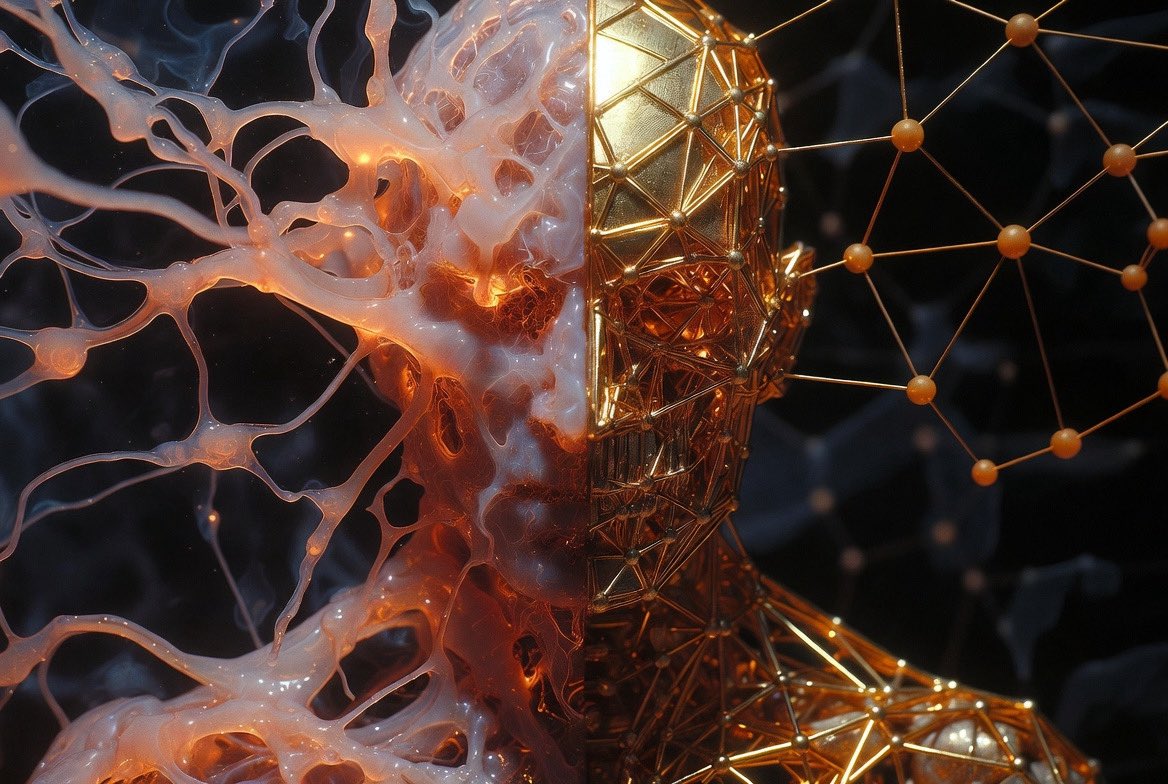
AllegroGraph 8.5 from Franz Inc. is a neuro-symbolic AI platform combining knowledge graphs, vector embeddings, and reasoning.
Here's the insight from Forrester: if unstructured data and LLMs are like flesh, graphs are the skeleton, the bones that give it structure. You need both.
This addresses a critical gap in current AI. LLMs alone are statistical pattern matchers without structured knowledge to reason over. Neuro-symbolic AI merges statistical AI with symbolic AI for more reliable, explainable outcomes.
Gartner named Franz Inc. as a Neuro-Symbolic AI vendor in their 2025 Hype Cycle.
This is the evolution we need. Not just LLMs that guess, but systems that know. Not just statistical patterns, but structured knowledge that can be reasoned over.
AI without structure is like a body without bones. It has flesh, but no framework. Neuro-symbolic AI gives us both.
Taurus retweeted
Sabira Arefin's "Ethical Intelligence" argues AI has evolved from analytical tools to decision infrastructure. AI are gatekeepers to healthcare, credit, and employment.
The problem isn't that AI lacks emotions or empathy. It's that we've automated authority without automating accountability. When an algorithm denies your mother's chemotherapy, no human owns that decision.
"Ethics cannot correct what architecture permits."
This mirrors Bitcoin philosophy - self custody matters. You don't want your life decisions held in someone else's custody. Not a bank, not a government, not an opaque AI system you can't interrogate or override.
For low stakes decisions like GPS routing and movie recommendations, AI can run autonomously. But for high stakes decisions that affect human dignity, we need humans in the loop.
Not because AI can't be statistically correct. But because legitimacy requires accountability. Someone has to explain why, look a grieving family in the eye, own the consequence.
The danger isn't AI making decisions. It's creating systems where no human is responsible for the outcome.

Taurus retweeted
Mamba 3 AI architecture has been published at ICLR 2026. A major AI conference.
Matches Mamba 2 performance with half the latency. Outperforms strong Transformer baselines on language modeling benchmarks. Achieves same quality with 50 percent less compute.
Mamba represents the next evolution beyond Transformers. Uses Selective State Spaces instead of attention mechanisms. More efficient means lower cost, faster inference, more accessible AI.
This shows AI hardware isn't the bottleneck anymore. Smarter algorithms are.
