

Tele Vue Optics, founded in 1977, has been thrilling amateur astronomers since 1979. It is our mission. It's in the materials we choose, the designs we create.
Chester, NY
Joined April 2017
- Tweets1.3K
- Following106
- Followers1.6K
- Likes2.7K






Tele Vue Optics, Inc retweeted

🔭 A shadow with a mane #Barnard33
The horse does not shine at all, it is a cold knot of dust and molecular gas standing in front of IC 434, a thin curtain of hydrogen that Sigma Orionis keeps glowing from the side. Above it the Flame Nebula burns beside Alnitak and hides newborn stars that only infrared can reach.
From chin to mane the head spans about 3.5 light-years, so an airliner at 900 km/h would need more than four million years to cross it, and you would have to lay the Earth to Moon distance end to end some 86 million times.
📷 Eye and sensor #Astrophotography
January is the month, when the belt crosses the meridian around 22:00 to 23:00 and the Horsehead stands about 39° high in the south from southern Germany. Visually it is one of the hardest targets in the sky, and even a 5“ telescope with an Hβ filter and a low power eyepiece shows a ghost at best.
However, my CCD sensor saw it easily. This frame comes from my #Televue NP127is at f/5.2 (660 mm) with the QSI683 and an Astrodon 5 nm Hα filter, a pairing whose field of roughly 1.6° × 1.2° holds Flame and Horsehead in one portrait, while the narrow band shrugs off light pollution and spends every photon on hydrogen.
🏛️ When this light left #History
These photons set out around 650 AD. Yazdegerd III, the last Sasanian king, died near Merv in 651 and four centuries of Persian empire ended with him, while at Palenque K'inich Janaab' Pakal sat on the throne.
The Horsehead is slowly worn away by ultraviolet light and may last another five million years. Run that span backwards and you reach the Zanclean flood, when the Atlantic broke through at Gibraltar and refilled a nearly dry Mediterranean.
🐎 The hunter's horse #GreekMythology
Orion was a son of Poseidon, and from his father he took the gift of striding over the waves as if they were solid ground. He became the greatest hunter of his age, until pride took hold and he boasted he would kill every animal the Earth had raised. Gaia answered with a scorpion, small enough to ignore, whose sting brought the giant down.
Zeus set both in the sky on opposite sides, so the Scorpion rises only when Orion sinks in the west. The horse at his belt is a modern name, first noticed by Williamina Fleming on a Harvard plate in 1888, yet it fits, because Poseidon was lord of horses and father of Pegasus, who sprang from the neck of Medusa.
✨ One star carves it, another lights it from behind, and all it asks for is a red filter and a long winter night.🙂🌍
Or a summer one.🙃🌏
Thanks for reading and Clear Skies /@xipteras
#HorseheadNebula #FlameNebula

Tele Vue Optics, Inc retweeted
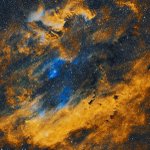
“Sleeping Beauty” is how I call it, but there are official names for this region. #Messier16 #astrophoto
—
🌌: @TeleVueOptics NP127is telescope, QSI 683 CCD camera, Astrodon 5nm h-alpha filter.


Tele Vue Optics, Inc retweeted

I made this picture years ago. The scope has been a great companion for casual star gazing for years. Thanks Televue! #Televue

Tele Vue Optics, Inc retweeted
⭐️⭐️⭐️ Nestled in Canes Venatici, the Whirlpool Galaxy (M51) is a barred spiral galaxy approximately 23 million light-years from our vantage point on Earth. Exhibiting an apparent magnitude of +8.4, Messier 51 spans roughly 11´x7´ in angular size. It is renowned for its pronounced spiral arms, replete with star-forming regions, molecular clouds, and dust lanes. At its nucleus, M51 harbors a supermassive black hole, driving the rotational dynamics of its arms, further accentuated by its tidal interactions with the satellite galaxy NGC 5195, see my image below.
🔭👀 Optimal #stargazing of M51 occurs in spring, post-midnight when it ascends to a prominent position. For us amateur observers, telescopes with an aperture of 8" provide a window into its galactic intricacies, while 14" or larger telescopes uncover deeper details of its spiral arms and star clusters. My personal experience using a 30" Dobsonian telescope revealed the striking tidal bridge between M51 and NGC 5195, a testament to the raw power of direct observational astronomy.
🔭🏋️♀️ My most recent encounter with the Whirlpool Galaxy was through the lens of our astronomy club's massive 30-inch Dobsonian telescope, set in the countryside of southern Germany, just a two-hour drive from the majestic Alps. As I gazed through this giant, I was captivated by the luminous bridge that stretched between M51 and its galactic companion.
That experience was nothing short of amazing - a contrast to viewing processed images or digital renderings from a robotic telescope. As I witnessed this celestial connection with my own eyes, I was overwhelmed by the realization that I was seeing ancient light traveling across the cosmos, a connection to space that simply can't be replicated in photographs.
🔭📷 We, the #Astrophotography enthusiasts aiming to capture M51 need to employ long-exposure techniques with sensitive CCD sensors or low-noise professional DSLRs on quality 🇺🇸 astrographs for refined detail. A motorized equatorial mount is mandatory to counter Earth's rotation, ensuring sharp and detailed captures of this distant galaxy. Take your time, it is never enough for this target.
🕯️➡️🌍 When the photons we now observe from M51 embarked on their journey, Earth was in the Miocene Epoch, a period marked by climatic transformations that favored grassland expansion, influencing mammalian evolution, including early hominids. This epoch was pivotal, heralding the rise of hominins and setting the stage for Homo sapiens. Geologically, it was a time of tectonic reshaping, with the uplift of the Himalayas and Andes, creating diverse habitats that catalyzed ecological diversification and complexity.
🙏 I'm passionate about bringing the wonders of the cosmos to you through my astrophotography and stories. I combine two decades of personal experience with extensive research. Your support through likes and especially retweets is greatly appreciated if you enjoy my views of the universe. Join me on this journey through time and space. 🌠
Clear skies and enjoy the night sky #stars ✨✨
/px
--
🎶 Now playing ‘John Askew Live From 🇬🇧 London 2023’ on #SoundCloud on.soundcloud.com/NCeSj
--
Image taken by @xipteras with @TeleVueOptics #NP127is telescope, QSI683ws8 CCD camera, NJP-JPZ mount.

ALT Messier 51 image by Panagiotis Xipteras


Tele Vue Optics, Inc retweeted
The Phantom is a face-on spiral galaxy in the constellation of Pisces. With a diameter of about 95,000 light years, roughly 22,000 times the distance between us and our nearest neighbor star, Proxima Centauri, it is somewhat smaller than our Milky Way galaxy.
Discovered by Pierre Méchain in 1780 and catalogued by Charles Messier as M74, its prominent spiral arms (see @xipteras image below), which are rich in the reddish star-forming regions, have made it an attractive target for #astrophotography.
When the starlight left the galaxy 32,000,000 years ago, Earth was transitioning from the Eocene to the Oligocene epoch, which was marked by a significant global cooling event. This shift caused the Antarctic ice sheets to grow and sea levels to fall. Meanwhile, grasslands began to expand, and many new mammal species adapted to the cooler climates appeared.
M74 is faint and its low surface brightness can be a challenging factor for us #stargazing enthusiasts observing from our light-polluted areas.
CS✨✨✨
—
Photo taken by @xipteras, @TeleVueOptics NP127is 🇺🇸 telescope, QSI683ws8 CCD camera, LPS-RGB filtering, less than 1 hour total exposure time from 🇩🇪. BTW, this is the original version for desktops or laptops 😊🙏


Tele Vue Optics, Inc retweeted

Last night, I observed the Venus/Jupiter #conjunction with my #TeleVue 85mm scope using a #Delos 6mm eyepiece. Saw Jupiter’s cloud bands, Red Spot , 3 moons & also had planet Venus in the same 100x field of view. Still my favorite scope after 20 years! Thanks @TeleVueOptics
Tele Vue Optics, Inc retweeted

Astrofotografía realizada por Luis Van Gogh de la Nebulosa del Águila (M16) realizada el 18/11/2022 a las 19:25 UTC con telescopio de ultra-campo profundo Tele Vue 85GXF Apochromatic Doublet Refractor (23,4") CCD Kodak KAF-3200E. Distancia: 7000 al.

Tele Vue Optics, Inc retweeted

Cold 26° but clear night, let’s pump up the magnification to 300x for a moon flyover @TeleVueOptics 10mm and 2x Barlow on 12"dob @321FlaSpaceGirl @lookitsthemoon @MoonHour321 @NASAMoon @telescopery @astro_vino @DubnHG1 @AstroNameHere @spacebrandonb @GP_O11 #moon #StormHour #luna – at Levittown, NY
Tele Vue Optics, Inc retweeted

November 2022 total lunar eclipse.
Taken from Pflugerville, TX.
The next one visible from this area is not until 2025.
Orion 10" XTg Dobsonian telescope
Canon 60Da through Tele Vue Paracorr 2
Prime focus f/0, ISO 2000, 0.8 sec exp.
#TotalEclipse #TotalLunarEclipse #BloodMoon


Tele Vue Optics, Inc retweeted

#Mars imaged from London in the early hours of this morning (25th Oct). Still a fair way from opposition - this year’s is going to be a good one for us in the north.
#astronomy #Astrophotography #space #televue #zwoasi #celestron

Tele Vue Optics, Inc retweeted

The planetary trio from 30/8/22
All imaged using a @Celestron NexStar 6SE, @zwoasi 224mc, Zwo ADC and a @TeleVueOptics 2.5x Powermate. #space #planets #solarsystem #astronomy #astrophotography #jupiter #saturn #mars #celestron #nexstar6se #zwo #zwoasi224mc #televue #powermate

Tele Vue Optics, Inc retweeted

Still processing Jupiter frames from the other night, but these turned out pretty nicely. #Astrophotography
@Celestron 8" EdgeHD + @TeleVueOptics PowerMate 2.5x + @zwoasi asi485mc.
@skyatnightmag @SkyandTelescope @AgenaAstro @OPT_Telescopes @FLO_UK @AstroBackyard @GP_O11
Tele Vue Optics, Inc retweeted

Glen Pidsadnick photographed the Crescent Nebula. The nebula is a cloud of gas that has been blown out by a massive, hot Wolf-Rayet star at its centre. Glen used special narrowband filters to record plenty of details in the nebulosity with a Tele Vue 101 telescope. #astronomy

Tele Vue Optics, Inc retweeted
This mornings images, possibly my best too. Using a Celestron NexStar 6SE, Zwo Asi224mc, Zwo ADC and a Tele Vue 2.5x Powermate. #space #planets #astronomy #astrophotography #Jupiter #Saturn #Mars #Celestron #Zwo #TeleVueOptics


