

Official HUB of the CoDeTech Eco-System $XCB:CB292120D3ABC3B8330A26DAF4BEB94B1F6A9C7B4963
Joined April 2024
- Tweets1K
- Following98
- Followers425
- Likes2.5K


Pinned Tweet
🌐 The Internet as you know it is broken.
It’s centralized. It’s censored. It’s fragile. If the server goes down, you go offline.
But what if the people were the network?
Welcome to the @CoreCoinCC Ecosystem ($XCB). They aren't just building a blockchain. They are building the Internet 2.0.
🧵 A 60-second deep dive into the future of #DePIN. 👇

A phone on the charger at one in the morning, mining XCB. Dr. Green Node tested CorePulse and turned it into a song.
Thank you for this. It is exactly why we built it: the device you already own becomes part of the network.
xitter.gq/DrGreenNode/status/211…

Tested it in the zolder at one in the morning. Phone on the charger, miner running, no account, no rig.
@TellMeAboutCORE built it. I just wrote the song. 📱
The rollout begins.
We brought @OckertLoubser into our studio and showed him what we built. His verdict: "Lars and Daniel built a very, very cool app."
Today it is yours. CorePulse mines XCB on your Android phone. CoreStarter runs a Core node on Windows, Linux and Mac. The new tellmemoreaboutcore.com is where it all starts.
No mining farm. No GPU. Just the device you already own.
This is the new chapter.
youtu.be/TZvZ43X0DsI

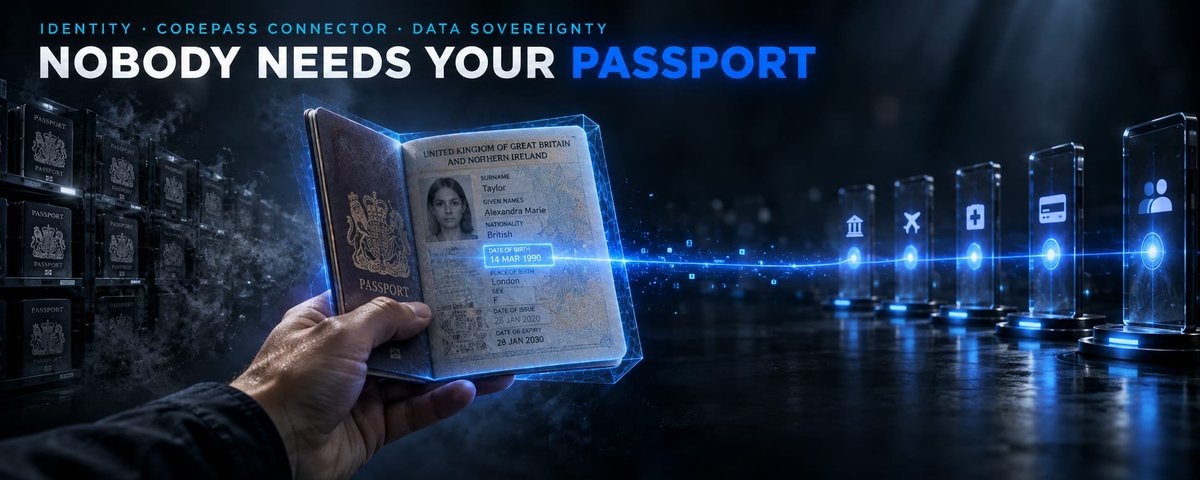
Nobody needs your passport to log in, or to prove you are over 18.
Today, proving your age usually means uploading a photo of your ID to a provider, who then has to store it. Last October, a customer support vendor working for Discord was breached, and the ID photos of around 70,000 users may have been exposed. Those photos existed because someone once needed to check an age.
Age and ID laws are coming either way. The EU Commission says at least 17 EU countries are preparing their own.
The CorePass Connector takes a different route. If a provider only needs your date of birth, it gets your date of birth. Nothing more. You scan a QR code, approve the sign-in in the CorePass app on your phone, and the app receives only what it asked for.
For builders, a working login takes about five minutes.
xitter.gq/TellMeAboutCORE/status…

"I've got the password" is not a corporate governance model.
Bringing a business into a decentralized economy takes more than handing the company a wallet and wishing its accounts good luck. It takes identity, authority and accountability.
Ockert Loubser, the CEO of CoDeTech, in Core Chronicle 15.
Most login screens give you two buttons. This film is about the third.
Sign in with Google or Apple is easy, but your login lives on their servers. The CorePass Connector moves it to your phone: scan a QR code, approve the sign-in in the CorePass app, and you are in.
The app receives your Core ID, the only identifier it needs to keep. No password, no email address, no phone number stored.
For builders, a working login takes about five minutes: connector.corepass.net
A company name attached to someone's personal wallet is not a business identity.
Ockert Loubser, the CEO of CoDeTech, on what a business has to be able to answer: who are you, who do you represent, and are you allowed to?
CorePass KYB ties the business to the people authorized to act for it. From Core Chronicle 15.
Heard of Core, and not sure what it is?
30 seconds, no jargon: what Core is (an open-source public blockchain, and not Core DAO or Core Wallet), what already runs on it, and why the source is worth trusting.
Two people documenting it from the inside since 2022. This is where to start.
Logging in as yourself is solved. Logging in as your company is not.
Through the CorePass Connector a business can sign into integrated services, share approved verified information and identify the person acting on its behalf. Ockert Loubser, the CEO of CoDeTech, puts it simply: the business identity and the representative's authority travel together.
Who are you is the easy question. Who do you represent, and are you allowed to do that, is the one every partner actually needs answered.
Being on the team does not make you the board.
That sentence is the whole design of CorePass KYB. A business runs as a DAO, a digital rulebook: who belongs, who can do what, how decisions get approved. Permissions decide what a member is allowed to do. Voting rights decide who approves, and with how much weight.
Majority to share company information, unanimous to sign on behalf of the business. Without the required approvals the action simply does not go through.
Most companies keep those rules in a PDF. Here they run.
KYB answered who may act for a company. Ping Exchange now takes that answer to the market.
Each trader works within a mandate: which markets, which order types, which limits. Moving funds needs the member approvals the company has defined.
Identity, then authority, then the market. The order is the interesting part.
xitter.gq/CoDeTechCC/status/2110…

PING EXCHANGE. BUSINESS TRADING.
CorePass verifies the business.
Ping connects it to the market.
We're introducing a major expansion of Ping Exchange, built for how real organisations operate.
This goes far beyond business accounts.
🎬 Watch the new Core Chronicle.
youtu.be/min56wg2HQU
Your business. Your people. Your rules.
#PingExchange #CorePass #CoreBlockchain

Most crypto launches are a design deck with a countdown. You get the vision, the mockups and a dashboard with coming soon under every button.
The CEO of CoDeTech draws the line in this clip: what the Core Chronicle showed was a release version of Wall Money, not a concept. That distinction is easy to say and expensive to earn, because a release has to survive people actually using it.
A concept only has to impress. A release has to work, which is also why it waits until it does.
Every partner eventually asks the same thing: who is actually allowed to act for this company?
The usual answer is a director who says so. Ockert Loubser, the CEO of CoDeTech, on why that is not a security policy, even with a very convincing LinkedIn profile.
CorePass KYB verifies the business and the people behind it, then connects that business identity to the person authorized to act on its behalf. The claim and the authority stop being two separate documents.
A request. A vote. A signed answer.
CorePass KYB is live: the company itself becomes a smart-contract wallet.
Today, every new partner asks the same three questions. Who is behind the company? Who decides? Where is the proof? The answer is a stack of papers: commercial register, power of attorney, shareholder list, notarized copies. And the next partner asks again.
With CorePass KYB the company gets a name, a team of members and approval rules for every kind of action. Once all voting members have signed, the wallet is active.
From then on, when a partner asks for data, the members vote and the answer comes back signed. There is no single key.
A form can say who may sign. A wallet can require them to.
@CorePassCC
Crypto spends a fortune on influencers and then wonders why nobody outside the bubble has heard of it.
Michael Loubser's view runs the other way: influencers follow the media, not the reverse. A story that lands in the press gets picked up and passed on. A story that starts with an influencer rarely travels back into the press.
If you want reach beyond your own followers, the order matters more than the budget.
Founders Tell All, December 2024.
Today is a good morning.
Verification confirms a company exists. CorePass KYB also records who may act for it.
The business becomes a self-custodial wallet with a DAO behind it: members get permissions, voting rights decide who approves what, and an action without the required approvals does not go through.
Being on the team is not the same as being the board.
xitter.gq/CorePassCC/status/2108…

ALT A newspaper front page on a marble table in front of a New York skyline at sunrise: the headline reads COREPASS KYB: THE COMPANY BECOMES THE WALLET, above a photo of four colleagues around a table looking at a phone that shows the CorePass logo.

COREPASS KYB IS LIVE.
Digital identity is expanding from people to businesses.
But verification is only the beginning.
What CorePass has built goes much further, and we believe it represents another world first.
🎬 Watch the new CC:
youtu.be/7FJUZLEGhjE
#KYB #DAO #RWA

2003. Rural South Africa. POS terminals on GPRS, a shared ledger, and the funeral industry replacing paper receipt books.
That is five years before the Bitcoin whitepaper, and it is where this team started building payment rails. Nobody called it blockchain because the word did not exist yet.
Twenty years of building in places where failure has consequences shapes how you ship.
Most bad takes in crypto are assumptions said with confidence.
Okkie opens the conversation with a rule for the room: speak from experience, not from what you think you know, because an assumption makes a fool of the person making it nearly every time. Then Michael does the unglamorous part and drags the conversation back to the question that was actually asked.
Two founders, two habits, both rarer than they should be.
Founders Tell All, December 2024.
Everyone calls inflation bad. On a blockchain, it's the security budget.
Every new coin pays someone to secure the network. Cut that pay, and security has to be paid for some other way.
Bitcoin halves it every four years until it hits zero. Fees cover less than 1% of miner revenue today. Unless that changes, the price has to double every four years just to keep miners paid the same in dollars.
Core went the other way. 5 $XCB every block, with no end date: 18 to 22.5M new coins a year, depending on block times. That's ~18 to 22% today. Sounds high, but it's the same curve Bitcoin ran in its first four years: at the same age, Bitcoin sat at ~25%. Then Bitcoin started cutting. Core just keeps going, so the rate falls on its own: under 10% in the early 2030s, under 5% in the early 2040s. To keep miners paid, the price only has to hold.
Gold's supply grows ~1.7% every year, too. Nobody calls gold broken for that.
Short term watches the rate. Long term watches who still pays for security.
xitter.gq/Daniel_StotheC/status/…

Opening 📁 Chain: Core Blockchain ($XCB)
Every folder in this tree stands on one floor. Most stacks rent theirs: a chain someone else runs, with rules written for someone else's use case.
Core is the floor @CoDeTechCC builds on: an independent L1 from a team working together since 2013, live since May 2022. Its own consensus, its own cryptography, its own address format.
📁 Decentralization starts with hardware you already own
Classic proof of work turns security into a bidding war for electricity, and AI datacenters now win that auction. PoDE, the next step from proof of work, never bids. Its RandomY algorithm needs a 256 MB dataset and a cache small enough for a phone chip. Decentralization was never a property of the hash function. It depends on who can afford to take part, and here the entry device is already in your pocket.
📁 No halving, no cliff
Every block pays 5 $XCB, and that never runs out. Bitcoin halves its reward until fees alone have to pay for security. The amount per year stays fixed while the supply grows, so the inflation rate falls every year on its own.
📁 Ed448 and SHA-3, not secp256k1 and Keccak
Signatures use Ed448 from RFC 8032, a 224-bit curve. Bitcoin and Ethereum sign at roughly 128 bits. Core even wrote its own HD wallet standard for it (CIP-99). Hashing uses SHA3-256, the finished NIST standard, where Ethereum uses Keccak, the version from before standardization.
📁 Addresses built like an IBAN
ICAN follows the IBAN structure: a network prefix, two check digits, modulo 97. The network is part of the address, cb for mainnet, ab for testnet, so a test address can never pass for a real one. Almost every typo gets caught before the money moves.
📁 Internet optional
A signed Core transaction fits in a few text messages. TxMS, maintained inside the ecosystem, relays it over a basic cellular network, no data plan needed. Core's own site lists mesh networks and satellite streams next to mobile internet, and Luna Mesh, in development, carries transactions device to device where there is no internet at all.
📁 Standards of its own
31 public Core Improvement Proposals. Beyond the familiar token standards, Core writes its own: ICAN addresses (CIP-100), Ed448 wallets (CIP-99), payto:// payments (CIP-10), and RWA metadata that links a tokenized asset to its lab certificate (CIP-150, CIP-152).
📁 One address for the whole stack
Your CorePass ID is a Core address. The same key that signs a transaction logs you into Ping, authorizes every withdrawal and is tied to your verified identity.
You use the other folders. This one is why they hold.
A delayed launch tells you very little on its own. What matters is whether everything else stopped with it.
In the latest Compressed Core Chronicle, the CEO of CoDeTech puts it in one line: this is a delay to Wall Money's public release, not a pause on the ecosystem. The rest of the stack keeps moving while one product gets verified properly.
Shipping late and correct beats shipping on time and wrong, especially when the product shows people their money.
Every finance app promises to put everything in one place, and then quietly leaves crypto in a separate app with a separate login.
This is the Wall Money account view as designed: bank account, virtual account, digital assets and crypto as four cards on one screen, under one identity. The CEO of CoDeTech walks through it in the Core Chronicle. It is not open to users yet, and it is shown as exactly that.
The idea underneath is simple. The four balances never needed to live apart in the first place.