

Global
Joined February 2020
- Tweets1.6K
- Following285
- Followers2.3K
- Likes700


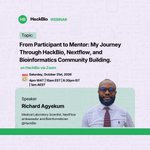



What can happen when you go from being a learner to helping others grow?
For Richard Agyekum, the journey didn't stop at learning bioinformatics.
Join us for HackBio To The World, where Richard will share his journey through HackBio, Nextflow, and bioinformatics community

building.
Come hear the lessons, experiences, and opportunities that shaped his path.
📅 Date: 31st October 2026
🔗 Register here: buff.ly/7vH8o0v
#HackBioToTheWorld #Bioinformatics #Nextflow #ScienceCommunity
What can AI learn from 112 million cells across 12 species? 🧬
Meet TranscriptFormer, an AI model helping researchers explore gene expression patterns and compare cells across species.
What does this mean for the future of bioinformatics?
Read here 👇
buff.ly/St0oJep

🧬 DNA, RNA, proteins… how do they all connect?
Each tells us something different about what’s happening inside a cell.
Curious about how it all works? Read the full article and explore the world of omics. 👇
buff.ly/e9mT0da

We've put together 6 learning opportunities from HackBio to help you decide what to learn next.
📩 Read more to find your next learning opportunity.
👉 buff.ly/07X47tA

What happens after you learn a new skill?
For some people, it's the beginning of a new career direction. For others, it opens the door to opportunities to help others grow.
This is the kind of journey we want to explore in our next HackBio To The World webinar......

Meet Richard Agyekum, a Medical Laboratory Scientist from Ghana whose bioinformatics journey has taken him from HackBio participant to mentor, into the Nextflow community as an Ambassador and open-source contributor, and to founding BioInfo Hub, a community creating opportunities
For life sciences students in Ghana.
On 30 October 2026, Richard will share his journey, his experiences and how learning has influenced his path in bioinformatics.
📅Join us for HackBio To The World.
Register here: buff.ly/1Dp9SSH
🧬 Wet Lab or Dry Lab? Which path is right for you?
Choosing your path in biology can feel overwhelming, especially with bioinformatics and computational biology opening up new possibilities.
We've put together a guide 👇
buff.ly/yJwiZyT


analysis and data visualisation
🧪 Conda for managing software environments
📈 MultiQC for summarising bioinformatics analysis results
Ready to begin your journey to becoming a Biocoder?
Explore the pathway here:
buff.ly/rOViztW
#HackBio #Bioinformatics #Python #RStats

At HackBio, you can choose between Courses and Pathways, depending on where you are in your learning journey.
Courses are perfect if you want to learn or strengthen a specific skill.
Want to learn Python?
Need to improve your Linux skills?
Want to understand a particular area

Of bioinformatics?
Pick a course, learn at your own pace, and build the skills you need.
Pathways are for those who want a more structured learning journey.
Just learn, build, and progress at your own pace.
🧬Start with one skill. Build from there.
buff.ly/K4Wqs1d

What do algae, light, and the human brain have in common?
More than you’d think.
The 2026 Nobel Prize in Physiology or Medicine recognized a discovery that transformed how scientists study the brain: optogenetics, a technique that uses light to control specific neurons.

The really fascinating part is the journey from a tiny light-sensing organism to neuroscience, and disease research.
And it raises an even bigger question:
What happens when we stop studying biology one layer at a time and start connecting the dots?
We have more biological data than ever before.
DNA. RNA. Proteins. Single-cell datasets.
But the real challenge is no longer just generating data.
But understanding the data and connecting the dots.
We explored this in our latest newsletter👇
buff.ly/CGUQ9Mw

A Multi Omics project can help you learn to:
🧬 Analyse DNA and RNA data
🔗 Integrate biological datasets
⚙️ Build workflows with Nextflow
🔬 Interpret biological results
Join HackBio’s final internship of 2026, Start Nov 1
Early bird: $50
Register: buff.ly/nYORbN2

