

Decision-making insights, infographics, and reports for everyone! (A product of @Businessfront) 🌐https://xitter.gq/t.co/YRxnqCIXsz
Lagos, Nigeria
Joined May 2021
- Tweets4.3K
- Following6
- Followers5.2K
- Likes401




Intelpoint retweeted
When you fall sick in Nigeria, who pays the bill?
In 2023, households paid directly for 71.9% of Nigeria’s current health expenditure, according to WHO data published by the World Bank. That is about ₦72 of every ₦100 spent on healthcare, the highest share among 54 African countries.
These out-of-pocket payments include consultation fees, laboratory tests, medicines and hospital care paid for directly by households. The money may come from a salary, savings or contributions from relatives, without reimbursement from insurance or another organisation.
Cameroon followed Nigeria at 67.7%, then Equatorial Guinea at 66.0%. Across Africa, 13 countries relied on direct household payments for more than half of their current health spending.
At the other end, out-of-pocket payments accounted for just 4.1% in Rwanda, 4.3% in Botswana, 6.7% in South Africa and 7.5% in Namibia. Nigeria’s share was more than double the sub-Saharan African figure of 30.4% and more than four times the global figure of 17.3%.
Paying directly for healthcare can leave families choosing between treatment and other basic needs. Those who cannot afford the bill may delay care or go without it, risking worse health and higher costs later.

Intelpoint retweeted
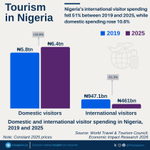
For every ₦100 international visitors spent in Nigeria in 2019, they spent about ₦49 in 2025, after adjusting for inflation.
The World Travel & Tourism Council (WTTC) estimates that international visitor spending fell 51.3%, from ₦947.1 billion to ₦461 billion over those six years. After recovering to about ₦73 per ₦100 of its 2019 level in 2022, it fell for three consecutive years, including an 18.6% drop in 2025.
Domestic visitor spending moved the other way, rising 10.6% between 2019 and 2025 to ₦6.39 trillion. That is about 1.7% growth a year, compounded. In 2025, domestic spending accounted for roughly ₦93 of every ₦100 spent on travel and tourism within Nigeria, across business and leisure trips.
All spending figures are WTTC estimates at constant 2025 prices. The per-₦100 comparisons and compounded annual growth rate were calculated by Intelpoint from WTTC data.
Source: World Travel & Tourism Council: Travel & Tourism Economic Impact Research 2026. All rights reserved.

Intelpoint retweeted
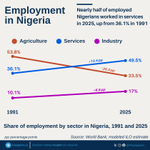
Agriculture accounted for more than half of employment in Nigeria in 1991. By 2025, its share had fallen to a third, according to modelled ILO estimates published by the World Bank.
Over the same period, services’ share rose from 36.1% to 49.5%, recording the largest increase among the three broad sectors. Industry’s share also increased, from 10.1% to 17.0%.
Across the 34 years, agriculture’s share fell by 20.31 percentage points, while services and industry gained 13.38 and 6.93 percentage points, respectively.
Note: Agriculture includes farming, hunting, forestry and fishing. Industry includes mining and quarrying, manufacturing, construction, and public utilities such as electricity, gas and water. Services includes trade, hotels and restaurants, transport, storage, communications, finance, insurance, real estate, business services, and community, social and personal services.

Intelpoint retweeted
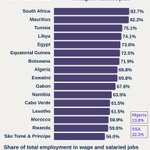
More than nine in ten employed people in Djibouti worked in services in 2025, at 92.2%, covering activities such as wholesale and retail trade, transport, hotels and restaurants, finance, education, healthcare and public administration.
According to World Bank data based on modelled ILO estimates, services accounted for more than half of employment in 18 African countries. Mauritius, South Africa and Libya followed Djibouti, each with shares above 70%.
Nigeria’s share stood at 49.5%, above sub-Saharan Africa’s 38.5%, but slightly below the global share of 50.6%.

Intelpoint retweeted
South Africa has 5,230 fewer ATMs than at its 2016 peak. Nigeria has 2,055 fewer than in 2019.
They top the 18 African countries with fewer ATMs in 2025 than at their recorded peak, ranked here by machines lost. The other 23 of the 41 countries with 2025 data recorded their highest ATM count in the series that year.
Seven of the top 10 countries peaked between 2016 and 2020, while Tanzania and Namibia peaked in 2024.
40 of the 49 African countries with a 2017 value and a later reported value had more ATMs in their latest reported year than in 2017.
Peak = highest value in each country’s available series since 2004; some series start later.

Intelpoint retweeted
Roughly one in four employed people worldwide worked in agriculture in 2025, representing 25.8% of total employment.
As the world marks World Food Day today, the figure offers a look at how important agriculture remains to livelihoods around the world.
In Burundi, 85.3% of employment was in agriculture, more than three times the global share. Mozambique and Niger followed at about 73% each.
Overall, 19 African countries had more than half of their employment in agriculture, while the Sub-Saharan Africa average stood at 49.3%.
Nigeria stood at 33.5%, above the global average but well below the Sub-Saharan Africa average.

Intelpoint retweeted
In Lagos, 87% of children aged 7–14 had foundational reading skills in 2021, compared with just 2% in Jigawa. That is an 85 percentage-point gap between the two states.
Across Nigeria, the share was 26.8%. Eighteen of the 37 areas, including the FCT, recorded higher rates, and 16 of those were in the South West, South East or South South. Kwara and the FCT were the only areas outside those three southern zones above the national average.
The figures come from Nigeria’s 2021 Multiple Indicator Cluster Survey (MICS6) and are available at the subnational level through UNICEF’s Foundational Learning Skills explorer. The assessment covered children aged 7–14, including those who were out of school. For reading, children had to read at least 90 per cent of a short Grade 2-level story and answer both literal and inferential comprehension questions.

Intelpoint retweeted
Africa had a strong presence among the currencies requiring the most local currency units to buy $1 in 2025.
Eleven African currencies featured among the 25 shown, accounting for 44% of the list. Somalia’s shilling led the African group at 24,300 per dollar, followed by Guinea at 8,663, Madagascar at 4,530 and Uganda at 3,596.
The naira also featured on the list, averaging 1,518 per US$1 in 2025. Iran was the clear outlier globally, with the dollar averaging 711,418 Iranian rials, nearly eight times Lebanon’s 89,500.
Using the UN M49 subregional classification, 7 of the 11 African countries were in Eastern Africa: Burundi, Madagascar, Malawi, Rwanda, Somalia, Tanzania and Uganda. The remaining four were Nigeria and Guinea in Western Africa, the Democratic Republic of the Congo in Middle Africa, and Sudan in Northern Africa.

Intelpoint retweeted
New data from the UNDP/OPHI Global MPI report shows Nigeria’s multidimensional poverty rate rose significantly from 33.0% in 2021 to 38.7% in 2024—affecting nearly 4 in 10 Nigerians (90.1M people).
While the timeline tracks this specific comparative trend, the UN's broader, comprehensive baseline estimate for the country is even more severe: it reveals that 48.7% of the population—approximately 113 million Nigerians—were living in multidimensional poverty.
Multidimensional poverty measures deprivation in health, education and living standards, not income.

Intelpoint retweeted
Where a child lives in Nigeria is closely tied to whether they have foundational numeracy skills.
In Lagos, 82.3% of children aged 7–14 had foundational numeracy skills in 2021. In Jigawa, it was just 0.8%. Across Nigeria, the figure was 25.3%.
Of the 18 jurisdictions above the national figure, 15 were in the South. In 11 northern states, fewer than 12% of children had foundational numeracy skills.
This measures the minimum numeracy standard expected at the Grade 2–3 level, assessed one-on-one with a randomly selected child aged 7–14 per household. The sample includes children who were not in school.
These are survey estimates with margins of error. For example, Taraba's estimate was 9.5%, with a 95% confidence interval of 6.0%–14.7%. Small differences between states may therefore not be statistically meaningful.

Intelpoint retweeted
Nigeria is adding people faster than it is adding ATMs, and the gap keeps widening.
In 2019, the country had 19,459 ATMs, its peak. By 2025 that was down to 17,404, which is 2,055 fewer machines, a drop of 10.6%. ATMs per 100,000 adults fell from 16.4 to 12.3, a 24.7% drop, because the adult population kept growing. That is lower than Nigeria’s 2013 level and the lowest since 2012.
Between 2009 and 2014, the network grew from 9,907 machines to 15,935, up 61%. Coverage then held at around 15 to 16 per 100,000 adults until 2021, so the network was at least keeping pace.
Since then, coverage has fallen four years in a row. The machine count has hardly moved since 2023, from 17,377 to 17,404, so the slide now comes from a growing population sharing the same machines.

Intelpoint retweeted
China's stock of foreign direct investment in Africa rose from $491 million in 2003 to $46.1 billion in 2018, a 94-fold increase.
The stock fell to $40.9 billion in 2022, 11% below the peak, and recovered to $43.8 billion in 2024, which is still about 5% below 2018 and only 1.2% above its 2017 level.
Africa also accounts for a small share of China's overseas holdings, about 1.4% of its $3.14 trillion global FDI stock. Nigeria's stock peaked at $2.86 billion in 2017 and stood at $2.72 billion in 2024.
Between 2018 and 2024, 19 African countries increased their stock of Chinese FD, and gains of $6.02 billion were outweighed by losses of $8.32 billion, a net decline of $2.31 billion.
Niger grew the most, from $758 million to $2.45 billion, rising every year, while Mauritius went from $998 million to $2.11 billion. The biggest falls were in Zambia (from $3.52 billion to $1.70 billion), Zimbabwe (from $1.77 billion to $759 million) and Ghana (from $1.80 billion to $1.20 billion).

Intelpoint retweeted
South Africa's $6.25 billion of Chinese FDI stock at the end of 2024 was larger than DR Congo's $4.27 billion and Nigeria's $2.72 billion, and together those three held about 30% of the continent's $43.80 billion.
The top ten countries accounted for about 64%, so Chinese investment was concentrated in a few markets: Niger ($2.45 billion), Mozambique ($2.28 billion), Angola ($2.13 billion), Mauritius ($2.11 billion), Ethiopia ($2.04 billion), Kenya ($1.91 billion) and Algeria ($1.86 billion) made up the rest of the top ten.

Intelpoint retweeted
The number of Nigerians enrolled in UK higher education fell by a third in one year, from 57,580 in 2023/24 to 38,040 in 2024/25. Postgraduate study accounts for 96% of that drop of 19,540, while first-degree numbers fell 4.5%.
The postgraduate decline comes after a rise from 8,170 in 2019/20 to 62,630 in 2022/23, and at 29,375 the current figure is still 3.6x the 2019/20 level.
The UK's international student total fell 6.3% to 685,565 over the same year, with India down 20,365 while Nepal nearly doubled from 12,755 to 24,435, moving from 8th to 5th as Nigeria slipped from 3rd to 4th.
The timing coincides with the January 2024 ban on dependants for most postgraduate taught students and the naira's devaluation.

Intelpoint retweeted
In 1990, roughly 208 of every 1,000 children born in Nigeria died before their fifth birthday, the 13th highest rate in the data.
By 2024 it had fallen to about 116, a drop of 44%, but Nigeria now has the highest rate because countries like Niger and Sierra Leone cut theirs by more, and its own has barely moved since 2015.

Intelpoint retweeted
Enugu generated ₦355.3 billion through ministries, departments and agencies (MDAs) in 2025, accounting for 87.3% of the state’s internally generated revenue (IGR). That was more than a quarter of the ₦1.36 trillion generated through MDAs across the 36 states and the FCT.
The other five states where MDA revenue accounted for more than half of IGR were Kwara, Katsina, Osun, Ogun and Ekiti. Together, the six states generated about ₦656 billion through MDAs, nearly half of all MDA revenue recorded nationally.
The number of Nigerian states where MDAs accounted for more than half of IGR rose from two in 2022 to seven in 2024, before falling to six in 2025.
Enugu has become the clearest outlier. Its MDA share rose from 82.9% in 2024 to 87.3% in 2025. Kwara followed at 61.6%, while Katsina and Osun recorded 60.1% and 58.5%, respectively.

Intelpoint retweeted
Lagos, Rivers and the FCT generated 63.5% of state-level PAYE, the income tax deducted from workers' salaries, in 2025. Together they collected ₦1.673 trillion of the ₦2.636 trillion total, and Lagos alone collected ₦993.3 billion, more than the next five jurisdictions combined and 2.8 times Rivers, the second highest.
Delta, in fourth place, collected ₦139.7 billion, less than half of the FCT's ₦320.1 billion. The top 10 accounted for 81.5%, while the bottom five collected ₦47.0 billion between them, under 2% of the total.

Intelpoint retweeted
Most Nigerian schools lacked basic water, sanitation or hygiene services in the latest available estimates. An estimated 64.4% lacked basic water services, 57.1% lacked basic sanitation and 76.4% lacked basic hygiene. The latest water and hygiene estimates are unchanged from the 2012 estimates, while the sanitation estimate has risen from 17.7% in 2012 to 42.9% in 2023.
Access also varied sharply by location. Only 29.9% of rural schools had basic water services, compared with 47.9% of urban schools. The gap was even wider for sanitation, at 33.1% in rural schools versus 63.5% in urban schools, showing that national coverage figures conceal a substantial rural disadvantage.

Intelpoint retweeted
In the Central African Republic, nearly half the population, 48.68%, was aged 0–14 in 2025, the highest share among the 54 African countries.
Somalia followed at 46.55%, then Niger (46.23%), Chad (45.96%) and DR Congo (45.95%). DR Congo stands out on this list for a different reason: at 51.85 million, its population aged 0–14 is by far the largest, even though its share ranks only fifth. It is a reminder that a high proportion and a high headcount are not the same story.
The Central African Republic’s share sits well above Africa’s aggregate share: 38.8% of Africa’s population was aged 0–14, compared with 40.38% in Sub-Saharan Africa and 40.52% in Nigeria.

Intelpoint retweeted
As of 2025, Nigeria was home to 96.25 million children aged 0–14. That means 16 of every 100 children across 54 African countries lived in Nigeria that year.
Ethiopia and DR Congo followed, with 52.54 million and 51.85 million respectively. Together, Africa's ten most populous countries for this age group, Nigeria, Ethiopia, DR Congo, Egypt, Tanzania, Uganda, Kenya, Sudan, Angola and South Africa, accounted for 60.91% of the continent's 600.17 million children.
