

Building my Ferrari fund 🏎️
Joined December 2017
- Tweets1.2K
- Following631
- Followers1.2K
- Likes1.5K




Investing in 2021:
- Money was free
- Every dip bounced
- Your group chat was full of crypto bros
Investing in 2026:
$TE posted a 19.6% gross margin last quarter.
But $24.4M of it was a one-time tariff refund sitting in cost of sales.
Remove this and margins are ~10%.
Always interesting what you learn in a 10Q. Now what will happen in Q3 earnings after two of the huge evervolt payments (esp between cash or stock)?
$TE every date that matters:
- Oct: DOE loan?
- Oct 15: $30M payment (cash or stock?)
- Oct 30: $18M payment
- Nov 13: Q3 earnings
- Dec 3: Section 232 tariffs take effect
- Feb 16: ITC hearing on a TOPCon import ban
- Q1'27: G2 first cells

“Sam please say something nice about us bc we’re being totally eviscerated online kthx” - $CBRS


Ryan Bannister retweeted

A google TPU engineer is telling us he thinks $CBRS is going to $1t market cap a day after semianalysis shook some kids out of their CBRS shares with some oversimplified comparison making CBRS look irrelevant.
What happens to $VICR if this Google engineer is even half right? $CBRS would not even be a viable commercial product without Vicor's power modules. CBRS is 15-20% of Vicor's 2026 revenue of 600m this year. CBRS will 3x their revenue next year and 2-3x again in 2028. To get to $1t they will have to continue similar growth past 2030 and VICR will be benefiting the whole way.
Oh yeah and did I mention Vicor is suing the whole Google TPU supply chain while already having Google pay them a royalty that increases by 3% per monnth? And have also got 2 AI OEM's to license their tech for the use of infringing products(cough cough amd+nvda).
I have not seen a no brainer this easy to hold since MU under $100 last year. I only had like 50 followers back then though so most of you missed my table pounding on that one.

Cerebras is going to 1T. Deep in the GPT 5.6 announcement is this gem. This offering will be a high priced fast mode offering for agentic coding. You will see customers like quant funds etc who have unlimited budget and the need for the fastest agentic coding in the world using GPT 5.6 on Cerebras. GPT 5.6 on Cerebras will enable coding projects to be completed in minutes due to this decode rate. The rate of progress in technology in the world is about to accelerate. $CBRS

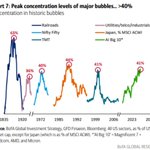
The top 10 AI stocks are now 41% of the US stock market.
That's the exact concentration where the last 3 bubbles peaked:
- Nifty Fifty,
- Japan '89,
- Dot-com
According to BofA, they also popped after bond yields surged ~2pts (10Y is already up 1.27pts since February 👀)
My problem with calling this a bubble though is, back in 2000, internet adoption was slow. Co’s laid miles of cable but nobody used it. Today AI infra supply literally cannot build fast enough.
But then I catch myself thinking "this time is different" and immediately think 😮 insane top signal
Verbatim crypto energy circa 2021.
So the real question is does the yield surge even matter when demand is insatiable? Bill Ackman seems to think not
BofA though says the fastest way to kill the boom is surging bond yields and we're more than halfway there. So what breaks first - AI capex financing, or the rest of the market being propped up by AI?

AI vs dotcom debate to me misses the real difference
In 2000, supply side was insane, but internet adoption was way slow. It’s like building data centers today with nobody using them
Today they literally can’t put them up fast enough.
Back then it was website shills with no revenue. Now companies are selling and using AI for legitimate purposes, at scale.
But the whole “AI capex ROI is infinite” is giving insane top signal energy, like crypto bros 2021
So what pops the (hopefully nonexistent) AI bubble? Does a 5.5% 30-year even matter when demand is insatiable?
What is the situation though? The rates are terrible for consumer debt, yes, but for US government debt it’s a non issue.
1) We can print more money
2) We are the top military superpower
Until either of those change the full faith and credit of the US govt remains.

The last time US Treasury yields were this high, total US national debt stood at just $8.9 trillion.
Today, US debt stands at $40.1 trillion. That's +$31.2 trillion more, or over 4.5 TIMES higher.
This means every 1 percentage point in the average cost of servicing the debt now translates to ~$401 billion per year in interest expense.
In 2007, the same 1 percentage point translated to just ~$89 billion.
That’s an additional ~$312 BILLION in annual interest expense for every percentage point increase in borrowing cost.
This is a vastly different situation than it was 19 years ago.
The bond market matters more now than ever.

And we wonder why income inequality is off the charts
The US Dollar has lost -23% of its purchasing power since 2020.
In other words, if your assets are up +30% since 2020, you have effectively just broken even in real terms.
Inflation has now been above the Fed's 2% target for 60-straight months, and the bond market knows this.
Own assets or be left behind.

Two demand inelastic goods (super intelligence + oil). The prospects that rate hikes curb these near-term is next to zero. But would the Fed really not see this?
It’s like the poison is also the cure. Two things that solve all our problems are exacerbating every issue.

The presumption that the Fed raising short-term rates reduces inflation is predicated on the belief that higher rates reduce demand and investment.
But what if higher rates don’t reduce demand and investment because the demand for intelligence and energy is unaffected by higher rates because winning the race for super intelligence has a near infinite ROI and the demand for compute will remain incalculable.
Why won’t higher rates at this unique moment in history therefore lead to more inflation as interest costs are embedded in everything?
And the problem is compounded as the more the Fed raises rates, the more inflation we will have and the more the Fed will need to raise rates further and so on.
But what if the old models don’t apply to the current paradigm and the Fed is wrong?
I think the Fed might have just made a mistake. Am I right or am I wrong?
Seems like this will be a huge boon for agentic trading, right? Asleep? No worries, Trader Tommy AI has you covered!


This is going to be an interesting week 👀
Another deep green night for commodities.
The input costs for just about all basic necessities are in a strong bull market that is gaining momentum.
Record diesel prices, record beef prices, $100+ oil prices, and record copper prices.
The most interesting part of it all is that the S&P 500 is ~2% away from a record high and up sharply on the year.
This is what happens when an energy crisis, inflation, and the biggest technological revolution in history all intersect.
As we have been warning for 2+ years:
Own assets or be left behind.


Ryan Bannister retweeted

BREAKING: August CPI inflation comes in at 3.4%, in-line with expectations of 3.4%
Core CPI inflation falls to 2.4%, also in-line with expectations of 2.4%.
Month-over-month CPI inflation rose +0.4%, the biggest increase since May 2026.
Treasury yields are rising on the news.
My thoughts exactly. Pending upcoming CPI print, all the conditions are there for a rate hike but with his Fed history there is no way Trump isn’t fighting it tooth and nail
As an investor, you have to ask yourself:
President Trump effectively made rate CUTS a pre-condition for his next Fed Chair.
Will Fed Chair Warsh actually raise interest rates in his first rate move since being appointed Fed Chair by President Trump?
We think markets are overestimating the chance of a September hike.