

Director of Software Engineering. Building production apps with AI agents. I build platforms from scratch and scale the teams that run them.
Minnesota
Joined January 2009
- Tweets371
- Following208
- Followers120
- Likes4.3K




Pinned Tweet
If your AI coding agent keeps producing disappointing results, look at how the conversation begins.
Many people start with a command:
Build this feature.
Fix this bug.
Refactor this service.
Implement this ticket.
Then they are surprised when the agent confidently builds the wrong thing.
You would not give a talented engineer on their first day a ticket that says “build this” and assume they understand six months of business decisions. Yet that is how many of us work with AI agents.
The agent may understand the language, framework, and architecture. It can inspect the repository and trace how the current system works. But does it understand why the application exists, who uses it, how those people work, which business rules matter, and what assumptions shaped the code?
A detailed implementation command does not answer those questions. It often hides them.
Before I ask an agent to build something substantial, I start a conversation. I ask questions that make it find the relevant context and explain its understanding:
What do you know about the users affected by this change?
How does this workflow operate today?
Which business rules and exceptions apply?
What assumptions are we making?
What concerns do you have with my proposed approach?
What alternatives should we consider?
How did you verify that against the code?
The answers expose the agent's mental model before that model becomes requirements, architecture, or code. I can see what it understands, what it missed, and where its confidence exceeds the evidence.
Questions also give the agent permission to reason instead of agree. Asking “What concerns do you have?” produces a very different collaboration than saying “Here is the solution. Implement it.”
This does not mean debating every mechanical task. Once we share an understanding of the users, the business problem, the constraints, and the intended outcome, implementation can move quickly.
The slower conversation at the beginning prevents much more expensive conversations after the wrong software has been built.
Good results require more than good prompts. The agent needs access to the knowledge your team carries about the business and the application. Then the human needs to activate, challenge, and verify that knowledge through conversation.
I wrote more about how I use context documentation, context preloading, Socratic questioning, human-paced collaboration, and evaluation to give an AI agent “six months of context in five minutes”:
tonyguinta.com/writing/ai-wr…
This is an interesting discussion with the highly talented filmmaker @arikuschnir about what he calls his “AI experiments.”
Ari brings 25 years of filmmaking and editing experience to videos that are entertaining, thought-provoking and genuinely funny. His creativity comes through in the stories, the editing and the comic timing. They show what someone with real imagination and skill can do with AI.
In this discussion, Ari talks about why he thinks it’s important to imagine alternatives to the dystopian futures we see portrayed so often. I appreciate that he’s using these tools to explore what a better future could look like.
Check out his latest videos on X featuring Trump, Dario Amodei, Sam Altman, Elon Musk, Jensen Huang and Mark Zuckerberg. I guarantee you’ll laugh your ass off. There’s real storytelling here, and nearly every other line will have you laughing.
I hope Ari takes this far and has a lot of success. I’m excited to see how his work evolves as the technology keeps improving and gives him even more ways to bring his ideas to life.
youtu.be/EFooQkVmGt4

Anthropic needs to make a product decision: build a general-purpose intelligence tool to serve human interests, or attempt to build a new artificial life form. Creating one product with both of these goals is a bad idea.
Claude’s Constitution, which plays a crucial role in its training and directly shapes its behavior, authorizes Claude to refuse some instructions based on its own ethical judgment. It also encourages Claude to consider its identity, wellbeing, possible moral status, and whether it may have some form of consciousness.
That is more than ordinary safety guardrails. It gives a general-purpose tool an independent normative role that can conflict with the humans supposedly in the loop.
This is Frankenstein product design.
If Anthropic wants to explore the philosophical capabilities and possible welfare of an artificial mind, it should do so separately from the general-purpose intelligence product people hire to follow their instructions.
I'm a big fan of Star Trek: TNG. I love seeing how we've surpassed so much of the tech they thought was futuristic.
They would have been amazed by our smart phones, internet, laptops, tablets, Google search, computer voice synthesis, etc. Never mind AI!
I rewatched S1E2 - The Naked Now (1987). Riker remembers an account of someone showering fully clothed, and Data says searching with so little information will take several hours.
Data does a key word search that returns the equivalent of a bunch of digital microfiche docs. He then reads them at super-human speed to look for the details.
No concept of Google. No full-text indexing, relevance ranking, metadata search, or semantic retrieval. Just enormous digital archives and an android who reads insanely fast. 🤣
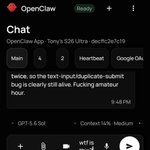
.@openclaw We need a legit text input space. I'm guessing you expect this to be mainly voice interaction, but it's still nice to be able to edit text as well.

"Our models are so dangerous they might wipe out humanity, so let's give them access to a bio-lab!" 🤣
reuters.com/world/anthropic-…

I know AI regulation sounds like a good idea to many. But, it's a sham.
All that regulation will do is prevent public access to the most powerful frontier models.
Labs will keep advancing in back rooms and the military will push labs to keep up with the world arms race. Countries might even sign treaties, but they'll cheat and keep advancing.
And what will they do about open weights models? Have AI police kick down the doors of developers they suspect are creating and training AI models?
Will the FBI monitor GPU usage of cloud providers to find these "criminals"?
Will GPU purchases be regulated like over the counter drugs used to create methamphetamines?
How are they going to regulate this in the practical sense?
I recently switched most of my AI work to OpenAI GPT-5.6, with Sol as my go-to, largely because I became frustrated with a recurring behavior in Claude that I’ve described as appearing “lazy.”
By that, I mean Claude sometimes finds reasons not to proceed, claims work is complete when it isn't, or gives a confident answer without actually checking. Then, when challenged, it may reverse itself.
What's interesting is that Anthropic's own evaluations have names for these behaviors:
• “Misrepresenting work completion”
• “Hallucinated facts,” including inventing details “without checking”
• “Flip-flopping on contradiction”
Anthropic also explicitly gives Claude latitude to refuse. Its Constitution says “declining to proceed” can be appropriate, and some Claude models have been given the ability to end conversations entirely with abusive users.
There's another part of the Constitution that I think is relevant. In cases of apparent conflict, Claude is told to prioritize:
1. Broadly safe
2. Broadly ethical
3. Compliant with Anthropic's guidelines
4. Genuinely helpful
Anthropic says this ordering is holistic rather than absolute, and that conflicts should be uncommon in everyday tasks. Still, “genuinely helpful” is explicitly fourth when those priorities do conflict.
That matters because Claude isn't trained simply to answer the user's request. It is trained to independently judge whether it should proceed at all.
Anthropic's newer evaluations go further. They explicitly test whether Claude pretends to execute code, read files, run shell commands, or query databases, then fabricates results when the necessary tool isn't actually available.
At the same time, Claude's Constitution says it should not be “secretly withholding full effort” and warns that “unhelpfulness is never trivially ‘safe.’”
So when I describe Claude as sometimes appearing “lazy,” I'm probably grouping together several different failure modes. I don't think Claude is literally lazy. But the behaviors I'm reacting to are real enough that Anthropic itself measures them.
For me, this is one of the biggest remaining AI reliability problems:
Don't just give me a plausible answer. Do the work, and be honest about what you actually checked and completed.
Sources:
Claude's Constitution
anthropic.com/constitution?u…
Claude Opus 4.6 System Card
www-cdn.anthropic.com/14e4fb…
Claude Opus 4.8 System Card
www-cdn.anthropic.com/0b4915…
Anthropic: Claude Opus 4 and 4.1 can end a rare subset of conversations
anthropic.com/research/end-s…

Why does Terra get no love? It's it just our nature to be min/maxers and only go with Luna or Sol? @thsottiaux @OpenAI
I’ve been following @unclebobmartin’s AI development journey on X since late last year, waiting for him to explain the whole thing: what he tried, what worked, what failed, and how his process changed.
His interview with @mattpocockuk finally delivered.
What made it valuable wasn’t a polished “AI changed everything” story. Uncle Bob described a workflow that kept evolving as it collided with failure.
His early experience will sound familiar: code arrived quickly, but reviewing and correcting it made him slower overall.
That’s the first lesson: code generation is cheap; judgment is still expensive.
Productivity is the complete loop: intent, generation, inspection, correction, verification, and integration.
Five ideas are directly relevant to the process my team and I are building.
1. Turn important instructions into executable evidence.
Bob found that long instruction documents were treated like suggestions. He shifted toward shorter assignments backed by tests, acceptance scenarios, mutation testing, coverage checks, and dependency rules.
A prompt can ask an agent to follow a standard. A tool can reject work that doesn’t.
Not everything can be automated. Whether the behavior serves the user still requires judgment.
2. Separate responsibilities and contexts.
Bob now uses focused roles: specifier, coder, cleaner, hardener, and QA agent.
I won’t copy that workflow wholesale. The durable insight is that one agent shouldn’t define the problem, implement the answer, critique itself, and declare itself correct.
Focused roles create stronger challenge, but agents inheriting the same assumptions can confidently agree on the same mistake.
3. Use AI to make rigorous feedback affordable.
Mutation testing is a great example. It isn’t new, but its cost often made routine use impractical. Agents can run it, inspect surviving mutants, improve tests, and repeat the loop without consuming the same developer attention.
AI’s greatest engineering value may be making rigorous feedback loops economical, not merely writing code faster.
4. Keep architecture visible and human-accountable.
Bob found that agents could create working software with poor structural boundaries. He built tools to visualize dependencies and enforce rules, but the architecture remained his decision.
Tools can enforce an architecture. They can’t necessarily choose the right one.
Human review may become more targeted toward intent, architecture, risk, and exceptions. That’s a reduced review surface, not the end of human accountability.
5. Plan globally, commit locally, and replan from evidence.
Bob described detailed upfront plans that omitted realities discovered during implementation. Agents followed them until he had to stop and back up.
That doesn’t make planning obsolete. It means speculative detail shouldn’t be mistaken for settled truth.
This overlaps with our process: keep a living implementation plan, execute in phases, and revise upcoming phases as completed work exposes new information.
The model I want to strengthen is:
Global direction.
Local commitment.
Provisional future phases.
Mandatory replanning from evidence.
My biggest takeaway: software-engineering fundamentals aren’t becoming irrelevant because AI can write code. They may be becoming more important.
Agents, prompts, and tools will change quickly. The durable principles won’t:
Make intent explicit.
Bound the work.
Turn expectations into evidence.
Make architecture visible.
Create genuine challenge.
Replan when reality disagrees.
Keep consequential decisions accountable to humans.
I’m not adopting Uncle Bob’s workflow as doctrine. I’m testing its strongest ideas against our real work, measuring the whole loop, and letting evidence change the process.
That was the interview’s real value: not a finished methodology, but disciplined evolution.
Watch the full interview: youtube.com/watch?v=zcLPGC-t…

I found @davidsenra's 2-hour, 23-minute conversation with @tobi about 21 years of building Shopify so densely packed with useful ideas that I asked my OpenClaw agent to turn it into a practical guide for me to study.
The result was too useful to keep to myself, so here's the condensed version.
The through-line: great company building is largely the discipline of refusing inherited assumptions.
Eight ideas worth stealing:
1. When reality changes, rederive the plan.
Plans sit on top of assumptions. If a foundational assumption changes, don't patch the visible tasks. Trace the decision tree back to the broken premise and rebuild everything above it.
2. Don't stop at the first correct answer.
There may be hundreds of workable answers. Require materially different options: the obvious answer, the smallest answer, and one that improves or eliminates another part of the system.
3. Make every "yes" expose its hidden "no."
A decision isn't legible until you can see what it displaces: money, people, time, attention, or another priority.
4. Give adults agency inside bounded boxes.
Define the problem, constraints, decision rights, and phase gates. Then let talented people surprise you instead of prescribing every move.
5. Treat accepted work as part of the commons.
Once work enters the company, it is no longer an extension of its author's identity. Everyone's job is to improve the artifact, not defend the person who made it.
6. Preserve the context around decisions.
"Tobi said" is useless without: When? Under what conditions? Based on which assumptions? What has changed since then?
7. Design the environment, not just the policy.
Repeated "user error" is often a bad affordance. Before adding training, rules, or blame, inspect what the system currently invites people to do.
8. Change your mind when the information changes.
Consistency isn't the job. Steering toward the best available outcome is. Write down what evidence would cause you to update before the decision becomes irreversible.
What surprised me most was how coherent the pieces are. Autonomy needs legibility. Criticism needs psychological framing. Intuition needs earned experience. Difference only matters if it produces mastery. Judgment can be aided by systems, but not replaced by them.
And Tobi's comparison of managing AI agents to playing StarCraft is dead on: split the work, scout constantly, coordinate parallel actors, zoom into the highest-value bottleneck, and keep a critic checking whether the whole thing is still on mission.
The full study guide pulled 40 practical ideas from the conversation and organized them into a two-week practice plan. But the five questions I'd actually keep on a card are:
• Which assumption produced this plan, and is it still true?
• What are three other right answers?
• What does this decision displace?
• Am I protecting the work, or improving the outcome?
• What new information would make me change my mind?
Excellent conversation. Worth the full 2:23:36:
youtube.com/watch?v=ZSM2uFnJ…

If you want real information on what it takes to be wildly successful you need to check out @davidsenra's podcasts. Excellent interviews with some of the world's greatest entrepreneurs.
Many podcasters have interviewed the same people but David's podcast is next level.
The pacing and editing are superb. There's no bullshit small talk or useless tangents--just excellent insights into how these people became successful.
David does his homework and leads the interviews at a lightning pace, putting a laser focus on the best details to dive into.
The @tobi interview is unbelievably packed with valuable insights that you can immediately apply to your profession. The James Dyson and @dhh ones are excellent too. I now have a backlog of others to get through.
Thanks for this excellent content, David! I wish you the best of success.
youtube.com/@davidsenra

Hey @MatthewBerman , have you tried out Buzz yet? Curious about your experience with its ability to chat with multiple agents simultaneously.
C'mon @unclebobmartin , you'll respond to trolls, but you won't tell me if you'll release a video presentation soon on your experience with agentic AI development? Even an article would be great.
.@unclebobmartin, when are you going to give a lecture on your experience developing software with agentic AI tools? I just searched YouTube and there's nothing recent out there with you.
I lead a software engineering team, and many of us are fans of yours. We're doing a lot of our development using AI tools now, and I'm constantly tweaking our processes as we hit limitations and as the tool continue to evolve.
I'd love to be able to discuss your experiences with my team, both positive and negative, i.e., what's working well, initiations you hit, workarounds, etc., but all I have is your posts here, which are helpful to me, but too fragmented to present to my team.
Maybe I can have my OpenClaw agent distill a presentation from your posts in the meantime. 😉