

2019 U.S. Investing Champion (Options) | Grew up poor, quit corporate at 34. Follow to discover how to build wealth & passive income w/ options & index funds.
Idaho, USA
Joined December 2009
- Tweets4.8K
- Following302
- Followers4.4K
- Likes3.8K






Pinned Tweet
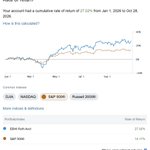
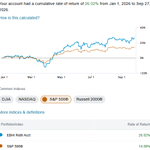
As far as I know, I'm the only person on the planet who can teach people how to achieve these returns while trading only 2 minutes per month and 10 minutes once a year to rebalance the portfolio.

ALT Enhanced buy-and-hold performance as of 10-29-26
Trader Travis Wilkerson retweeted

Thanks Travis. LEAPS are definitely tricky right now, but on core holdings you don't mind owning that can make sense. Very selectively, unlike last year which was a free for all.
Trader Travis Wilkerson retweeted

Today was the worst market decline since the last one you don’t remember or care about anymore.
As I often say, focus on facts, not feelings. Fact: my accounts are down $250k +\- today. Focusing on that fact did not help me 😆. Jokes aside, focusing on the facts below is how I've survived the schizophrenic market for nearly 30 years.


I find attitudes like this extremely common among extremely successful people. Not all successful people, but many of them. 🤔

I paid no attention to the election. Watched exactly 0 minutes of news coverage in the last 2 years. Did the same thing in 2024.
I learned long ago that these elections are meaningless, necessary evils, as if a choice between slicing off my thumb or my big toe is a choice, and that's how this crap works. There is no choice, only the illusion of choice.
Not one politician gives a f*ck about me, so I don't give a f*ck about them. Voting for which deck chair to throw off the Titanic will not stop the inevitable sinking.
In the US, celebrating or mourning political outcomes is fools errand. My life today is exactly the same as yesterday.
Control what you can. Your health. Your family. Your happiness. Your mental sanity. Inviting politics in your life is like inviting in a pack of rabid hyenas in your home... protect your home.
Trader Travis Wilkerson retweeted

If you invested $10,000 in the U.S. stock market 10 years ago you would have $42,043 today.
The same investment made 50 years ago would be worth over $3.7 million.
The magic of compounding, in one chart…

Trader Travis Wilkerson retweeted

"Buy the dip" sounds like great advice.
Until the dip becomes a correction.
And the correction becomes a bear market.
Buying weakness can be a valid strategy.
But without a plan for what happens if prices keep falling, you're not managing risk.
You're hoping.


Trader Travis Wilkerson retweeted
The U.S. stock market has recovered 100% of the time from every pullback, correction, drawdown, bear market, crash, recession, and depression that has ever been thrown at it
Emotionally weak people rarely become massively wealthy in the stock market!
Tip: Cap your losses at a small amount, and you'll be surprised by how gains and strong performance happen automatically.
Handle the current market environment by focusing on facts, not feelings.
Working out will make you "feel" weak, but it's actually making you stronger.
Learning new things will make you "feel" dumb, but it's actually making you smarter.
Enrolling in an options course and investing in yourself will make you "feel" poorer, but it's actually making you rich (assuming you implement what's taught).
Facing your fear and staying invested during a market crash will "feel" terrifying, but it's actually making you braver. Focus on facts, not feelings.
For nearly 30 years, no one has believed me when I tell the truth about what I do. I don't want to manage money; I only want to help others achieve the same. What do you think? Should I accept that the world will never be ready for my truth, or is there something else I should do beyond what I've already done (sharing this secret in my books)?
Trader Travis Wilkerson retweeted

Many investors have no clue about the 2008 crisis.
I didn’t even understand what was happening then, and my mind simply became numb.
Warren Buffett and Howard Marks bought very heavily during that period. It’s not that they knew the future. Their logic was simple: if you buy bargains during a bad period, you create a fortune during a good period.
If it is the end of the world, it doesn’t matter whether you buy or don’t buy. So better to take a chance and buy, because the world comes back from every doomsday scenario.
During bad times, it is difficult to believe that good times will come again.
During good times, we think they will last forever.
The reality is that everything in this world, including markets, is cyclical.
I’m not even asking you to buy anything.
Don’t redeem mutual funds or sell stocks in panic.
Good times will definitely come again. It can take a few months to a few years. No one knows.
But don’t convert paper losses into real losses, thereby completely destroying your capital.
For the record, I'm one of the people who think those ETFs are "trash," but I'm highly biased because my investment approach delivers the same yields as those funds, and my account goes up. A win/win.

People love to trash YieldMax ETFs.
"Your NAV is going to zero!"
"You're just getting your own money back!"
"Those yields aren't sustainable!"
Meanwhile, some investors are using the distributions to pay bills, buy more assets, and build additional income streams.
The critics focus on total return.
The supporters focus on cash flow.
Who's actually right?
And can BOTH sides be right?


Oh wow! How awesome. This pumps me up! Our little secret club of 10-minute investors who beat the market. 😄 Congrats, Tom. I wish you much more success.


Here are my solutions for growing a smaller account. If I have a small account I'm growing, I keep adding money to it until it's bigger. Or I would consider the three approaches below. All are based on the concepts taught in my books, but someone with limited belief wouldn't think of these solutions. A person looking for solutions would.
#1: Buying Shares of SPY (the safest approach): If I had $10,000 or less, I could buy SPY shares and then add money to the account (there is no wealth without savings). Once the account reaches $20,000 to $30,000, I would add a LEAP call to boost profits. As usual, I follow the enhanced buy-and-hold rules for any option I purchase.
Once the account reaches $50,000 to $60,000, I would begin selling SPX credit spreads and add LEAP put insurance to balance the account. This EBHI approach is profiled in the 10-Minute Investing Club (TMIC).
If a person wanted faster growth, they could wait until the account reached $100,000 before adding the put. The downside is that you'll have a wilder ride if the market declines.
#2: Credit Spread Approach: I'd use the $10K account to sell credit spreads on XSP. This approach has two possible paths.
Path #1: I'd follow the 2/10 formula and sell XSP spreads. I would also add money to the account. As every book teaches, adding money to a small account is THE fastest way to grow it. Many ignore this sobering truth and keep struggling to grow their wealth.
Path #2: I could allocate 80% of the account to SPY shares and keep 20% in cash. I would use that cash to cover the margin for the XSP credit spread. In this case, credit spreads replace the LEAP call option as the profit boost. I would also keep adding money to the account (notice the personal contribution theme?).
Once the account reached $20,000, I'd decide whether I preferred the passive EBH call-and-stock approach or the semi-passive SPX credit-spread approach. At $50,000, I could integrate both strategies: EBH and SPX credit spreads.
#3: The Buffett Call option approach: This is profiled in the free public case study. I would buy a LEAP call 10% out of the money (OTM) and 'aggressively' add funds to the account so that, within 6-12 months, the call represents 20-30% of the account's value. I would NOT do this unless I knew for a fact that I could add more funds to the account.
I would also hold off on buying SPY shares until the account is larger. Buying call options and shares with a $10K account will create massive volatility in your portfolio, and I promise you will freak out over the losses and sell everything (ignore my warning at your peril). Or worse, the market will go up, and you will double the account, and the excitement will turn you into a reckless gambler.
***
In summary, these are just a few of the many approaches I can take, but the approaches themselves are irrelevant. Your mindset is more important. A millionaire shared this helpful advice with me years ago: "To a person committed to finding solutions, obstacles become irrelevant."
I'm not saying that overcoming the obstacle of growing a small account is easy, but it is doable. Hard does not mean impossible.
Disclaimer: As usual, none of this constitutes financial advice. It is for educational and informational purposes only. I am showing what I would do if I started with $10,000. If you follow the same path, you do so at your own risk. You are solely responsible for your trading results.
It's awesome seeing my son @DJW2028 do well at football, seeing that his dad is a money nerd and I'm completely clueless about football. 😆 I didn't know how good he was until a commenter told me 🤦🏾♂️.

ALT DJ Wilkerson is the player of the game.
I taught him how to invest because if his football dreams come true, I want him to be a good steward of his blessings.

Started investing at a young age. My dad @tradertravis taught me how to trade options.
- Got an at home job to make $
- Funded my own investment account
- Let my profits keep coming in until I could buy my first car — paid in cash
- I Still manage my portfolio & use profits for the things I want.
