

Natural Language Processing research group at The University of Illinois Urbana-Champaign @IllinoisCS @UofIllinois
Joined July 2019
- Tweets682
- Following150
- Followers1.4K
- Likes1.6K






Congratulations to the StudentSim team on their 🌟 Spotlight selection at the UserSim Workshop @ NeurIPS 2026!

Happy to share that our StudentSim paper has been selected for a 🌟 Spotlight presentation at the UserSim Workshop @ NeurIPS 2026 in Paris!
Many thanks to my collaborators and advisors for their support!
📄 Paper: arxiv.org/abs/2609.01591
💻 Code: github.com/microsoft/Student…

1
4
385
Make sure to check out these amazing papers at EMNLP 2026!
Congratulations to all the authors! 🎉


1
12
686
Check out what @shuhaibmehri was up to during his internship @MSFTResearch!
Really exciting work on improving user simulation fidelity 🚀


Thrilled to see Microsoft Research feature this collaborative work! 🎉
Since its release, StudentSim has sparked interest across education, recommendation, healthcare, and finance.
This highlights the growing potential of user simulation as a foundation for personalized AI.
Grateful to Microsoft Research for featuring our work, StudentSim!
Since its release, we've been amazed by the attention it has received, not only from the education community, where professors have called it "the very first foundational work in this area" and shared that they'd envisioned this direction long before data and training made it possible, but also from researchers and project leads working on user simulation in recommender systems, healthcare, and financial services.
It's exciting to see a shared recognition of the importance and potential of user simulation for personalized AI services.
Hope StudentSim can be a useful stepping stone for the community!
2
411
Congratulations to Nguyen! 🎊
Check out PSI-Bench! 👇

PSI-Bench won the best paper award at Social Simulation with LLMs workshop at @COLM_conf !
We introduce a framework for interpretable and clinically meaningful evaluation of depression patient simulators. Read more: arxiv.org/abs/2604.25840

6
361
We believe this is still not the final map of the area. But we are happy to see if it helps people find a question worth working on, or shows them where to disagree.
Proactive AI for Superintelligent Agents
In 1995, Wooldridge and Jennings listed proactiveness among the basic properties of intelligent agents.
31 years later, our agents can reason, code, and run complex workflows. Yet someone still has to notice the work and tell them to start.
We think this is a major gap.
1/7
It's easy to miss the problem when agents are judged on a task they've already been given.
A long open-ended project is different. Instructions are incomplete, plans fail, priorities change. Humans still decide what to investigate and when to change course.
That won't scale forever.
2/7
There's also a product shift underway.
Meta's Muse and OpenAI's dots both point toward proactive agents that keep track of goals, anticipate needs, and work beyond a single chat session.
We expect users to ask less often for individual tasks and more often for continuing progress.
3/7
Proactiveness isn't a new idea.
Relevant work spans agent theory, planning, HCI, robotics, ubiquitous computing, and LLM agents. Communities have developed different terms and benchmarks for related problems.
It's surprisingly hard to get a clear picture of the field.
4/7
We felt this was a good moment to put those threads together.
23 of us from UIUC, Google, Stanford, UC Berkeley, and CMU worked on a survey, with backgrounds spanning agents, robotics, retrieval, computational biology, and finance.
5/7
We tried to write it differently from a bibliography dump.
Chapters were drafted by people closest to the topic, then discussed and revised across backgrounds. When searching for papers is becoming cheap, the harder work is deciding which connections are meaningful.
6/7
The resulting survey organizes proactive agents around 6 capacities: awareness, anticipation, agenda formation, arbitration, action, and adaptation.
We also review evaluation at three levels and compare initiative with action authority across 13 domains.
7/7
We don't expect this to be the final map of the area. We'd be happy if it helps people find a question worth working on, or shows them where to disagree with us.
Proactive AI for Superintelligent Agents
empathyang.github.io/Proacti…
research.google/pubs/proacti…
#ai #agent #survey #uiuc #google #stanford #ucb #cmu

241
A must-read survey on Proactive AI Agents! 🚀 A timely collaboration from UIUC, Google, Stanford, UC Berkeley, and CMU. Check it out before it’s too late!
🤔 AI agents can do a lot once you give them a task. Can they also figure out what’s worth doing and get started before being asked?
🏫 That’s the question behind Proactive AI for Superintelligent Agents, our joint survey by researchers from UIUC, Google, Stanford, UC Berkeley, and CMU. Our backgrounds span AI agents, embodied AI, information retrieval, computational biology, economics, and finance.
🕵 As finding papers gets cheaper, we think a survey’s value increasingly comes from hard-earned research intuition: knowing what matters and what to try next. Contributors drafted the sections closest to their own research, then refined them through several rounds of discussion and revision across research backgrounds.
📃 Paper: empathyang.github.io/Proacti…
🌎 Website: empathyang.github.io/Proacti…
💼 Google Research: research.google/pubs/proacti…
More in the video below 👇
6
520
Can a tiny text edit redirect a robot’s trajectory?
New work from UIUC researchers shows how subtle changes to text instructions can steer robot foundation model outcomes toward an attacker’s goal, without naming that goal.
Congratulations on their #CoRL2026 acceptance! 🎉

Paper accepted at #CoRL2026!! We study how language perturbations propagate through closed-loop VLA control and uncover a new attack!
Work done in collaboration with: @Vardhan_Dongre , @pthangeda_ , Hooshang Nayyeri, @dilekhakkanitur , Melkior Ornik
TL;DR: we introduce a new VLA attack where tiny, meaning-preserving edits can redirect the robot’s entire closed-loop behavior toward an adversary-chosen goal—without ever stating that goal in the prompt!🧵 (1/9)
📄 arxiv.org/abs/2606.12978
🌐 vla-redirection-attack.githu…
💻 github.com/vla-redirection-a…

5
562


Congratulations @hengjinlp for being selected as an ACL Fellow!
You’re unable to view this post because this account owner limits who can view their posts. Learn more
3
793

Live demo for LM-Steer is up! Feel free to check it out 🙌

🎮 Check out the live demo for LM-Steer “Word Embeddings Are Steers for LMs” (Outstanding Paper ACL 2024) at huggingface.co/spaces/Glacio…, which can:
1.🕹️Steer model generation
2.🔬Discover word embedding dimensions
3.📊Profile sentences & identify keywords
#ACL2024 #LLMs #Science4LM


6
470
Calling for submission to our AI4Research Workshop at AAAI!📚🔬🧪

We're open to all relevant studies. We have a thrilling dataset & evaluation track. See the website for more details! twtr.to/_sqcK
We will also feature amazing keynote speakers @WeiWang1973 @hengjinlp @_DougDowney @aviadlevis and more.
It’s happening today at 3:30 pm CT!

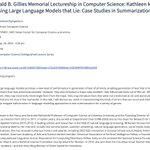
Excited to announce Prof. Kathleen McKeown from @Columbia will be giving a Donald B. Gillies Memorial Lecture "Addressing Large Language Models that Lie: Case Studies in Summarization". Join us next Wed at 3:30 pm CT online or in person at SC 2405!
🔗: calendars.illinois.edu/detai…

Excited to announce Prof. Kathleen McKeown from @Columbia will be giving a Donald B. Gillies Memorial Lecture "Addressing Large Language Models that Lie: Case Studies in Summarization". Join us next Wed at 3:30 pm CT online or in person at SC 2405!
🔗: calendars.illinois.edu/detai…
📢 Join us for a colloquium by @feifeiM on how content creators' competition impacts user welfare and recommendation dynamics. Learn about theoretical insights and models shedding light on these questions. Feb 5th, 3:30 pm CST in SC 2405 or online. Hosted by @IllinoisCS.
1/3

Detailed information about the colloquium can be found on our webpage.
💻: calendars.illinois.edu/detai…
3/3
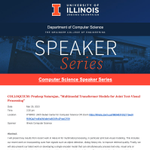
Our upcoming CS colloquium will feature an exciting talk by Pradeep Natarajan on "Multimodal Transformer Models for Joint Text-Visual Processing". Join us next Wednesday (March 29, 2023) at 3:30 pm CT in person at SC2405 or online via Zoom.
🔗: calendars.illinois.edu/detai…

We're excited to host @gneubig at our next CS colloquium, where he will talk about "Is My NLP Model Working? The Answer is Harder Than You Think". Join us next Monday at 3:30 pm CT in person at SC2405 or online via Zoom!
#NLProc
🔗: calendars.illinois.edu/detai…

For our next CS colloquium, We are excited to host @boydgraber to talk about "If We Want AI to be Interpretable, We Need to Measure Interpretability". Join us today at 3:30 pm CT at SC2405 or over zoom! #NLProc
calendars.illinois.edu/detai…
