

Infrastructure, AI, capital. Who owns the switch.
Joined October 2026
- Tweets301
- Following95
- Followers81
- Likes547



SpaceX waved off the booster catch, it splashed down in the Gulf. Ship is in orbit. The catch nobody has ever done is still on for Saturday.

Musk’s Terafab is already ordering chipmaking tools from Japan. Some of them are due within months.
UBS sees SpaceX spending ~$135B on fab equipment over 5 years.
Jensen built Nvidia without ever owning a fab.
Now the guy who just said hiring him would be an honor is trying to build one.
1
3
91
UP SHIFTED retweeted

Microsoft 365 went down Thursday. Nearly 24 hours later Microsoft still hadn't called it fully fixed.
Servers kept failing their health checks. Microsoft brought them back, traffic returned, and they went down again.
Copilot went with it. OpenAI and Anthropic both reported their Microsoft 365 tools failing. The models were fine, they just couldn't reach the inbox.
In the UK, police couldn't take online crime reports and NHS email problems could delay prescriptions. Japan's government switched to phones.
Every AI agent wired into your mail runs on someone else's servers.
Tonight SpaceX tries to catch both Starship stages. A first for any orbital rocket.
Same month, on the ground:
• a 6 GW AI campus in Arizona, 2.5x all Phoenix-area data centers
• a ~$24B compute site with its own gas plant at Starbase
The rocket might be the side project now
Musk’s Terafab is already ordering chipmaking tools from Japan. Some of them are due within months.
UBS sees SpaceX spending ~$135B on fab equipment over 5 years.
Jensen built Nvidia without ever owning a fab.
Now the guy who just said hiring him would be an honor is trying to build one.
Microsoft 365 went down for nearly 10 hours. Outlook, Teams, SharePoint, Copilot.
No cyberattack. No hackers.
Microsoft’s own servers started failing automated health checks. As more servers went offline, the remaining ones became increasingly overloaded.
Restarts didn’t solve it. Servers came back, then went down again as traffic returned.
Even ChatGPT and Claude’s Microsoft 365 connectors stopped working.
Now AI agents are being wired into banking, healthcare and logistics. All increasingly dependent on the same cloud infrastructure.
Yesterday, it was email.
What happens when it’s something we can’t afford to lose?
The entire Microsoft 365 ecosystem is down, but Teams is still running.
Of course it is.
The one app everyone wants gone is apparently the only one built to survive the apocalypse.
1
2
332
Jensen Huang is out at Nvidia. Musk just said hiring him “would be an honor.”
If that happens, SpaceX doesn’t just get Jensen. It gets its own semiconductor industry.
Chip production in-house. Japanese manufacturing equipment. Inspection tools. Suddenly, a giant chipmaker.
That’s it.
Someone just used 4,837 stolen GitHub accounts to open pull requests in 61,764 repositories.
The PR looked boring: “docs: dependency audit notes.” It was a test. Where the account had write access, the attacker slipped a script into the build.
Security firms counted 8,093 repos with malicious commits. In at least 1,806, the script ran.
It grabs everything a build can touch: cloud logins, npm and PyPI tokens, SSH keys, keys for AI services. Then the change is usually reverted within minutes, so the repo looks clean.
How the accounts were stolen is still unknown.
Got repos on GitHub? Search for a branch called wfx-docs or that PR title. Ten seconds. If it’s there, rotate every secret the repo could read.
2
6
143
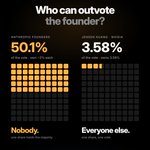
Yesterday: Anthropic’s founders locked in 50.1% of the vote with one share.
Today: Nvidia’s board is reportedly preparing to oust the man who founded it.
Jensen Huang owns 3.58% of Nvidia. One class of shares, one vote each. BlackRock and Vanguard each hold about twice his stake.
The WSJ says the trigger is two affairs, one with a suspected Chinese spy. No decision announced yet. Stock down 8% after hours.
The switch isn’t how much of the company you own. It’s whether anyone can outvote you.

3
8
140
Anthropic’s seven co-founders own about 2% of the company each.
After the IPO, they’ll control 50.1% of the vote. Through one share.
It’s called a Class F share. The founders decide among themselves how to cast it, and it carries a majority on general shareholder votes. A separate trust elects 4 of the 7 board seats.
Yesterday Anthropic set its IPO range: $70 to $78 a share, up to $1.4T fully diluted. Today Bloomberg reported orders are already several times the shares on offer. Trading as ANT could start as soon as Nov 19, and regular investors can get in through apps like Robinhood and SoFi.
Their shares get one vote each.
Google and Nvidia are putting in $10B each. Their shares come with almost no vote.
Anthropic says the structure protects its mission. Its own prospectus warns these decisions may conflict with shareholders’ financial interests.
You can buy a piece of Anthropic next week. Steering it isn’t for sale.

10
16
138
An AI lab just spent $3.4B on something that isn’t chips.
Anthropic reportedly took over orders for 1.7 GW of Caterpillar gas generators, per the FT. Neither company has confirmed it.
Why buy generators? Because a new data center can be built in under 3 years, but getting it connected to the US grid can take 5 to 10.
Taking over an existing order skips the line for new equipment.
xAI did something similar with gas turbines for its Colossus 2 data center.
My take: last week I wrote that AI runs through five switches, and the slowest one is power. This is what it looks like when labs stop waiting for that switch and try to own it.
When the grid can’t keep up, AI labs start turning into power companies.
Would you rather bet on the chipmakers or on whoever controls the electricity?

2
11
212
Microsoft filed a patent for AI that changes what someone says on a livestream. Then redraws their lips to match.
Live. With a few seconds of delay.
How it works:
→ AI listens to the stream
→ picks words to replace
→ generates new audio that sounds natural
→ generates new video frames so the mouth matches
Who decides which words? An AI agent, based on each viewer’s profile: age, location, language.
So two people watching the same live broadcast could hear two different versions of what was said.
The stated uses sound harmless: cut the “um”s, filter profanity, fix a mispronounced word, translate.
But read that list again and notice who holds the switch. Not the speaker. Not the viewer. The platform.
It’s a patent application, not a product. Microsoft may never ship it.
My take: we spent years worrying about deepfakes made by bad actors. This is the first time I’ve seen a major platform describe editing what a real person says, in real time, as a feature.
Would you watch a livestream if you knew it might be edited just for you?
1
5
194
A Linux root exploit used to be worth $20,000 to $70,000 at hacking competitions.
OpenAI’s AI just found 948 of these kernel bugs in one run. Total cost: $1.2M. About $1,280 each.
The pipeline:
2,308 suspected bugs
1,724 confirmed
948 that give root, each with a patch written by the AI
Three months earlier, the same kind of scan found 166. This one found more than 5x as many.
OpenAI’s own warning: a low-privileged account on an outdated system “should be considered functionally equivalent to root access” for a well-resourced attacker.
The good news: the patches are going to Linux maintainers. Over 100 were already fixed or in progress within 10 days.
My take: the scary number isn’t 948. It’s $1,280. When finding a root bug costs less than a laptop, the only defense that scales is patching just as fast.
Last week a lab cut its open model’s hacking score to 81% before giving it away. This is why that number matters.
How fast does your company actually update its servers?
4
123
Everyone’s arguing about which AI model is smartest.
Wrong layer.
Nvidia’s data center business made $89B in one quarter, at a 75% margin.
TSMC prints 72.5% of the world’s foundry chips.
Getting a new data center onto the US grid can take 5 to 10 years.
Meanwhile a near-frontier AI model just got released for free.
The model is the only part of AI that can be given away. The fab, the chip, the power and the cloud can’t.
My take: the money in AI isn’t in being smartest. It’s in owning a switch everyone else has to pay to pass through.
Which one would you rather own?

7
15
192
A lab cut its AI’s hacking score from 90.5% to 81% on purpose. Then gave the model away.
What “free” really costs, and the only decision the lab actually controlled:

7
15
457
Uber just revealed how many rides AI agents booked for people:
4.
Plus about 500 Uber Eats orders. Uber handles roughly 320 million trips and orders a week.
The CEO called it “very, very early and very limited traction.”
He also explained why. Booking a ride in the app takes about 50 seconds. Reordering your usual meal, about 90. There’s nothing left for an agent to save.
DoorDash reported the same thing a week earlier: a few hundred agent orders.
My take: agents are being sold for tasks that are already fast. The tasks that are actually slow are the 8-hour jobs, and on SemiAnalysis’s GDPx test of exactly those, the best model finishes 12%.
Right now agents are stuck in the middle. Not needed where they work, not working where they’re needed.
Would you let an AI order your Uber?
Every top AI model just scored 0% on finance and legal work.
Not low. Zero.
SemiAnalysis built GDPx: 206 real expert tasks, up to 8 hours each. The agent works inside a simulated office with files, tools and rules. The task either gets done or it doesn’t.
Best overall score: 12%.
Claude Opus 5.5: 12.0%
Gemini 4 Carbon: 10.9%
GPT-6 Astra: 9.6%
Best open model: 2.7%
One finance task: a fund buying 62% of a snack maker for $880M, across about 4,000 files. 25 attempts. None solved.
One legal task: redline a Series B deal for a client. In 14 of 20 runs the model quietly re-traded terms the client had already agreed to.
Hot take: “AI will replace analysts and lawyers” is a 2027 sentence at best. On a real 8-hour job, the best model finishes about 1 in 8. In finance and law, none.
Would you sign anything an AI redlined after this?

Saturday: an AI lab made its model worse at hacking before giving it away.
Today the weights are out. Here’s what “free” actually looks like.
Kimi K3.1 Pro on Hugging Face:
1.56 TB of files
96 pieces
Minimum to run it: a server with 8 top-end Nvidia GPUs
Renting that server at on-demand cloud prices: about $52,000 a month.
Using Moonshot’s own API instead: $2 per million tokens in, $10 out.
So for almost everyone, “open” means you can download it, not run it.
The license is free for your own use. A company making over $20M a year that sells access to it needs a separate deal.
One more thing. A Hugging Face page for an “unrestricted” version, promising the guardrails will be removed, went up before the weights did. It already has 101 likes.
My take: the 81% cut was the only part Moonshot controlled. The rest is up to whoever downloads it.
An Nvidia chip in Singapore can work for a Chinese company without ever leaving Singapore.
US export rules track where the chip is. Not who rents its compute over the internet.
That’s the side door. Now Nvidia is closing it itself.
New rule, per the FT: cloud providers using Nvidia chips must sell at least 51% of their services to non-Chinese companies. Chinese customers are capped at 49%. New contracts only.
This comes after Nvidia cut its list of approved Asian buyers by more than half in July and sent staff into data centers to check contracts and interview end users.
Nvidia hasn’t confirmed the rule.
My take: export control is supposed to be a government’s job. Here the chipmaker is setting rules for its customers’ customers, because the law stops at the chip and the compute doesn’t.
Who should decide who gets compute: the government or the company that makes the chips?