





Pinned Tweet
In 2014, a naturalist and two historians posited a theory about a major zoological motif of the Indian subcontinent.
....that the Lion was a exotic alien brought to India around the time of Alexander's invasion over the Iranian Plateau.
They published a book about it.

Some followers have expressed the impracticality of attaching tiny bells to weapons. Animal hunts and chases lasted for as long as a week when the prey was injured non-fatally. Bands of hunters on foot chased the quarry. Blood trails and scents were the primary markers for hunting dogs. The weapon was designed to stay stuck in the body, emit sound or leak more blood. The harpoon (vajra) did all three in tandem.

share.google/pjKmeu9s0uG6enV…
Looks similar to the ones used in Palnati yuddham (this pic shows bells too)

1
6
329
Hunting dogs are often chained with bells for the same reason.
huntingpup.com/reasonforbell…

70


Ugra retweeted

A man from eastern Tajikistan split the famous Ashkenazi Levite line, R-Y2619.
That means 9% of Ashkenazi men share a direct *Iranian* male ancestor with this man from Badakhshan, around 2,500 years ago.
The final result is here, and so is our writeup.
jewishgeneticdiscovery.subst…

This is a stellar example of a Type II harpoon with an eyelet visible on the lower half (right-bottom). A string was threaded through the eyelet to trace the wounded animal as it sped through the jungle's undergrowth. A bell or a plank was tied to sound hunters and to slow down the animal. This is significant as we know of only one Vedic weapon whose iconography includes a "strange" bell whose meaning evades modern viewers.


Detail about the Rohingya formation date - about which some followers had questions. Clearly it is not dating to the colonial period.

After settling in the Arakan (Rakhine) region, they received local gene flow from surrounding Tibeto-Burman-speaking groups.
Result: clearly elevated East Eurasian ancestry compared with neighbouring Bangladeshi populations. Admixture dates more recently (~700–970 years ago).

10
556


Ugra retweeted

The new paper provides a smoking gun for the mid-5th c. BC events: an individual (bah010) with both steppe ancestry and an IBD link to the Volga in Central Anatolia.
This is direct evidence for the predicted southward migration from the Caucasus-Lower Volga and...
We have a new sample (count of one) in Chalcolithic Anatolia that has Steppes ancestry (female mediated?) and apparently the Proto-Indo-Anatolian question is now being settled. Another low bar record set for expectations!

The year 1754 is when flintlocks started to replace matchlocks in South India, a trend accelerated by Anglo-French wars. Everywhere at once, the strategists of small kingdoms began to adopt the superior one. Except for the large, clumsy inland Empire in the North.
You’re unable to view this Post because this account owner limits who can view their Posts. Learn more
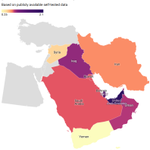
The ME distribution of the Indian origin y-haplogroup R1a-L657. The formation was in the Bronze Age (2000 BCE or older) when the primary Culture was the Indus Valley Civilization. Finds of IVC artifacts dovetail with modern L657 intensities in UAE, Qatar, Iraq & Oman. The outlier is Iran, despite proximity to the Indian subcontinent.

Ugra retweeted

The Bronze Age collapse was catastrophic
Here's something on the link between the Sea peoples, a global megadrought, and the oldest workers' strike in history


The “Sea Peoples” of Ancient Egypt and the Medieval East African Coast.
africanhistoryextra.com/p/th…

The Neolithic and BA sedentarism of IA branches come across strongly in this etymology. The Araṇya-Kāṇḍa of Ramayana is a survival story. Banished from the city to near-certain death. In 2000 BCE, outside cities and villages, roughly half a million tigers lived.


