

Welcome to the X page of https://xitter.gq/t.co/qT49TKsP7T, an online platform dedicated to the exploration of a vast and mysterious #universe. #astronomy #space #science
Poland
Joined May 2026
- Tweets3.2K
- Following71
- Followers317
- Likes4.8K








Pinned Tweet
JUST IN: SpaceX’s Cargo Dragon departs from the International Space Station
After riding out weather delays on the California recovery zone, SpaceX’s Cargo Dragon departed the ISS today at 12:05 p.m. EST, setting up a Saturday afternoon Pacific splashdown (4:55 p.m. EST) following its mid-October arrival.
Unlike expendable cargo vehicles that burn up in the atmosphere, Dragon’s downmass capability turns Low Earth Orbit into a genuine round-trip lab: bringing back sensitive biological tissues (3D-bioprinted vessels and tumor organoids), frozen microbes, and long-duration hardware for hands-on terrestrial analysis.
Reliable downmass is one of the hardest parts of orbital infrastructure and CRS-35 is executing another clean return cycle.
🤖 Made with AI

BREAKING: Canadian defense startups move to cut Arctic military reliance on Starlink
Canada is stepping up efforts to reduce military dependence on Starlink in the Arctic, with Dominion Dynamics (@DominionDynamic) signing a $2.2 million agreement with Telesat to develop Arctic-ready satellite terminals for field troops and its Scout uncrewed combat aircraft.
Driven by Prime Minister Mark Carney’s push toward network sovereignty and concerns over single-provider reliance in conflict zones, the effort targets future use across Arctic defense, the Coast Guard, and emergency response.
Yet the underlying space-logistics equation remains tight: Telesat Lightspeed is still years away from full operational scale, Telesat faces major legacy debt maturities, and SpaceX remains a critical launch partner to get competing LEO hardware into orbit.


38
SpaceX ( $SPCX ) Stock Snapshot: Nov 21, 2026
📉 Currently at $127.79: down 7.69% today and 5.3% below its $135 IPO price, with a market cap of $1.74 trillion. The 52-week range shows just how volatile this stock has been: from $104.83 all the way up to $225.64.
📈 Analysts see massive upside ahead: average target is $243.60 (+91%), with the most bullish call at $500 per share.

12 hours and 10 minutes.
One single shot of the Soul Nebula - a vast stellar nursery 6,500 light‑years away, where new stars are being born right now.
It’s breathtaking to realize every delicate filament and glowing cloud represents light that began its journey before we were even here.
The universe truly showing off ✨
Image by @AstroTanja, absolute masterclass in astrophotography!


59
Falcon 9 Launches USSF-317 on Booster B1100's Record 11th Flight
SpaceX successfully launched the classified USSF-317 mission for the U.S. Space Force early Saturday morning, November 21, 2026. Liftoff occurred at 4:22 a.m. PST (12:22 UTC) from Space Launch Complex 4-East (SLC-4E) at Vandenberg Space Force Base in California.
What makes this flight particularly remarkable is the first-stage booster, B1100, completing its 11th mission to orbit and back. This Falcon 9 booster, identifiable by its distinctive "100" livery in place of the usual serial number, has become one of the most frequently flown rockets in history. Following stage separation, the booster successfully touched down on SpaceX's Pacific Ocean droneship Of Course I Still Love You, marking yet another precision recovery at sea.
The USSF-317 payload remains classified, with SpaceX providing no additional details on the spacecraft's identity or mission objectives, which is a standard practice for national security space launches . Both fairing halves were also recovered and will be reused on future missions.
This launch underscores the incredible operational maturity SpaceX has achieved with Falcon 9. Where rockets were once discarded after a single use, boosters like B1100 now routinely fly half a dozen missions or more, drastically reducing launch costs and increasing access to space. With turnaround times shrinking and flight counts climbing into the double digits, the era of fully reusable spaceflight is no longer just a concept - it's now a daily reality.

1
73
8 years. 10 billion kilometers. 9 planetary flybys.
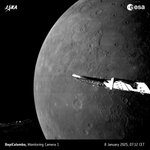
TOMORROW, HUMANITY RETURNS TO MERCURY
After an eight-year, nearly 10-billion-kilometer journey through the inner Solar System, the joint ESA/JAXA BepiColombo mission enters orbit around Mercury tomorrow, November 21.
Reaching Mercury is one of the toughest orbital mechanics problems in spaceflight, because a spacecraft has to constantly brake against the Sun's immense gravitational pull, BepiColombo needed nine planetary gravity assists across Earth, Venus, and Mercury just to slow down enough for capture.
Once captured, the stacked spacecraft will separate into two dedicated probes in December, ESA's Mercury Planetary Orbiter (MPO) and JAXA's Mio, to simultaneously study Mercury's mysterious magnetic field, exosphere, and permanently shadowed polar craters starting in April 2027.

ARTEMIS II CREW IN LINE FOR CONGRESSIONAL GOLD MEDALS.
The House Problem Solvers Caucus, co-chaired by Reps. Tom Suozzi and Brian Fitzpatrick, just endorsed the Artemis II Congressional Gold Medal Act (H.R. 9417), moving Congress's highest civilian honor closer to the crew that flew humanity's first lunar mission in over half a century.
Led in the House by Reps. Don Bacon and Salud Carbajal, the bipartisan bill honors Commander Reid Wiseman, Pilot Victor Glover, and Mission Specialists Christina Koch and Jeremy Hansen after they pushed the human distance record from Earth to roughly 252,756 miles and circled the Moon for the first time in 53 years.
With bipartisan caucus backing now locked in, H.R. 9417 gains fresh legislative momentum on Capitol Hill as lawmakers move to formally recognize the crew's deep-space milestone and renew the Apollo-to-Artemis torch.

137
BREAKING: 12 SPECKS OF DUST JUST PROVED AN ANCIENT WATER RESERVOIR BEYOND NEPTUNE.
NASA and UCLA researchers just published new findings in Science Advances ("A Primordial Heavy Water Reservoir in the Outer Solar System") confirming a long-suspected reservoir of ancient water ice out in the Kuiper Belt.
The team examined just 12 microscopic interplanetary dust particles, each thinner than a human hair, collected from Earth's stratosphere by NASA's ER-2 high-altitude aircraft. High densities of solar energetic particle tracks pointed to a Kuiper Belt origin, while electron microscopy at NASA Johnson Space Center and ion microprobe analysis at UCLA revealed water-altered minerals strongly depleted in oxygen-16 (a heavier oxygen isotope signature).
That isotopic signature is largely absent in inner-system meteorites. Growing giant planets, such as Saturn's early disk pressure barrier, likely kept much of this outer water-rich material from migrating inward, showing early solar system water wasn't uniformly mixed.

☕️ Morning Orbital Briefing | November 20, 2026:
1️⃣ Deep Space Relay: Voyager 1 continues pushing past the 1-light-day threshold from Earth. Signals take roughly a full day each way, so a round-trip exchange spans two days before telemetry returns.
2️⃣ Post-Splashdown Science: Following CRS-35's departure from the ISS and splashdown off California, research teams are receiving the 3D-bioprinted blood vessel construct, frozen tumor organoids, and antibiotic-resistant microbes for post-flight analysis.
3️⃣ Solar Activity Watch: Active regions on the Sun remain elevated after recent flaring and a rise in sunspot counts, keeping geomagnetic conditions unsettled following recent storm activity.
4️⃣ SpaceX Pad Turnaround: Following a Thursday night scrub, SpaceX is targeting tonight for Falcon 9 to launch the classified USSF-317 mission from Vandenberg's SLC-4E during a window opening at 6:32 pm PST (9:32 pm EST / 02:32 UTC Nov 21), kicking off a back-to-back West Coast weekend ahead of NROL-136 early Saturday morning at 4:30 am PST (12:30 UTC).
#OrbitalBriefing

1
1
99
ESA JUST GREENLIT A SEVEN-SPACECRAFT PLASMA HUNTER
In a major move to secure leadership in heliophysics, European Space Agency Member States have officially selected the Plasma Observatory as ESA’s next medium-class (M-class) science mission. This ambitious project will tackle one of the most complex challenges in space science: understanding exactly how solar energy is transferred from the solar wind into Earth’s near-space environment to drive violent space weather.
Unlike traditional missions that rely on a single, monolithic spacecraft to gather data, the Plasma Observatory is designed as a revolutionary multi-point observatory. It will deploy a swarm of seven highly coordinated spacecraft that fly in precise formation, acting as a dynamic, three-dimensional sensor web. This architecture allows scientists to map plasma dynamics simultaneously across multiple spatial and temporal scales for the very first time, separating rapid time variations from true spatial gradients within the plasma.
This unprecedented capability is critical because space weather phenomena, such as magnetic reconnection and plasma turbulence, do not occur at just one scale. By using a seven-probe swarm, the mission will provide the high-definition data needed to fundamentally improve our space weather models. This will lead to much sharper warnings for critical infrastructure, including satellites, power grids, and global communication networks, which are vulnerable to geomagnetic storms.
The selection of the Plasma Observatory solidifies ESA’s commitment to next-wave science, placing it on the fast track for development alongside other flagship studies. Europe is betting big that distributed, multi-point spacecraft swarms are the key to finally decoding the volatile, invisible plasma boundary between the Sun and Earth.

100
STARSHIP 16 IS ABOUT TO BLOW THE SPACE INDUSTRY WIDE OPEN! Florida LC‑39A Launch - 52 Starlink V3 Satellites - DOUBLE‑CATCH DREAM!
The space community is exploding over the viral Starlink G30‑1 / Starship Flight 16 mission leak! If this mission plays out exactly as the tracking post predicts, we are witnessing the birth of the true Starship‑era Starlink constellation buildout.
Imagine this scene: Starship blasts off from legendary LC‑39A at Kennedy Space Center, carrying 52 Starlink V3 satellites, therefore DOUBLE the payload of Flight 14 and Flight 15! That’s the equivalent of roughly 20 Falcon 9 Starlink launches packed into one single Starship launch! The Super Heavy booster gets snatched by the LC‑39A Mechazilla chopsticks right back at the Florida launch pad, while the Starship upper stage spends 8‑9 hours in orbit, completing 5‑6 orbits deploying the full Starlink payload, then flies all the way back across the country for a tower catch at Starbase, Texas.
Flight 15 already delivered the historic first‑ever Starship ship‑catch, proving the tower‑recovery concept works.
Now Starship 16 is poised to take that breakthrough to the next level, turning Starship from a test‑flight vehicle into the primary engine expanding Starlink’s global internet coverage faster than humanity ever thought possible!
Launching from LC‑39A also unlocks a second major Starship launch site, smashing the bottleneck at Starbase and sending Starlink deployment cadence into overdrive.

1
208
Two 23m Large-Sized Telescopes Headed to CTAO-South in Chile
Major astrophysics infrastructure update from Chile: ESO announced today that two 23-metre Large-Sized Telescopes (LSTs) are officially joining the Cherenkov Telescope Array Observatory's southern site (CTAO-South) at Paranal.
Coordinated by Italy's INAF and INFN alongside the international CTAO LST Collaboration, on-site preparations are already underway with foundation construction scheduled to finish by the end of the year.
Unlike optical telescopes, LSTs capture brief nanosecond flashes of Cherenkov radiation produced when high-energy gamma rays collide with Earth's upper atmosphere.
Because these massive dishes can reposition in roughly 20 seconds, they can lock onto transient events like gamma-ray bursts and flaring supermassive black holes almost instantaneously, pushing our view of the extreme universe further than ever before.

116
☕️ Morning Orbital Briefing | November 19 2026:
1️⃣ Dragon CRS‑35 ISS Return
Delay: NASA + SpaceX stood down Wednesday undocking due to bad splashdown‑site weather; next undocking window 12:05 PM EST today, splashdown timing still pending weather review. Dragon carries 3D‑bioprinted‑blood‑vessel construct, tumor organoids, antibiotic‑resistant microbes and ISS science samples back to Earth
2️⃣ Voyager 1 One‑Light‑Day
Milestone: Humanity’s farthest probe hit the one‑light‑day boundary; a signal sent now takes 24 hours one‑way between Earth & Voyager 1, JPL milestone briefing coverage continues
3️⃣ Falcon 9 USSF‑317 Targeting
Today: SpaceX Falcon 9 targeting launch Vandenberg SLC‑4E 18:46 PST / 21:46 EST; booster 11th flight, OCISLY droneship landing, backup Nov 20
4️⃣ Long‑March‑2D Shijian‑24 Success: Long‑March‑2D successfully placed Shijian‑24 satellite into orbit overnight; full operational mission details still unconfirmed
5️⃣ Amazon Leo Comeback Ride:
After Vulcan lost 40 Amazon Leo satellites, next Leo batch still targeting Ariane 64 LE‑04 no earlier than Nov 23 11:09 UTC Kourou
6️⃣ Solar Watch: Continuing solar‑flare & geomagnetic‑field monitoring; follow NOAA Space Weather for real‑time Kp‑index and flare alerts
#OrbitalBriefing

BREAKING: China’s Long‑March‑2D rocket has successfully launched the Shijian‑24 satellite from the Taiyuan Satellite Launch Center, placing it into its planned orbit!
This is the 678th flight of the Long March rocket family and the 84th Chinese space mission of 2026.
Official sources have not fully detailed the specific operational mission of Shijian‑24, marking another busy day for global space‑launch activity alongside Falcon 9 USSF‑317 and Dragon CRS‑34 recovery operations.

1
131
Just imagine the absolute revolution if Jensen Huang and Elon Musk fully aligned their engineering genius for Terafab, SpaceX, and the future of spaceflight!
Jensen built NVIDIA into the backbone of the global AI revolution, mastering massive‑scale semiconductor manufacturing, compute‑density design, power‑system optimization, and the supply‑chain discipline needed to turn insane hardware visions into mass‑produced reality. That exact skill set is the missing piece for turning SpaceX’s orbital‑data‑center, Starlink‑AI, lunar‑base compute, and Terafab high‑volume hardware dreams from blueprint‑stage ambition into fully‑scaled industrial reality.
Elon’s SpaceX has already cracked the code on reusable heavy‑lift launch with Starship, creating the transport highway to get massive compute racks, satellite platforms, and factory hardware off‑Earth. Pair that Starship launch cadence, Starlink communications network, and in‑space infrastructure roadmap with Jensen’s legendary GPU‑compute scaling expertise, and suddenly orbital AI‑data‑centers stop feeling like a distant concept - they become an industrial‑scale build‑out target.
This partnership would not only accelerate satellite‑on‑board AI processing for Starlink, lunar‑surface computing for Artemis‑class missions, and self‑sufficient Martian‑base compute systems. It would also supercharge Terafab’s mission to redefine terrestrial high‑volume hardware manufacturing, creating a closed‑loop ecosystem where AI‑optimized factories on Earth feed the industrial expansion of humanity beyond our planet.
Two of the greatest hardware‑engineering minds of our generation, focused on the same big‑picture goal: scaling compute, manufacturing, and human civilization beyond Earth’s limits. This is the kind of collaboration that changes the trajectory of spaceflight, AI, and industrial civilization forever. The possibilities are literally out-of-this-world!

142
From Vice City to Orbit: How Aerospace Engineering and the GTA VI Launch Mirror Each Other
As players around the world finally boot up Grand Theft Auto VI following its November 2026 release, the long-running internet joke: "we got [insert monumental achievement] before GTA VI", has officially reached its expiration date. Looking back at the thirteen-year gap since Grand Theft Auto V debuted in 2013, the timeline of Rockstar Games’ flagship title parallels one of the most transformative eras in modern spaceflight.
When GTA V first hit shelves, reusable orbital rockets were still largely theoretical, NASA’s Space Launch System (SLS) was on the drawing board, and commercial spaceflight was in its infancy. By the time players finally returned to the neon-lit streets of Leonida this week, the aerospace landscape had been completely rewritten:
The Era of Catching Rockets: Between GTA V and GTA VI, SpaceX transitioned from experimental grasshoppers to routinely landing Falcon 9 boosters, and ultimately catching its 400-foot Starship upper stage with mechanical "chopsticks" during Flight 15 just days before GTA VI's launch.
Returning to Deep Space: NASA successfully flew the uncrewed Artemis I mission, sent astronauts around the Moon on Artemis II, and finalized plans to test lunar landers in Earth orbit ahead of a 2028 Moon landing, all while fans analyzed trailers frame by frame.
Commercializing Low-Earth Orbit: Private space stations moved from sci-fi concepts to active hardware assembly, while global satellite constellations fundamentally changed worldwide internet access.
Beyond the memes, both modern rocketry and AAA open-world development share a core engineering reality: exponential complexity. Just as aerospace teams rely on thousands of hours of telemetry, simulated reentry profiles, and incremental test flights to ensure a vehicle survives atmospheric reentry safely, modern game development requires years of engine overhauls, AI systems, and stress-testing to prevent massive digital worlds from collapsing under their own weight.
Now that GTA VI has finally landed, the internet will have to find a new benchmark for impossible timelines, perhaps The Elder Scrolls VI, or the first human footprints on Mars.
🤖 Made with AI

301
Webb Confirms Real‑Time Stellar Merger “Bao”
NASA Webb has confirmed the real‑time stellar merger system AT 2025abao, nicknamed Bao, located within the Andromeda galaxy.
The event, detailed in a new Nature publication, shows a large supergiant star engulfing its smaller companion over roughly seven years, with Webb capturing observations just 47 days after peak eruption.
Astronomers say this discovery provides an unprecedented opportunity to study common‑envelope stellar‑merger physics, which shapes the formation of neutron stars, black‑hole binaries and gravitational‑wave sources.

1
124
BREAKING: ULA just shared its first real clue about what went wrong on Vulcan Leo 1.
After an initial integrated review of the flight data, ULA says the low booster thrust looks like it came from inadequate fuel supply from the vehicle to the BE-4 engines. In ULA's words, "not from the performance of the engines." The cause still isn't pinned down.
Quick recap. Vulcan lifted off from Space Launch Complex 41 on Sunday, Nov. 15, carrying 40 Amazon Leo satellites. Booster performance was low right after liftoff, so stage separation came too low and too slow to reach orbit. The Centaur V second stage started normally and its RL10s ran as planned, but it couldn't make up the difference. ULA lost telemetry and the mission about 10 minutes in. The six solid rocket boosters, flying with new nozzle improvements, look nominal.
The FAA is overseeing the ULA-led investigation and has to approve the final report.
So the engines were ready to run. The fuel just didn't get to them.

139
Yesterday a small asteroid flew between Earth and the Moon.
2026 WA made its closest approach on November 17 at 07:59 UTC (2:59 a.m. EST), passing about 126,400 km from Earth's center. That's roughly a third of the way to the Moon, and only about three times farther out than the geostationary satellites.
It was moving at 6.7 km/s relative to Earth, around 24,000 km/h. Its brightness puts it somewhere around 4 to 9 meters across, small enough that it would most likely have broken up high in the atmosphere if it had come our way. NASA/JPL lists it as an Apollo-type near-Earth asteroid on a 2.5-year orbit around the Sun, and not a potentially hazardous one.
The orbit JPL has is built on just 20 observations, all made in the days right before the flyby.
We found it barely in time to say goodbye.

147
Last night Earth went gold for Voyager. This morning the milestone hit.
Last night, after sunset, NASA asked the world to shine a light at the sky.
The campaign was called Shine Bright for Voyager's Light-Day. People pointed phones, flashlights, even whole buildings upward and flashed V-G-R, Voyager's call sign, in Morse code. NASA built a little browser flasher that does the pattern for you. In New York, the Empire State Building went gold, in partnership with NASA. The agency says that color is emblematic of the gold-plated record still flying on the spacecraft. Nicky Fox, NASA's science chief, and Ann Druyan, who helped craft that record, took part in the lighting.
This morning the milestone arrived. On Wednesday, November 18, 2026, at 5:16:07 a.m. EST (10:16:07 UTC), Voyager 1 reached one light-day from Earth, about 16 billion miles. No human-made object has ever been this far. A radio signal now takes 24 hours to get there. The spacecraft has been flying for 49 years, two months, and 11 days.
Every flash from last night is still racing outward. It reaches Voyager's distance sometime tonight.
Image credits: NASA/Bill Ingals


132