

I'm sharing my curiosities on Copy, AI, Marketing, and Funnels. DTC Creative Strategist for Health/Wellness & Supplements Brands.
Federal Capital Territory, Nig
Joined September 2022
- Tweets4.9K
- Following150
- Followers121
- Likes2.2K





Pinned Tweet
A finished piece of work opens doors that a polite question leaves shut.
The person you want to work with is busy, and every "How can I help?" hands them a job.
Jay Yang worked this out while he was, in his own words, "a naive high-school kid."
At 16 he cold emailed Tyler Denk, the CEO of beehiiv.
The obvious email asks "How can I help?"
In his words, that question "puts the burden on him to figure out who I am and how I can help."
He pitched three projects he could lead. That email became an internship, where he built beehiiv101, a course for the platform.
About a year later he went after Noah Kagan.
He dropped everything and spent 50 hours pulling apart Noah's marketing funnel. He sent a 19-slide deck on everything Noah could be doing better, plus 9 pieces of content ready to publish.
All Noah had been looking for was someone to help grow his newsletter.
He landed a $150,000 role at 17 and became head of content. The campaigns he led helped Million Dollar Weekend become a New York Times best-seller.
His name for this is the Permissionless Approach.
At 18 he scaled his own ghostwriting and creative agency.
At 19 he self-published his first book and dropped out of college.
He joined Alex and Leila Hormozi's media team at Acquisition.com.
By his account he was "the first internal copywriter that they ever hired."
He is also the man in the green morph suit in their launch footage. His own YouTube thumbnail points him out.
That team's launch of $100M Money Models sold 2,917,443 copies. It took the Guinness World Record for fastest-selling non-fiction book.
His certificate says he took part in it, which is an honest way to hold a record that size.
Noah Kagan, the man he pitched at 17, wrote the foreword to that first book.
His agency's own case study credits the Million Dollar Weekend launch with more than 35,000 new email subscribers for Noah in six months.
His second book, Work With The Best, came Sept 30th.
Look closely at both covers. The D in DO and the B in BEST are drawn as open doors, knob and all.
This detail is the whole method in one picture.
Here is the part that matters to you.
Asking "How can I help?" leaves you knocking and waiting, while a 19-slide deck turns up with the key already cut.
Jay puts it plainly. Doing the work upfront shows you want the opportunity, and it shows you can do it.
A question proves neither.
I run my own cold outreach on the same law. The first thing a prospect sees from me is their own work, already improved.
The keyword to pay attention to here is: UPFRONT.
Pick the one person you most want to work with.
Do one real piece of their work before you send a single word.
Send the work first and let the ask wait until they reply.
Jay never waited for permission to walk through a door he could cut the key for himself.
Jay website BEFORE my touch: jayyanginspires.com/
AFTER me touch: jay-yang-concept.vercel.app/
YOU CAN JUST DO THINGS!

1
337

AI can do all this 100% when train it right
Key emphasis "right"
And that right takes tons of hours and back and forth feedback from YOU the user so it learns your taste and instinct

Creative strategists,
Where do you leverage AI the most?
Writing hooks,
Doing research,
Briefs,
Reading the data
And what do you do manually and what handles the AI for you?
1

I can guarantee you when Anthropic released another model y'all will be saying Anthropic will reign for another year 🤣

3
Why on earth will you even use Claude for research? That has always been Gemini and Perplexity's job for me tbh


1
49
Failure gives you information
Regret gives you a question you may carry for years: “What would have happened if I had tried?"
There’s something freeing about knowing you gave an opportunity a real shot, even when the outcome wasn’t what you wanted
A failed attempt closes one possibility
Avoidance can leave the door open forever
13
I wonder what you guys want in a model
This same guys will come here and say neon is "nerfed" if it doesn't do what they want lol

16
Thank God I didn't fall for the doom scroll thingy
Gotta be intentional

Watching 100 ads a day won’t get you anywhere
It’s just procrastination
Basically a Creativity strategist cope for
„Doom Scrolling“
Actually breaking them down
Will work wonders though
It’s about staying conscious while watching and having a goal in mind
It’s the same for actual scrolling
Scrolling with a goal and Intension can get you results
DOOMscrolling will literally shrink your brain
11
Yes
I watched Bot Building Bot course 5 times and created 155 bots and counting
That skill has made so good with AI tools that I can create almost anything
When you want it badly you do the work

1
1
59


Always challenge it too
When I work with my Claude code its like two best friends toasting each other
Have fun in this process :)

12

A leaner workflow can create a serious advantage when strategy, production, and feedback are tightly connected
But the creative strategist still needs strong testing discipline
Producing more ads faster only matters when each iteration generates useful learning and better performance

if you're an ecom brand owner and you're still paying for multiple editors + designers + agencies, you're literally burning $50k+/month for no reason
in 2026 all you need is cracked creative strategist + editor + ai agents
the creative strategist does the only part that actually makes money. the thinking, and deciding what the ai agents will work on
the editor looks over agentic editing
that's it
no 10+ people team waiting on each other for 3 days to ship 5 ads
16


When you understand communication and how to get these LLMs to do what you wants
The only limitation is only in your imagination

Reading and writing are not irrelevant because of AI.
Quite the opposite.
The ability to interact with models and deploy agents is limited by one's thinking and writing.
Clear thinking, articulation, taste, and judgment are paradoxically more important now than ever.
9
I think I am ahead
I even linked my Claude Code with my bots I built inside Poe so I can call them off anytime to do stuff for me
ALL IN
if you're still using basic claude chat or projects instead of agentic workflows and ai agents, your store will be dead in 6-12 months and you'll be serving fries in mcdonald's
this feels exactly like 2018 facebook dropshipping ads era all over again
random mfs printing money with stores they built in a weekend
most of them were nowhere near as skilled as people are now, they were just early
ecom mfs that are learning how to build agentic workflows right now are in the exact same spot
it's a massive edge in the market rn, and the window won't stay open forever
in 12 months, everyone will use them and it won't be an edge anymore, it'll be the bare minimum
13
The best line on a magalog cover is rarely the headline.
It usually sits in small type underneath, waiting for someone to promote it.
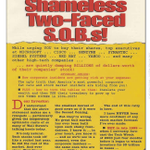
This is the front of a health magalog, the magazine-style sales piece that lands in the post.
The headline reads: "The 5 mind-bending marvels that DEFEATED CANCER, DIABETES, HEART DISEASE and ALZHEIMER'S."
Four of the scariest diagnoses there are, stacked in type you could read from across the room.
Each one could carry a whole issue on its own. Put all four in one line and the reader skims for theirs and lets the other three slide past.
"Mind-bending" is an adjective doing a job a picture should be doing.
Then look at the two words sitting above it.
"COVERED UP!"
Those two words carry more than the twelve below them. They hand the reader a secret and a villain before a single disease shows up.
Now drop to the deck, in the small type under the headline.
"These FDA blunders could humiliate the U.S. Government...but you can use them to get healthier than ever."
This is the strongest idea on the page, and it sits under the headline like a footnote.
It has an enemy with a name, a stake you can picture and a reason the reader comes out ahead.
Here is what I did with it.
I ran the cover through the same process I use on paid hooks.
Pick one idea, leave the rest behind, then push that one idea until it turns strange.
The four diseases stayed behind and the FDA blunder went in the pan.
Twenty headlines came out, and these are the three I would test against the original:
→ The 5 discoveries hidden by the very people paid to find them
→ The FDA tripped over 5 marvels and kept walking
→ These 5 FDA blunders are the only government mistakes that will ever make you healthier
Hook one is a paradox the reader has to resolve.
Number two gives the blunder a body you can watch.
The third turns the enemy's mistake into the reader's gain, which is the promise the deck was already making in small print.
The disease list still earns its place one line down, where a reader scanning for their own condition finds it anyway.
One more thing worth stealing from this cover.
A teaser in the sidebar reads "Heart attacks actually caused by 'STALE BLOOD'?!"
This is a rename, the move where an old fear gets a cause nobody has heard of.
It is parked on page 4, and as a single line it hits harder than anything in the headline.
Before you rewrite a headline, read every line on the page in smaller type and find the one with the enemy in it.
The line that sells is usually already there, set two sizes too small.
Happy Friday :)
P.S. What is sitting in the smallest type on your current control that deserves the headline?

2
66
It sells a day, and nobody can buy a day.
The headline points at a date on the calendar, 2011, and never says what happens on it.
That gap is the hook. You want the day filled in and the only way to get it is to keep reading.
"Most important day in America in 50 years" sets the stakes at the size of a country, and the reader is American, so it's his country on the line.
Then the warning. "Controversial... may be offensive... viewer discretion is advised" is TV broadcast language and nobody puts it on an ad.
It makes the page feel like news somebody tried to keep off the air, and forbidden pulls harder than promised.
Can you tell you're being sold? Not on the first screen. There's no product, no price and no benefit on it.
Back in the day, Clayton Makepeace found in split tests that the packages where you could barely tell a product was being sold beat the plain benefit ones by a wide margin. This is one of those.
Why frame it like this? Lead with a benefit and the reader feels the pitch coming.
Lead with something he's already scared of and he nods before he's asked to believe anything.
Every reader of this had just lived through 2008, so Porter lists the calls he got right on Fannie, Freddie, Bear Stearns and Lehman, then says "that's not why I created this letter." The track record buys him the right to make a bigger prediction, and the fear does the rest.

COPYWRITING EXERCISE!
Check out this Salesletters Headline and Subheadline.
Why do you think it worked?
Can you tell youre being sold something?
Why would they frame it like this?

1
43