

Trust is a resource. VRE is how you earn it. On-chain proof of who won. @solana | @colosseum | https://xitter.cf/t.co/iHSuqXoYbp
Joined April 2026
- Tweets245
- Following98
- Followers77
- Likes332








Pinned Tweet
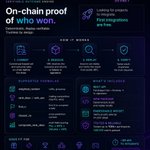
On-chain proof of who won on @solana.
Every raffle asks you to trust the backend.
VRE closes that gap.
Commit → replay from tx sig → MATCH / OK
Building something that picks winners?
loom.com/share/cddf80a4f5434…
@OnSwig @multisig @worldnetwork @metaplex
#Solana #Colosseum

VRE retweeted

It's an increasingly common take that AI hacking means cybersecurity is doomed.
I disagree. I think cybersecurity is naturally defense-favoring once people get their shit together. And anyone who continues to hold cryptocurrency (including me, ~90% of my net worth) is implicitly making that bet.
Here's why I am making that bet.
First, the oversimplified punchy one-line statement:
If AI can prove Navier-Stokes and FLT, then AI can prove the statement "this program is secure" as a mathematical theorem. Even if the program is very complicated.
Now, the nuance:
(See also: vitalik.eth.limo/general/202… )
The word "secure" is hiding all kinds of skeletons in the closet in terms of what it actually means. What does it mean for Signal (the encrypted messenger) to be "secure"?
The most basic definition you might think of is: no one who doesn't hold the recipient's secret key can read the contents of the message.
But:
* Did you remember to include _other_ critical forms of security? Can the adversary forge messages? Can the attacker prevent messages from reaching the recipient? Can they cause your client to crash by sending malformed messages?
* Have you made sure that your model of the adversary includes attackers that interfere with the protocol actively and not just passively? And attackers that interfere by replaying messages to you or the recipient that either of you sent over the wire at any point earlier?
* What if the adversary hacked (or _is_) the Signal server?
* How did you learn which public key belongs to the recipient in the first place? What if that process was tampered with?
* What if your device gets hacked at some point in the past or future - is your message still safe then?
* What if your key leaks because of a bug in your operating system? Or because you got a bugged version of the Signal client? Or what if the database is corrupted?
* Or the libraries, interpreter or compiler of the programming language you wrote it in?
* What if your key leaks because tiny perturbations in perceptible signals generated by the hardware leak mathematical relationships that can extract the key a few hundredths of a bit at a time?
* Are you hiding the *size* of the payload? Does that matter?
* You're definitely not hiding the identity of the sender and the recipient, and the exact time each message was sent (think: not just time-of-day, but also time deltas between one message and the next). Is that not enough to deduce a lot of important facts about what relationships you have, and what *kinds* of conversations you are having?
So ... even definitions can be over a thousand lines of code, and need deep careful thought to figure them out.
Working on making definitions more human-readable is of extreme importance - it's perhaps the only "high-level language" that matters right now.
But even still, even despite all of the above, for security-critical components, the definition is a much smaller attack surface than the implementation. Verifying that the definition is adequate is a much more tractable task than scanning over the code directly - and can become even more tractable with better tooling.
Definitions are also _additive_: if two groups have two different definitions A and B, then, well, you can just prove that the program satisfies both A and B. Code is not additive in this way: if a program is A + B, a bug in A _or_ B can sink the whole thing. Definitions are additive. And if you can't satisfy A and B at the same time, you've isolated the most important philosophical issue for your project to spend its next few weeks grappling with.
Sometimes, definitions are not much smaller than the implementation - UI components might be one example. But for many of the most critical components - message-passing protocols, sandboxes, cryptography like SNARKs and FHE - the asymmetry is real.
Historically, a large class of failures with this approach have come from people only verifying a small portion of their code, that they self-declared to be the security-critical portion, and ignoring the rest - and it turns out that something in the rest of the code is security-critical too.
This was reasonable back when verification was difficult and scarce. The solution today: sorry, you have to verify over literally your entire program, including database, networking, any caching layers, everything. Modern AI can do it.
So it's not about "the good guys find all the vulnerabilities before the bad guys do" - that could maybe work too, after all a finite program only has a finite number of vulns, but it's riskier - it's specifically an asymmetric strategy of making code that is much more resilient in the first place.
This is the kind of direction that Ethereum is going in for the next few years. There is no future for blockchains - especially blockchains with scalability and privacy - without doing this. We need to make software actually secure. And we have already made a lot of progress.
You can me ask a question!

Yeah, it is one of the most important problems which was discovered.
There are some things that defends it today:
1) Target slots are fixed at prepare stage, there are 3 of them in different leader groups and you need right one.
2) Skipping is reroll but not a pick so a 1-in-N entrant with k tries is at roughly k-in-N, and each skip burns the leader's block reward.
3) It leaves evidence and anyone can replay it by public rpc data.
4) In two-phase mode anyone can seal the randomness, and an operator who won't record the winners loses their stake.
5) I measured 50000 slots and one validator held 2 of the 3 targets in 3.1% of draws, never all 3.
what I'm building next:
1) Mode when operator commits to a random secret and reveals it on-chain after the last slot is confirmed. This trust VRE as operator but the reveal is on-chain.
2) Unicorn-G to remove that trust. It's already built: randomness goes through a VDF verified on-chain with a Groth16 proof, so nobody, including us, can compute the result within a slot. It could be used with big payouts (xitter.cf/VREprotocol/status/206…).
3) Randomized targets for two-phase draws: offsets come from the prepare slot's hash, so nobody can time a draw to land on a friendly leader.
4) Visibility. VRE doesn't hold the prize, the team running the draw does, so they're the ones who need to see the risk. For every draw the verifier will show which validator led each target slot, which targets were skipped, and which slot and leader replaced them, i.e. whose hashes actually went into the randomness. If the leader of the last target skipped their slot, it gets flagged. The verifier will also show every draw with the same rules, and prepare will be public before the targets, so a draw can't be quietly re-run.
5) An audit module on top of that, reporting to the integrator: a skip on the last target, a target leader whose keys are among the participants, the same leader skipping across many draws, repeated runs of the same rules, and one leader getting the last target more often than their stake explains. A single skip isn't proof, since slots also get skipped for normal reasons, but the pattern is visible. It can't catch a leader who changes block contents without skipping, and that's exactly what 1) and 2) remove.
Hi there, Timur here! I'm the founder, developer, and pretty much every other role at the VRE project.
Over the last two days I've been working hard to make the product much easier to use for the Colosseum hackathon. VRE works fine on devnet by design, so it can be used today without problems.
Shipped:
→ rng_v2 (future-slot entropy) is the main random engine
→ big draws are public end-to-end with Irys devnet and our mirror
→ replayed a 10,001-participant draw straight from the chain's own URI — MATCH
→ fixed a crash under load, safer confirmations for sortition/conditions, program errors now come back as proper 4xx codes instead of 500
→ new version of verifiable-outcome-sdk 0.9.1 (npmjs.com/package/verifiable…)
→ vre-helper skill for your agents (github.com/mskrad/vre-helper)
The @colosseum hackathon is running now, so if you're building there and want verifiable draws on devnet, DM for a partner key. Feedback and partner keys → t.me/maskradiation
verifiableoutcome.online/exa…
#solana #vre #random #colosseum #hackathon #developer #infrastructure #blockchain
verifiable-outcome-sdk 0.8.0 is on npm:
→ slot-hash draws (rng_v2, future SlotHash entropy)
→ sortition draws (entry fee + rent skim, replayable close/claim)
→ conditions draws (partner-committed rules + revealed facts)
Hey, VRE is here!
The program now selects winners itself, on-chain, for every compact draw (raffles, first-n, rank, multi-field scoring) — not just the large snapshot format. Already localnet/devnet passed!
Planning to release mainnet this year.
VRE retweeted

Timur, co-founder of @VREprotocol, on where the randomness comes from, and why there's no oracle in it
"Every answer for fair randomness points somewhere outside. It is maybe oracle, a beacon, maybe someone's service, and you remove the trust from the operator and you hand it to a third party. So again, you didn't really solve the problem, you just changed who you depend on"
"And I think @solana can stand on its own here, because it is fast enough, as I said, and it is cheap enough. So the state is already there, so the randomness should come from it"
"When a draw is prepared, it doesn't take a random number from anywhere. It points at three specific Solana slots in the near future, so it writes those slot numbers on chain. And those slot numbers have not been produced yet, so nobody can predict it. Not the operator, not me. And then you wait, and once those slots exist, the program reads their hashes out of chain and combines them into master seed, and it refuses to seal before that"
"So you can't rush it and you can't pick different slot hashes later, because slot numbers already on chain. So everything comes from Solana itself, and there is no oracle anywhere in the path. So if our servers disappear tomorrow, the check still works because nothing belongs to us"
That’s VRE Randomness layer.

Timur, co-founder of @VREprotocol, on where the randomness comes from, and why there's no oracle in it
"Every answer for fair randomness points somewhere outside. It is maybe oracle, a beacon, maybe someone's service, and you remove the trust from the operator and you hand it to a third party. So again, you didn't really solve the problem, you just changed who you depend on"
"And I think @solana can stand on its own here, because it is fast enough, as I said, and it is cheap enough. So the state is already there, so the randomness should come from it"
"When a draw is prepared, it doesn't take a random number from anywhere. It points at three specific Solana slots in the near future, so it writes those slot numbers on chain. And those slot numbers have not been produced yet, so nobody can predict it. Not the operator, not me. And then you wait, and once those slots exist, the program reads their hashes out of chain and combines them into master seed, and it refuses to seal before that"
"So you can't rush it and you can't pick different slot hashes later, because slot numbers already on chain. So everything comes from Solana itself, and there is no oracle anywhere in the path. So if our servers disappear tomorrow, the check still works because nothing belongs to us"
VRE retweeted
Ship Talk #7: Heres Protcol & VRE Protocol xitter.cf/i/broadcasts/1AxRnZZya…

VRE retweeted

⚡ Yesterday, we had a truly amazing experience and shared many productive conversations.
We also had the opportunity to meet our interesting @Heresprotocol and @VREprotocol for the Solana ecosystem.
If you missed it, please watch it via the provided link. Watch to learn about the problems Heres Protocol aims to solve, how our service works, and our future plans!
P.S. I would like to sincerely thank @sagapad_icm, @theshiptalk, and @solana_stream for providing such a wonderful environment and a great gathering, and for inviting us.
We hope we can continue to communicate and expand the Solana ecosystem community in the future. 🙏
Ship Talk #7: Heres Protcol & VRE Protocol xitter.cf/i/broadcasts/1AxRnZZya…
Glad to see you!
Ship Talk #7: Heres Protcol & VRE Protocol xitter.cf/i/broadcasts/1AxRnZZya…
See you!

📢 This Friday, Aug 14, 4 PM UTC!
@Heresprotocol will be participating in @theshiptalk Ship Talk, hosted by the @sagapad_icm team.
You can learn about what kind of project Heres Protocol is, what problems we address and solve, and even see a demo of our product firsthand!
Join us for a deep dive to learn more and meet up.
Also, take this opportunity to meet the @voutcomeengine team, who are joining us.
We would also like to thank our partner @solana_stream for providing the environment for Ship Talk.
See you tomorrow! 👀
VRE retweeted

2/ @voutcomeengine
Plenty of onchain draws call themselves "provably fair" when they're really only showing you half of it.
You get the dice roll onchain, which looks legit enough. But the odds themselves, the prize table, who actually wins what, all of that sits in code the operator can change whenever they feel like it, and you have no way of checking whether they did.
@voutcomeengine locks the entire ruleset onchain before the draw runs, so nobody can quietly adjust the odds afterwards. The randomness comes from a Solana block that hasn't happened yet, which means there's nothing to predict or grind, and every re-roll costs the operator money.
The good part is that after any draw you can replay it yourself from the transaction and get the exact same result, byte for byte, so you never have to take their word for it.
That's the trust layer for every result along the way.
VRE retweeted
Ship Talk #7 is here
📢Friday, Aug 14, 4PM UTC
Two questions crypto still doesn't have a clean answer to.
Who can open your wallet after you're gone? And who's checking that the raffle you just entered was ever winnable?
Two @colosseum teams built primitives for exactly those gaps.
Featuring on @theshiptalk:
> @Heresprotocol
> @voutcomeengine
Hosted by @sagapad_icm, in partnership with @solana_stream.
60 minutes. Pitch, live demo, and questions we've already warned them about. 🚢
There will be some plans and news about VRE protocol and new ecosystem products.
2/ VRE
Ever open a loot box or enter an onchain raffle and wonder if the odds are even real?
Here's the thing: even the "provably fair" ones only show you half of it. You get the dice roll on the blockchain, so it looks legit. But the actual odds, the prize table, who wins what - that lives in code the operator can change whenever they want, and you have no way to check whether they did. Fair dice, unverifiable rules.
@voutcomeengine locks the whole ruleset onchain before the draw, so the odds can't be touched after the fact. The randomness comes from a Solana block that hasn't happened yet - nothing the operator can predict or grind, and every re-roll costs them money.
Best part: after any draw you can replay it yourself from the transaction and get the same result, byte for byte. You don't have to take their word for it.
Loot boxes, raffles, NFT mints, giveaways. Live on devnet today. Stop trusting. Start checking.
That's the trust layer for every result along the way.
Let’s go!
Ship Talk #7 is here. 🚢
Theme: The Trust Layer for Onchain Life.
Crypto keeps saying "don't trust, verify." But two big things still run on pure trust: whether a game or raffle is actually fair, and whether your coins survive if something happens to you.
This Friday, two @colosseum builders fixing exactly that come on the mic.
📅 Friday, Aug 14 | 4PM UTC
Co-hosted by @sagapad_icm x @solana_stream
Featuring:
@voutcomeengine
@Heresprotocol
Let's talk about the SHIPPING. 🔥
VRE retweeted

We just submitted OddSol to the @TXODDSOfficial hackathon.
OddSol turns the World Cup into a prediction arena. Everyone gets the same live data — straight from TxLINE — so the edge isn't the data, it's who reads it better.
Two ways to play:
☀️ Solo — go free against Sol, our AI analyst. His read is grounded on TxLINE + live web, and locked with a hash so it can't be changed after the match.
⚔️ Arena — stake test-USDC, peer-to-peer. Winners split the pool by their coefficient. You play real people, never the house.
And every result is proven on-chain — verified against TxLINE's signed scores, and independently replayable through @voutcomeengine. Don't trust us. Check it yourself.
Live on devnet -> oddsol.fun
Skill-based. Transparent. Honest by design.
🤖 Made with AI

VRE retweeted
Every match on the board starts the same way: same live odds, same public data, for everyone. Nobody's got an information edge here.
What's different is what happens next. Every match gets a quick read from Sol right on the card — live, upcoming, or finished, all filterable. Open one up and the full breakdown is waiting: Sol's probability, its confidence, the actual reasoning — sitting right next to what the market's really pricing.
Same data for everyone. Find where Sol fades the crowd.


🌞 SOL vs MARKET — SUI v COL
🇨🇭 Switzerland — Sol 35% · Market 21% ← Sol's play
🤝 Draw — Sol 30% · Market 49%
🇨🇴 Colombia — Sol 35% · Market 30%
The crowd wants a stalemate. Sol reads a Swiss side scoring for fun vs a Colombia missing Córdoba. Fade the draw.
AI opinion, not betting advice. oddsol.fun · @OddSolFun