

Research Scientist @AdobeResearch | Ph.D. @ CUHK | Prev. Research Intern @AdobeResearch | Photographer | Opinions are my own
California, USA
Joined November 2019
- Tweets264
- Following532
- Followers803
- Likes2.1K



Pinned Tweet
Excited to share Chimera!
As Kimi K3 brings hybrid linear attention into the spotlight, our work explores the same architectural transition from the visual side: adapting KDA-based hybrid attention to token-extensive visual generation, together with a systematic scaling recipe.

Interested in how frontier labs pre-train image/video generation models?
We were too.
Since those recipes are rarely made public in full, we started from the most mature pretraining playbook available in the open: how modern LLMs are built.
Introducing Chimera: a visual generation model family that brings LLM-style hybrid linear attention and scaling co-design to visual generation.
In large-scale pretraining, nearly every design choice eventually shows up.
That means solving architecture design and scaling as one coupled problem: every architectural choice changes how the model scales, and scaling behavior determines which choices actually survive.
Chimera approaches both jointly, building a model family that remains predictable as model size, compute budget, and data distribution change.
Our key architectural observation is a simple division of labor: a single raster-ordered KDA stream carries long-range state, while modality-aware short convolutions preserve native local geometry.
Together, they form an effective and elegant linear-attention backbone for multidimensional visual data, with periodic MLA providing direct global interaction and sparse MoE expanding capacity at controlled activated compute.
This design comes with a useful effect: NoPE.
In Chimera, position is represented by the computation itself. KDA’s ordered recurrence and learned state decay encode order and recency, while the short convolutions encode local spatial-temporal structure.
Explicit positional embeddings are not needed in our design.
Because these mechanisms are not tied to a fixed training grid or sequence length, Chimera shows strong zero-shot extrapolation in both space and time.
Trained exclusively on 1K images and 5-second videos, it directly generates coherent 4K images with little visible quality degradation and 30-second videos with only 6.5% FID degradation over the final five seconds, all zero-shot, without resolution- or length-specific finetuning.
But architecture alone is not a pretraining recipe unless it scales predictably.
Thus, scaling should not be treated as an afterthought: fitting a curve over model sizes is easy; making that curve meaningful is much harder.
If every model size is differently under-tuned, your scaling law may simply be measuring optimization error.
We propose HeteroP to transfer proxy-tuned hyperparameters module by module across width and depth, giving us a consistently tuned model family. This allows us to fit Chinchilla-style laws over activated model size, training tokens, and the image-video data mixture.
The laws not only provide the reference for compute-optimal model and data size, but also suggest that visual generation may be more model-hungry than we tend to assume.
Under the same parametric loss-fitting method used in Chinchilla, compute-optimal model size grows as FLOPs^0.516 for images, compared with FLOPs^0.46 for language. Video is even more model-hungry, with the exponent rising from 0.516 for images to 0.544 for video.
Guided by these laws, we trained an 11B-parameter Chimera that activates only 2B parameters per token, using ~600 H100 days.
- It matches Wan-2.1 2B pretraining loss with 7.3x fewer FLOPs, and runs 2.14x faster than full attention at 255K tokens.
- It matches FLUX.1-dev and Z-Image-Turbo on GenEval and outperforms both on DPG-Bench, using roughly 20× less training compute than Z-Image-Turbo.
Ultimately, Chimera indicates that once you pretrain at scale, every decision shows up.
And if the Kimi K3 recipe caught your attention, Chimera may look oddly familiar, except the tokens are pixels and frames with diffusion models.
A team effort from team @ChongjianG30781 , me, @VisionSteve , Jiuxiang Gu, @Xu_Arthas , @chenziwee , @ShaotengLiu , @Jingorz , @YicongHong , @Zefan_Cai , @HaoTan5 ; supported by Hailin Jin and @kalyank_s at @Adobe @AdobeResearch


1
17
43,835
I hope the new FSD version fixes the freeway lane-change problem I’ve been seeing. My Tesla sometimes abruptly moves left when it’s about 3.8 or 1.6 miles from the exit, almost as if it’s following a fixed distance threshold. Sometimes, with 3.8 or even 6-plus miles to go, it makes a V-shaped maneuver, going from the far-left lane all the way to the far-right lane before moving back to the left. This happens after 14.3.x

v15 is 25x safer than v14 across the fleet.
That’s hard to notice on any individual drive because most drives are already very safe. The difference only becomes clear when you aggregate millions of miles.
All credit goes to the incredibly talented and dedicated @TeslaSI engineers who made this possible. It’s an honor to work alongside them.
139
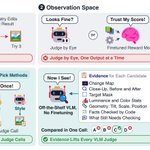
When an image-editing agent fails, does it really need another try?
Introducing our new paper: EditAgent: Rethinking Agentic Image Editing.
We argue that editing agents are bounded by two spaces:
🔧 Action space: what the agent can do.
🔍 Observation space: what its judge can see.
Three findings:
1️⃣ Expanding the action space matters.
Across 600 expert-annotated candidate sets, FLUX.2-klein-9B produced no acceptable candidate in 42.7%. Specialized methods rescued 175 of those 256 failures.
2️⃣ Expand what the judge can observe.
EditAgent enriches the observation space with parallel candidates for comparison, task-specific verification evidence, and earlier images and requests as historical context—supporting better candidate selection and detecting when a new edit undoes an earlier one.
3️⃣ Explore diverse alternatives through parallel search.
Different specialists, generalists, and repeated samples offer different ways to fulfill a request. Parallel search lets the judge compare these alternatives, while generating each candidate from the same source avoids carrying errors from one attempt into the next.
Even with a single editor and the same four-generation budget, experts preferred parallel search over sequential refinement in 78.5% of non-tied comparisons—with at most half as many judge calls.
EditAgent expands both spaces and connects them through parallel candidate generation and comparative judging. It improves two editing backbones on three benchmarks, and its accepted sessions provide training data that strengthens standalone editors.
Our takeaway: building reliable editing agents requires expanding both what they can do and what their judges can observe.

For more details, please check our paper or project page:
📄 Paper: arxiv.org/abs/2610.39664
🌐 Project: editagent.github.io/

1
1
203


Great work! But it would be great to cite our 2D-Box ObjectMover paper in CVPR 2025.

Here is a short video of our Thinking in Boxes. Enjoy!
More results on our website: thinking-in-boxes.github.io/
1
3
751
If you’re attending, please stop by our oral session for EditVerse:
I won’t be there in person, but I’d be very happy if you could check out the work, chat with the team, and join the discussion.
📍 Room 201 A/B
🕚 Apr 25, 11:18–11:28 AM

Excited to share our paper EditedVerse is accepted as oral to ICLR 2026! Many thanks to our amazing coauthors!!
Paper Link: arxiv.org/pdf/2509.20360
Project Page: editverse.s3-website-us-east…

Check out our project that answers how to train any-step T2I model from scratch.
We release the code for everyone to explore this area.
Looking forward to seeing more on this!!
#CVPR #CVPR2026

😀😀We’re excited to release the training code for Self-E (accepted to CVPR 2026): github.com/XinYu-Andy/SelfE
Self-E is a training-from-scratch, self-contained framework for any-step text-to-image generation, without teacher distillation.

The last version of FSD V13 is good! Confident and smooth. But the v14.1.4 is bad, not confident and not smooth. I put my hand back to the wheel again.😅 Cancel subscription again and wait for a stable version.

I took delivery of a beautiful new shiny HW4 Tesla Model X today, so I immediately took it out for an FSD test drive, a bit like I used to do almost daily for 5 years. Basically... I'm amazed - it drives really, really well, smooth, confident, noticeably better than what I'm used to on HW3 (my previous car) and eons ahead of the version I remember driving up highway 280 on my first day at Tesla ~9 years ago, where I had to intervene every time the road mildly curved or sloped. (note this is v13, my car hasn't been offered the latest v14 yet)
On the highway, I felt like a passenger in some super high tech Maglev train pod - the car is locked in the center of the lane while I'm looking out from Model X's higher vantage point and its panoramic front window, listening to the (incredible) sound system, or chatting with Grok. On city streets, the car casually handled a number of tricky scenarios that I remember losing sleep over just a few years ago. It negotiated incoming cars in tight lanes, it gracefully went around construction and temporarily in-lane stationary cars, it correctly timed tricky left turns with incoming traffic from both sides, it gracefully gave way to the car that went out of order in the 4-way stop sign, it found a way to squeeze into a bumper to bumper traffic to make its turn, it overtook the bus that was loading passengers but still stopped for the stop sign that was blocked by the bus, and at the end of the route it circled around a parking lot, found a spot and... parked. Basically a flawless drive.
For context, I'm used to going out for a brief test drive around the neighborhood to return with 20 clips of things that could be improved. It's new for me to do just that and exactly like I used to, but come back with nothing. Perfect drive, no notes. I expect there's still more work for the team in the long march of 9s, but it's just so cool to see that we're beyond finding issues on any individual ~1 hour drive around the neighborhood, you actually have to go to the fleet and mine them. Back then, I processed the incredible promise of vehicle autonomy at scale (in the fully scaleable, vision only, end-to-end Tesla way) only intellectually, but now it is possible to feel it intuitively too if you just go out for a drive. Wait, of course surround video stream at 60Hz processed by a fully dedicated "driving brain" neural net will work, and it will be so much better and safer than a human driver. Did anyone else think otherwise?
I also watched @aelluswamy 's new ICCV25 talk last week (xitter.gq/aelluswamy/status/1981…) that hints at some of the recent under the hood technical components driving this progress. Sensor streams (videos, maps, kinematics, audio, ...) over long contexts (e.g. ~30 seconds) go into a big neural net, steering/acceleration comes out, optionally with visualization auxiliary data. This is the dream of the complete Software 1.0 -> Software 2.0 re-write that scales fully with data streaming from millions of cars in the fleet and the compute capacity of your chip, not some engineer's clever new DoubleParkedCarHandler C++ abstraction with undefined test-time characteristics of memory and runtime. There's a lot more hints in the video on where things are going with the emerging "robotics+AI at scale stack". World reconstructors, world simulators "dreaming" dynamics, RL, all of these components general, foundational, neural net based, how the car is really just one kind of robot... are people getting this yet?
Huge congrats to the team - you're building magic objects of the future, you rock! And I love my car <3.
1
195
Very proud that two of the projects I worked on were featured in this year’s Adobe MAX Sneaks!
I co-led Project Frame Forward, which builds upon our previous GenProp — with major improvements in stability and image editing & video alignment. #AdobeMax #ProjectFrameForward

AI video editing on show here at Adobe Max!
#ProjectFrameForward lets you alter the start frame but keep the same motion of the original video.
Here’s a quick demo:
Check out our latest work in Video Editing!
A unified model handles image and video editing and generation!
🥳Excited to share our work #EditVerse: Unifying Image and Video Editing and Generation with In-Context Learning.
Edit and Generate Anything with an instruction!
Paper Link: arxiv.org/abs/2509.20360
Project Page: editverse.s3-website-us-east…
Our GenProp is now featuring in the Adobe Research Blog!❤️

Adobe researchers shared a groundbreaking publication at #CVPR2025, introducing an experimental generative video propagation framework that applies edits in the first frame of a video to all the following frames in a reliable and consistent manner, all while preserving areas the user hasn’t edited. adobe.ly/3Zvh0ms
We will organize HiGen @ ICCV 2025 in Honolulu! Join us to explore human-interactive generation with top speakers from Adobe, Stanford, CMU, and more. Submit by June 30 for a chance to win $800! #ICCV2025 #ICCVworkshop #HiGen


ObjectMover is our experimental project to explore the world knowledge from Video Generation model. It works super well in three tasks even we only provide a very naive instruction map. Thanks @andy_yx27 for hard work and congrats on paper acceptance! Checkout our paper 👇
🚀 I am very glad to share that our work #ObjectMover is accepted by #CVPR2025! 🎉
We introduce an image editing model that enables realistic object movement/removal/insertion by leveraging a video diffusion model.
Project Page: xinyu-andy.github.io/ObjMove…
How?👇

3/3 papers are accepted #CVPR2025
Thanks ACs, PCs, reviewers and my team!
Two intern projects I co-led last summer and my previous intern project finally completed 🤣
38
4,663
𝑾𝒂𝒏𝒕 𝒆𝒅𝒊𝒕 𝒚𝒐𝒖𝒓 𝒗𝒊𝒅𝒆𝒐 𝒖𝒔𝒊𝒏𝒈 𝒑𝒐𝒘𝒆𝒓𝒇𝒖𝒍 𝒗𝒊𝒅𝒆𝒐 𝒈𝒆𝒏𝒆𝒓𝒂𝒕𝒊𝒐𝒏 𝒎𝒐𝒅𝒆𝒍 𝒃𝒖𝒕 𝒏𝒐𝒕 𝒋𝒖𝒔𝒕 𝒕𝒆𝒙𝒕 𝒄𝒐𝒏𝒕𝒓𝒐𝒍?
Check out our new work 𝐆𝐞𝐧𝐏𝐫𝐨𝐩!
A powerful video propagation model enables various video editing possibilities!

We propose GenProp✨, a generative video propagation framework, which can seamlessly propagate any first frame edit through the video. 🧵(1/n)
- Arxiv: arxiv.org/abs/2412.19761
- Project Page: genprop.github.io/
- Video: youtube.com/watch?v=GC8qfWzZ…
1
948
