
We are the @UN’s health agency working for #HealthForAll Always check our latest tweets for updated advice/information.
Geneva, Switzerland
Joined April 2008
- Tweets83.5K
- Following1.7K
- Followers12.7M
- Likes14K



Pinned Tweet
On 20 October 2026, France reported the first documented case of human disease caused by the Shamonda virus. This virus primarily affects animals such as cattle, sheep, goats and horses.
WHO is in touch with the French authorities and is closely monitoring the situation.
Here is what you need to know ➡️


In paint. In dust. In soil. In water. In some ceramics, cosmetics, medicines, toys and jewelry.
Lead exposure can come from more places than many people realize — which is why awareness must lead to action.


Leprosy is curable, and effective treatment is available. Yet for too many people, the greatest barrier is not the disease itself, but the stigma and discrimination that prevent them from seeking care.
Ending leprosy means ending discrimination.
Thank you, @enhypen! ❤️
Your unwavering support for blood donation is helping save lives and raise awareness 🩸
#ENHYPEN

I am very delighted to meet @ENHYPEN JUNGWON, JAY, JAKE, SUNGHOON, SUNOO, and NI-KI in person in Seoul 🇰🇷 today.
Thank you for your work and commitment in promoting blood donation with @WHO
I look forward to continuing our collaboration in the future, and perhaps next time you will come to visit me and my colleagues in Geneva.

World Health Organization (WHO) retweeted
#France has reported the first documented case of a human infection with #Shamonda virus, a virus only previously detected in animals.
The patient was immunocompromised, which made them more vulnerable to infection and severe disease, and unfortunately died. My heartfelt condolences to their loved ones.
Shamonda virus primarily affects animals such as cattle, sheep, goats and horses. The virus is thought to spread between animals by the bites of a midge, which is a small fly-like insect. Further studies are needed to fully understand transmission.
The French patient was in an area where the Shamonda virus was circulating in animals and where Culicoides midges were also present.
@WHO is in contact with French authorities who are collecting information to better understand the source of infection in the first human patient, possible routes of transmission and any potential risk to public health.


Follow the journey of an Ebola survivor at the Bunia clinic. ⬇️⬇️⬇️

Follow-up care for Ebola survivors is an essential part of any Ebola outbreak response. After discharge from treatment centres, survivors need continued physical and psychosocial support, provided through dedicated survivor follow-up clinics.
With support from @OCHAFunds and @FCDOGovUK, @WHO has helped establish the first two clinics, in Bunia and Beni.
🎥 Follow the journey of an Ebola survivor at the Bunia clinic.
There is no known safe level of lead exposure for children. Even low levels can harm developing brains and have lifelong consequences.
The safest exposure is no exposure bit.ly/3TKEwwd

World Health Organization (WHO) retweeted
Vaccines have saved more than 150 million lives over the past 50 years. But this progress is under threat from funding cuts, conflicts, climate change and misinformation.
With #measles outbreaks in dozens of countries, immunity gaps anywhere can threaten health security everywhere.
At the same time, innovation offers new hope: malaria vaccines are being rolled out, promising tuberculosis vaccines are in development, and new Ebola vaccines against Bundibugyo virus are approaching trials.
But vaccines only save lives when people can access and trust them.
@WHO calls on governments, scientists, health workers, industry, technology companies and communities to work together to ensure everyone has access to accurate, evidence-based vaccine information.
Everyone, everywhere, at every age deserves the protection vaccines offer.
#VaccinesWork

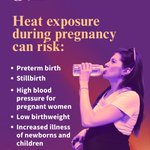
Extreme heat can affect health before a child is even born.
Heat exposure during pregnancy has been linked with preterm birth, stillbirth, low birth weight, and other complications.
Better monitoring can help health systems identify emerging risks - and protect women during and after pregnancy as well as their babies.
Learn more: bit.ly/4zLTLEh

Protect your baby from measles with 2 doses of measles vaccine.
1️⃣ In countries where measles is common, it is vital to give the first dose around 9 months of age; in other countries, at 12-15 months of age.
2️⃣ Give the second dose later in childhood to ensure full protection.
Remember: Infants can be vaccinated around 6 months of age if there is an outbreak or before travel to endemic countries.

World Health Organization (WHO) retweeted
My sincere thanks to Republic of #Korea's President @Jaemyung_Lee for his warm welcome and 🇰🇷's steadfast partnership with @WHO.
We discussed the WHO Biomanufacturing Training Hub in Seoul, which has trained over 4,000 professionals from 100 countries. It was an honour to inaugurate its first building yesterday, with the President's strong support.
We also discussed harnessing AI for better health, including through today's Seoul Declaration on #AI in Healthcare, with a focus on equity in healthcare delivery and local production of medical products.
Our discussions also covered the Pandemic Agreement negotiations on Pathogen Access and Benefit Sharing, the #Ebola response in #DRC, and Korea's role in strengthening global preparedness and multilateral cooperation.
xitter.cf/Jaemyung_Lee/status/21…


<대한민국과 WHO는 세계 보건의 든든한 동반자가 되겠습니다>
테드로스 게브레예수스 세계보건기구(WHO) 사무총장님(@DrTedros)께서 대한민국을 찾아주셨습니다.
보건의료 인공지능 활용과 바이오 인력 양성, 신종 감염병 대비 등 함께 협력할 수 있는 분야에 대해 깊이 논의할 수 있는 자리였습니다.
특히, 향후 감염병 대응에 공백이 없도록 WHO를 중심으로 한 다자협력을 굳건히 이어가야 한다는 데 뜻을 같이하였습니다.
한국인 최초 WHO 사무총장이셨던 故 이종욱 박사님께서는 "가능한 한 많은 사람에게 가능한 최고의 건강을"이라는 신념으로 세계 보건을 이끄셨습니다.
우리 정부 역시 그 뜻을 이어받아 전세계의 건강을 지킬 WHO의 든든한 동반자로서 책임을 다하겠습니다.


Nearly 59 million lives have been saved by the measles vaccine since the year 2000. Let that sink in.
59 million people — because of science.

Experiencing extreme heat during pregnancy is linked to higher risks for babies, including preterm birth, stillbirth, and low birth weight. Pregnant women may also face higher risks of high blood pressure. Children also can become ill during extreme heat.
WHO, WMO, UNICEF and UNFPA have identified key indicators to help countries spot these risks using data they already collect — such as preterm births, clinic visits, deaths and school attendance — alongside heat exposure data.
Measuring the health impacts of heat means, we can act sooner to protect those most at risk: bit.ly/4zLTLEh

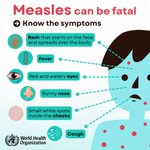
Measles can be fatal.
Do you know its symptoms?
- Rash that starts on the face and spreads over the body
- Fever
- Cough
- Red and watery eyes
- Small white spots inside the cheeks
Seek health care if you suspect you or your child has measles.

Extreme heat can endanger lives before birth—and put pregnant women, newborns and young children at increasing health risk. This means higher odds of preterm birth, still birth, low birth weight, and cardiovascular complications during labour.
For 1.5 billion children, heatwaves are becoming more frequent, lasting longer and growing more severe.
WHO, WMO, UNICEF and UNFPA are helping countries make health impacts visible - so they can take action.
Learn more: bit.ly/4zLTLEh

⬇️ What is the Bundibugyo virus disease? Here’s a short video to bookmark.
As countries in the African Region work to detect and respond to Bundibugyo virus disease (BVD), knowing the facts is essential.
BVD is a severe and often fatal form of #Ebola disease caused by the Bundibugyo virus. Learn more⬇️
#ViralFacts
@viralfacts