

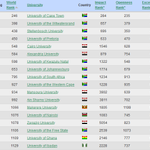
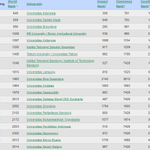
The largest and the most reliable Ranking of Universities: 30 000 Higher Education Institutions from all over the World https://xitter.gq/t.co/demGfsSsKa
Spain
Joined March 2020
- Tweets939
- Following59
- Followers843
- Likes274




Ranking Web of Universities: Webometrics retweeted

Cuatro de nuestros investigadores figuran entre el 2% de científicos más citados del mundo, según el ranking Stanford-Elsevier.
¡Enhorabuena a @isidroaguillo, Ferrán Catalá-López, Adelheid Holl y Pablo del Río González!
elsevier.digitalcommonsdata.…

Ranking Web of Universities: Webometrics retweeted
💡 ¡Ya tenemos las 7 propuestas seleccionadas para nuestro Laboratorio Ciudadano!
Buscamos personas que quieran colaborar en su desarrollo. No necesitas experiencia previa.
⌛️ Inscripciones hasta el 15 de noviembre.
ℹ️ Conoce los proyectos y participa:
ipp.csic.es/es/article/labor…

Ranking Web of Universities: Webometrics retweeted

Future Faculty Development in the Age of AI: University Teachers’ Roles, Needs, and Institutional Support; towards a role-based framework for faculty development
link.springer.com/article/10…

Ranking Web of Universities: Webometrics retweeted

De aquí a poco será posible publicar trabajos en #OpenResearchEurope Para ir calentando motores hemos preparado esta guía para investigadores: guiasbib.upo.es/open_researc…

👩💻🧑💻 Impulsamos la participación de España en una nueva plataforma europea de publicación científica en acceso abierto junto a otros diez países europeos a través de @OpenResearch_EU.
Facilitará a la comunidad científica publicar sus trabajos sin costes.
ciencia.gob.es/Noticias/2026…

Ranking Web of Universities: Webometrics retweeted

Visualizing scientific data is key to understanding the performance of journals and countries. 📊
With the SCImago Compare tool, you can simultaneously analyze up to 6 publications or countries, contrasting their key bibliometric indicators using dynamic charts.
Explore now 🔗scimagojr.com/viztools.php
#SCImagoCompare #SCImagoTools #VizTools

ALT SCImago viz tool - Journal Comparison

ALT SCImago viz tool - Country and region comparison
Ranking Web of Universities: Webometrics retweeted
Google anuncia que en 2027 permitirá a las webs indicar, mediante robots.txt, si autorizan el uso de sus contenidos para entrenar IA.
Un paso hacia un estándar común basado en AIPREF (IETF), con implicaciones para editoriales y revistas científicas.
developers.google.com/search…

Ranking Web of Universities: Webometrics retweeted
¿Democratiza la IA la publicación científica? En 2024 destacaba en @el_pais su potencial lingüístico. Hoy, la evidencia revela nuevas desigualdades. 👇
linkedin.com/pulse/la-ia-dem… @manuelansede

Ranking Web of Universities: Webometrics retweeted
🚨 Scientific Reports, bajo revisión de la National Library of Medicine: suspendida temporalmente su incorporación a PubMed.
La indexación no es un certificado permanente de calidad. También debe someterse a seguimiento y reevaluación.
retractionwatch.com/2026/10/…

Ranking Web of Universities: Webometrics retweeted
#ScimagoIRIS | Research integrity is managed with data and strategic governance.
SCImago IRIS is a non-punitive early-warning tool that uses a dynamic set of indicators and Z-score normalization to help institutions proactively detect their exposure to scientific risks. By anticipating structural vulnerabilities, it transforms scientometrics into actionable intelligence to support informed leadership decisions.
The credibility of knowledge begins with the capacity to anticipate its risks.
🔍 Explore your institution's broader landscape and request a detailed report 👉scimagoiris.com/integrity-ri…
#SCImagoIRIS #ResearchIntegrity
Ranking Web of Universities: Webometrics retweeted
This tool aims to support research assessment, strategic planning, and evidence-based policymaking in science and research.
🌐 Explore the platform and institutional profiles here: scimagoiber.com
Ranking Web of Universities: Webometrics retweeted
Open-access indicators: One of SCImago IBER’s greatest strengths is its commitment to the visibility of science.
It provides open access to data and institutional profiles for both institutions featured in international rankings and those not typically represented in them.
Ranking Web of Universities: Webometrics retweeted
#ChartOfTheWeek | How are scientific impact and research output distributed across Ibero-America? 🌎
By default, the #SCImagoIBER map visualizes research performance by combining two key dimensions at a glance: ⚪ Size: Research output 🎨 Color: Normalized impact. 🧵👇

Ranking Web of Universities: Webometrics retweeted
Congratulations to the editor of the Ranking Web HcDr Isidro F Aguillo for being included in the new 2026 edition of the Ranking of Stanford of the researchers that are in the top 2% most cited of the world. It is the 7th year in the row
Ranking Web of Universities: Webometrics retweeted
How do scientific production and the location of publishers connect around the world?
Exploring the dynamics of global research has never been so visual and intuitive. Today, we want to highlight #CountryGraphs, a powerful tool that allows you to analyze the distribution and relationship of science worldwide through two key variables:
📍 Publisher's country: Where journals are published and indexed (for example, in databases like Scopus).
🔬 Author's affiliation country: Where the scientific research actually originates.
Would you like to integrate this tool into your upcoming bibliometric analyses or literature reviews?
🔗scimagojr.com/countrygraph.p…
Tell us in the comments how you measure research impact in your region! 👇
Ranking Web of Universities: Webometrics retweeted
Northern America sets a high benchmark for global research excellence. Explore the top 10 institutions leading the region in the SCImago Institutions Rankings (SIR) 👇
At SIR, we transform data into tangible intelligence through 20 open and auditable metrics distributed across three key dimensions: Research, Innovation, and Societal Impact.
Move from monitoring to strategic decision-making. Shift the conversation from "where do we stand?" to "how do we improve?". Access the full ranking and analyze the data behind the leaders: scimagoir.com/rankings.php

Ranking Web of Universities: Webometrics retweeted
Who pays the real cost when a problematic article gets published and has to be retracted?
In our new blog, Gali Halevi analyzes how costs accumulate from initial funding and peer review hours to complex subsequent investigations.
Looking beyond isolated cases and using tools like #SCImagoIRIS allows universities and publishers to detect patterns and optimize their integrity resources.
Read the full article here 👇scimagolab.com/the-economic-…
#ResearchIntegrity #SCImagoIris #SCImagoBlog

Ranking Web of Universities: Webometrics retweeted

Researchers proved that “naive RAG” beats every complex memory system.
A new paper just dropped comparing these elite, complex memory systems against "Naive RAG."
Naive RAG won. It beat 12 different complex systems across 6 out of 7 benchmarks.
Developers have spent years building architectures that explicitly rewrite, update, and delete memories to make agents "smarter."
Researchers found this buys almost zero accuracy gains.
when they tried adding graph expansion, raw summaries, or atomic facts to the naive rag setup, the performance literally dropped by nearly 20 points on one benchmark.
why? because complex systems destroy the original context.. they break apart the relations and dependency paths needed to actually answer the question.
naive rag just takes the raw history, embeds it into a flat index, and hands the pure evidence straight to the llm.. it turns out preserving raw information is the most important thing you can do for accuracy.
oh, and it's massively faster.. the simple setup finished ingestion and retrieval in about 5 minutes, making it up to 30 times faster than complex systems like EverMemOS.
we are spending millions of compute hours trying to make agents "think" about their memories when simple search was the answer the whole time..

Ranking Web of Universities: Webometrics retweeted
#SCImagoResearch | More than 55% of records in open databases are missing affiliation information.
When evaluating institutional output or calculating precise citation indicators, standardization and consistency remain the key differentiators of curated databases.
Read the findings from our comparison between open sources and Scopus: 👇scimagolab.com/open-vs-curat…
#SCImagoResearch #OpenAcces #BibliographicDatabases

Congratulations to the editor of the Ranking Web HcDr Isidro F Aguillo for being included in the new 2026 edition of the Ranking of Stanford of the researchers that are in the top 2% most cited of the world. It is the 7th year in the row
Ranking Web of Universities: Webometrics retweeted
📸 Ayer celebramos la Simon-Goldin Lecture '26 con
@g_escribano y... ¡la hora y media de conferencia se nos hizo corta!
¡Muchas gracias a Gonzalo y a todas las personas que nos acompañaron!
Os dejamos algunas imágenes de la jornada 👇


