

An exploration of the secret, hidden and downright weird history of Bath from author Charlie Revelle-Smith. This is a sister feed to my @WeirdBristol
Joined March 2017
- Tweets31
- Following82
- Followers426
- Likes37





One of the most frequently reported ghost sightings in #Bath comes from the Royal Crescent where a Georgian-style horse and cart is supposedly seen riding through the streets at twilight and night.

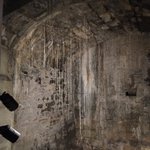
These stalactites which can be found in some of the vaults and chambers of the Roman Baths are caused by decades of rainwater leaching minerals through the #Bath stone brickwork. They have been growing longer every year since the Great Bath was rediscovered and excavated in 1878.

After the first attack on #Bath during WWII, a bomb shelter was built in the middle of Queen Square following public pressure. However, the park was locked at night and only the residents of the square had keys, and therefore access to the shelter - causing anger across the city.

This gilded bronze head, representing the goddess Sulis Minerva was discovered during 1727 excavations of what is now the Roman Baths. It was once part of a statue of the #Bath goddess. Only fragments of two other Roman-era gilded bronze statues have ever been found in Britain.

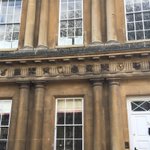
Although it’s believed that the designer of the Circus, #Bath, John Wood the Elder was not a Freemason, he had a great interest and admiration for the Masons. This frieze around the Circus represents trades and skills associated with Freemasonry.

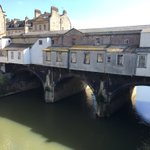
The seldom seen north side of Pulteney Bridge (visible from the back of the Podium shopping centre) did not always look as drab as it does today. Enormous floods in 1799 and 1800 washed away much of Robert Adams’ 1763-designed opulent facade from this side and was never repaired.

This summer house in Sydney Gardens is a recreation of the ancient Temple of Minerva (complete with a detailed recreation of the temple’s pediment) which was once at the heart of Roman #Bath. This version was built as part of a six day celebration of the city’s history in 1909.

Weird Bath retweeted

Exactly right! More info can be found on our blog: ow.ly/C38r30oCE66 🙂
This mark etched into the #Bath Guildhall building is an Ordnance Survey benchmark. It is part of a vast network of similar marks which once helped map makers and surveyors ascertain the topography of the whole country. Satellite technology has now rendered the network redundant.

This bronze bust in the @VictoriaArtBath Gallery is of William Harbutt, the #Bath School of Art headmaster who, in 1879 invented plasticine. The bust was sculpted in 1910 by Edwin Whitney-Smith, who used plasticine to mould the original design which was later cast in bronze.

The pavements along Great Pulteney Street are wide not just to reflect the grandeur and size of the street but also to accommodate for the fashionable, Georgian custom of “promenading”. It allowed two women in large gowns and their male acquaintances to easily pass one another.

The symbols to be found on the bricks inside the canal bridge under Sydney Road are Georgian mason marks. Stonemasons would have their own unique markers and would be paid per brick. These identifiers allowed employers to know how many bricks each mason had made.


Designed by John Wood, the Elder in 1754, the Circus is believed to reflect the architect’s interest in Druidism. The acorns which adorn the top of each building are thought to symbolise a crown of acorns encircling his design - a potent Neo-Druid symbol of power and protection.

An interesting but fanciful legend from #Bath claims that on some nights the bell of Holy Trinity Church tolls thirteen times and when it does, these two lions at the entrance to Royal Victoria Park come alive and kick their balls to one another.

I’m back from another sensational @Showofstrength walking tour, this time FRANKENSTEIN IN BATH. I had no idea Mary Shelley mostly wrote her masterpiece in #Bath. Fabulously gothic fun, filled with revelations and scandals. Highly recommended!

Five of the buildings along the southern side of Queen Square are mid 20th century replacements for the original Georgian buildings which were destroyed in the Bath Blitz. #Bath was of no strategic importance during WWII and was targeted simply due to its historic significance.

The walled trench which divides the grass in front of The Royal Crescent is called a ha-ha. It was built to allow livestock to graze on the lower part of the field, leaving the upper half for the residents, whilst allowing for a view over #Bath which wasn’t interrupted by a fence

This enigmatic face which was once placed over the entrance of the Temple of Minerva in the Roman Baths dates back to the 1st century AD and seems to be heavily influenced by Celtic/pagan designs. It is likely a gorgon (possibly Medusa) but mysteriously in the guise of a man.

One of the most unusual hauntings in #Bath comes from the @TheatreRBath where a tortoiseshell butterfly has been spotted during pantomime performances since 1948. It's believed to be the benign spirit of a former theatre manager who died during a pantomime rehearsal in the 1940s.

This 1861 public drinking fountain bears the inscriptions “take the water of life freely” and “water is best”. It was installed by the #Bath Temperance Society as a means of providing the people of the city an alternative to alcohol, which they considered a dangerous vice.
