

Worcester Cathedral Library and Archive: The second largest medieval Cathedral library in the UK.
- Tweets606
- Following422
- Followers672
- Likes628
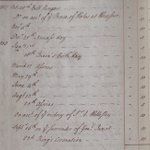




ALT For this week's #ArchiveZ letter V is for Victory. In 1808 Sir Arthur Wellesley (later Wellington) led the British and Portuguese victory at the Battle of Vimeiro. The Cathedral bellringers were paid to ring the bells to celebrate and tell the city. This document shows all the occasions in 1807 and 1808 when the bellringers were paid by the cathedral to ring on notable occasions such as the battle or the Queen's birthday.


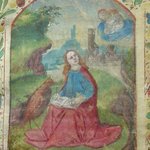
ALT A cheerful Saint John the Evangelist writing his gospel. Jesus looks down from heaven approvingly, whilst an eagle waits nearby. The eagle is a symbol of Saint John. John is sitting on an island with greenery. In the distance beyond a stretch of water is a medieval city. John wears a blue tunic and a long red cloak. Image dated to c.1400. (WCL Q102)

ALT The title page of a 1596 edition of John Foxe's Acts and Monuments telling the stories of the martyrs of the church, and in particular those in England during the reign of Queen Mary Tudor. This shows a variety of images from people in heaven through to people listening to preachers and much in between.

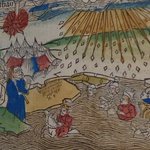
ALT The Israelites having escaped safely to the other side, God instructs Moses to close up the waters and stop Pharaoh with his chariots and cavalry pursuing them in Exodus chapter 14. Medieval Woodcut of 1475 which has been crudely painted in simple colours. The medieval artist has drawn the chariot as a cart (WCL Inc.13)


ALT The start of a 13th Century copy of Justinian's Codex shows Emperor Justinian giving the law to his loyal subjects. This was made in England. Justinian wears a maroon tunic and is seated on a throne. His kneeling subjects in blue, red and maroon. Sadly the drawing is damaged and the faces can't be made out clearly (WCL F78).

ALT Another page from a 13th Century copy of Justinian's Codex shows lots of marginal notes and a clear drawing of the head of a queen or princess added by a law student (WCL F78).

ALT This week's #ArchiveZ letter U could be for union as in the English Glee and Madrigal Union and their evening concert in 1852 as this flyer shows. It was held in the Worcester Music Hall. "Front seats cost 3 shillings and back seats cost 2 shillings".

ALT A Green dragon, with a tail of foliage snaps, at a bird inside a large red and blue letter which is surrounded by fronds and leaves. William Durand, a Frenchman who studied and worked in Italy, was a canon law expert but he also wrote a book all about medieval liturgy in the 13th Century in western Europe. This copy was made in the 14th C. (WCM F129 folio 1)

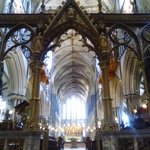
ALT Prince Arthur Tudor's Chantry Chapel looking pleasant in the late summer sunshine. Below Arthur's chapel in the photo are two tombs of a medieval bishop (possibly Bishop Giffard) and a lady who may have been a kinswoman of the bishop.


ALT The library also has a large music collection which researchers can use. This is just one piece by George Frederick Handel, 1685-1759.

ALT A page of music from the a fugue by Handel.

ALT The second page of music from a fugue by Handel.

ALT The final page from a fugue by Handel.

ALT This is from Stephen of Antioch's translation of 10th Century Muslim doctor Haly Ibn Abbas' medical book the Royal Disposition of Arguments. This is from the practical part of the work. This copy dates to the 12th Century. A letter S is spilt half way across into red and blue halves, with blue frond decoration around the red half and red frond decoration around the blue half.

ALT This week's #ArchiveZ letter T could be for Tudors. This huge document actually extending onto 2 sheets is a general pardon issued by the first of the Tudors - King Henry VII. It is dated 24th June 1486. This was a pardon for all crimes committed before 23 April 1 Henry VII.

ALT Medieval camping tip: wander off away from the tent and pretend to be busy doing something while the other person does all the hard work. Two men are depicted by a tent. One is holding a corner of the tent and looking for someone or something. The other man appears to be behind the tent, and is glancing in the same direction. The woodcut has been painted in red, blue, yellow and green (A 1475 depiction of Israelite camp on exodus from Egypt in the Bible in WCL Inc. 13).


ALT The Three Choirs Festival main programme from a pivotal year in the 20th Century- 1929 - and one of the concert programmes. The impressive list of patrons included the King and Queen, the Prince of Wales, the Duke and Duchess of York, Princess Mary and the Archbishop of Canterbury!

ALT This image is the front cover of one of the morning concerts from 1929. It includes a motet by Purcell, and another by Byrd as well as Elijah by Mendelssohn.

ALT The cathedral's old organ is something to look out when visiting. This was paid for by the Earl of Dudley as part of the Victorian Restoration. It has green pipes with small gilded designs on every pipe in a dark wooden case.

ALT This week's #ArchiveZ letter S could be for signature. In this case Sarah, Duchess of Marlborough and wife of the famous General. She signed a counterpart lease with Worcester Cathedral for property in 1729 (WCM B2997).

ALT In the 14th Century a vicar Willliam de Pagula went to Oxford to study law. He wrote a textbook on Canon law and theology. This is from a later copy of the Summa Summarum. This illuminated letter is in maroon, with a blue square border. Foliage is within and without, and a winged monster with a hooded human head crouches within the letter (WCL F131 fol.224r).