

A chart a day keeps the doctor away - the thesis behind the $XNET trade. Tracking XNET, DePIN, telecom and wireless infrastructure space.
Joined October 2026
- Tweets120
- Following43
- Followers15
- Likes394






SpaceX has the cash and the sky. The carriers have the customers and need cheaper capacity, fast.
Renting it by the gigabyte inside buildings is about the cheapest way to get it. That’s the gap XNET was built for.
Join the ride!
solana:xNETbUB7cRb3AAu2pNG2pUwQcJ2BHcktfvSB8x1Pq6L #DePIN
That’s what @XNET_Mobile does. Phones hop onto Wi-Fi that’s already in shops, venues and offices, and the carrier pays only for the data used.
XNET carried 1,556 TB from January to September, about 5x a year earlier. No towers, regulatory burden or spectrum auctions.
So where do carriers fight back without burning cash? Indoors, where 70 to 80% of mobile data is used.
A new tower can run over $1M and take months or years of permits. An indoor antenna system costs $250k to $2M+ per building.
Or they can use the Wi-Fi that’s already there no?

Whats interesting is that SpaceX doesn’t have to win.
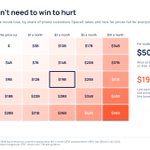
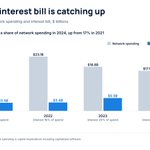
On rough numbers, if it took 5% of phone customers and pushed prices down $3 a month for everyone else, the big three would lose about $19B a year. That’s close to 40% of their network budgets.

Customers are where carriers are miles ahead. Roughly 120 to 150M connections each, against 13.6M Starlink broadband subscribers.
But Musk told investors he sees “a clear path to several hundred billion dollars a year in connectivity revenue.” Scary days for the big three.
Then there’s the balance sheet. Strip out debt and SpaceX still has about $50B of spare cash. Each carrier owes well over $100B.
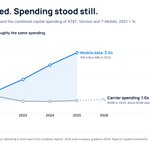
SpaceX plans to spend $35 to 40B this quarter alone, mostly on AI and rockets. The carriers plan about $50B on their networks for the whole year.
The carriers still bring in more. Each made $24 to 34B in revenue last quarter, against SpaceX’s $14.6B.
But SpaceX grew 161% on a year ago. The carriers grew somewhere between 1.5% and 7%.
One of these is a utility. The other is a rocket, literally.
It wasn’t the only satellite news this week.
On Tuesday the FCC approved Amazon’s roughly $11B purchase of Globalstar, which it wants for its own satellite to phone network.
SpaceX already bought EchoStar’s spectrum for about $17B. Real money is chasing your phone now.
The FCC voted to propose 482 MHz more spectrum for satellite to phone, taking the usable bands from 5 to 13. The carriers had pushed hard to get 290 MHz of that cut.
A final vote likely comes in 2027.


XNET Signal retweeted

Bringing decentralized wireless to Silver Dollar, Athens! Catching the nighttime view of City Hall or playing cards with friends just got a boost as @XNET_Mobile arrives. Dawg Nation's hub since 2011 is backed by #XNET and $XNET.

So many good reasons why carriers need to find inventive ways to compete.
Squeezed margins will make billion-dollar tower builds harder to justify. Capacity you can rent by the gigabyte starts looking very good.
Very bullish on wifi offload as a solution for the big 3!
This is a proposal, so feedback comes first and then a final vote probably lands in 2027. SpaceX is aiming for early 2028 anyway.
The carriers have a window to get ready. The smart ones will spend it adding cheap capacity indoors 👀
Wifi offload is the future!
$SPCX #DePIN

Big news, the FCC voted today to advance new satellite-to-phone rules that could benefit @SpaceX's Starlink Mobile, despite lobbying efforts by AT&T, Verizon, and T-Mobile to restrict parts of this proposal.
FCC: "This marks a major step to unleash American innovation and investment in next-generation connectivity."
The FCC voted to advance a proposal that would:
• Open up an additional 482 MHz of spectrum for satellite-to-phone services, expanding eligible frequency bands from 5 to 13.
• Eliminate restrictive spectrum-leasing requirements
• Remove rigid geographic coverage restrictions
• Allow more flexible agreements between satellite operators and wireless carriers
• Modernize technical rules to allow more efficient spectrum use
• Reconsider exclusive-use rights for certain satellite spectrum bands
If finalized, these changes could make it easier for SpaceX to expand Starlink Mobile, access additional spectrum, and reduce regulatory barriers.
Here's what happens next:
• Late 2026: Public comment period opens, allowing SpaceX, AT&T, Verizon, T-Mobile, and others to weigh in.
• Late 2026–Early 2027: Companies submit comments and responses arguing for or against specific rule changes.
• Early–Mid 2027: The FCC reviews the feedback, evaluates interference concerns, and considers revisions.
• Sometime in 2027: The FCC holds a final vote to officially adopt the new regulations.

Notice what he’s defending. Cities & suburbs make 98% of Verizon’s revenue.
That’s also where people sit indoors on Wi-Fi that’s already there.
Carriers and SpaceX are fighting over the most expensive way to add capacity. The cheap one is inside the building!
Bullish on solana:xNETbUB7cRb3AAu2pNG2pUwQcJ2BHcktfvSB8x1Pq6L
Verizon's CEO said today that SpaceX will need at least 4-6 years and $300B-$500B to fully build out its @Starlink Mobile U.S. carrier network:
"Their service just can't compete with a terrestrial network. In suburban and urban areas, where 98% of our revenues are, we're somewhere between 100x–1,000x more efficient than they are. We know exactly what they're going to do. We know who they're talking to on towers. There's no magic wand. There's no secret sauce. There's no shortcut.
They're going to look at 65,000–80,000 macro sites. They're going to need backhaul, RAN, and a tremendous amount of spectrum. It's going to take a minimum of four to six years to fully build that out. It's going to cost hundreds and hundreds of billions of dollars, I assume somewhere between $300 billion and $500 billion.
Then they need to build retail, customer service, back office systems, et cetera. All of that gets them basically the same network and same capabilities and same cost structure as what we have today. Then sometime over the next four to six years, they have the possibility of becoming the sixth, not the fourth, the sixth competitor in the market.
You can be sure over these next three to five years or six years, we are not going to be standing still. Four to five years from now, we will be two to three generations better than where we are today. We will have high-speed broadband gig-plus coverage across the country with our millimeter wave. We are ahead of most people and already experimenting with what 6G applications will look like."
(via Verizon's Q3 earnings call earlier this morning)

AT&T is planning to spend less on its network.
$23 to 24B this year, then $22 to 23B a year in 2027 and 2028, per its Q3 results. In the same quarter it added 379,000 phone customers.
More users, smaller budgets. The cheapest capacity is the Wi-Fi already inside buildings 👀
XNET Signal retweeted
Wimberley just leveled up its community-built wireless coverage! Meat & Drink is officially on the map with @XNET_Mobile. Powered by local builders, #XNET is expanding decentralized connectivity one site at a time. Stronger community infrastructure powered by $XNET! 📶
