

I am obsessed with helping swimmers learn to swim faster. Author of YourSwimBook, Conquer the Pool, etc. Get daily swim tips via my newsletter 👇👇👇
Joined October 2012
- Tweets7.8K
- Following3.6K
- Followers5.6K
- Likes30K




Pinned Tweet
This New Mental Training Workbook Will Help You Swim Like a Rock Star This Season
yourswimlog.com/new-mental-t…


Why Elite Sprinters Don’t Breathe in the 50 Freestyle
yourswimlog.com/sprint-frees…

A Race Pace Set for Winning the Back Half of the 100 Freestyle
yourswimlog.com/a-race-pace-…

A Sprint-Focused Workout for Explosive Underwaters and Closing Speed
yourswimlog.com/a-sprint-foc…

Goal Setting for Swimmers: How to Set Goals that Drive Performance
yourswimlog.com/goal-setting…

Dryland Training for Sprint Freestyle: What to Do and How to Program It
yourswimlog.com/sprint-frees…

A quick self-talk tip for high pressure moments 👇
Self-talk is one of the best mental skills swimmers can use to get better in the water.
And one trick to making it work really well?
Self-talk that is smaller and simpler as pressure gets bigger and heavier.
Swimmers often go overboard with using mental skills, thinking that more = faster.
But keeping things simple and succinct is where it’s really at.
Instead of:
“I need to swim with excellent technique, kick like a motorboat, nail every turn, not get flustered when other swimmers go fast, time my breaths better—"
Try:
➡️ Swim strong and tall.
➡️ Attack the walls.
➡️ Lock in.
Short.
Punchy.
Useful.
No Shakespeare required.

Why Core Strength Isn’t Enough for Swimmers
yourswimlog.com/why-core-str…


Why More Swim Strength Doesn’t Always Mean More Speed
swimswam.com/why-more-swim-s…

The missing piece between training hard and swimming fast 👇
To get faster, we often break up our swimming up into smaller pieces.
In the water, this can mean doing more kick, pull, drills, or using equipment like paddles and fins.
Outside the water, we lift weights, jump rope, core training, and all sorts of other fun stuff.
And this kind of training can work and be motivating, especially when we see progress, whether that means more plates on the barbell or faster times when doing a kick set.
But often, those improvements don’t show up where we want them most… In full-stroke swimming.
For example:
➡️ We kick past our teammates during dedicated kick sets, but our legs are a hot mess when swimming.
➡️ We can deadlift half the plates in the gym, but those bigger numbers aren’t reflected on the clock at the Big Meet.
➡️ We can pull like a freight train when using a drag chute or swim tether, but struggle to use that same power when swimming without resistance.
In each example, there is improvement.
We are getting better.
But not necessarily at swimming faster.
The missing piece?
Connecting those improvements to our regular swimming.
After all, having an awesome kick on a kickboard doesn’t guarantee faster swimming. Neither does lifting heavier weights or making swim tethers strain and squeal from force.
We have to train those improvements in the context of full-stroke swimming.
✅ With kicking and pulling – Keep working on them separately, but also practice using that stronger kick or more powerful pull while swimming full stroke.
✅ With lifting weights – Use resisted sprint training to take that raw strength and force and apply it to swim-specific movements in the water.
✅ With heavy tethered sprinting – Mix in lighter, semi-tethered efforts that better reflects how you actually move through the water.
While it’s great to improve your kick, get stronger, or pull more load in the water, the ultimate goal is faster swimming.
Keep that in mind when breaking down your swimming into smaller pieces.
And have a clear path between the isolated training that you are doing and the swimming you want to show up on race day.

How to Use Music to Improve Stroke Tempo in the Water
yourswimlog.com/how-to-use-m…


Swimming offers a lot of opportunities to be wildly granular about performance.
Times are measured to the hundredth of a second.
We have an almost limitless amount of data at our disposal.
Stroke rates. Stroke length. Reaction time. Splits. Time elapsed. And so on.
And yet, many swimmers don’t bring that same level of specificity to the goals they have in the pool.
Instead, it’s:
Do my best.
See what happens.
Try my hardest.
While there value in open-ended goals like this, especially when starting something new and challenging, subjective goals can lead to vague effort.
Goal setting research with swimmers also shows that clear performance targets tend to outperform foggy “try hard” goals (Ferchichi et al., 2026).
Clear goals give your attention and energy something to lock onto.
So, sit down this week and be more granular about what you want to accomplish in the water.
Attendance goals. Effort goals. Finally attacking those “impossible” intervals or rep distances.
They don’t even have to be time-specific…
But they should be specific enough to drive the habits and actions that inevitably lead to those faster times.

The right way to get faster with resistance in the water 👇
One of the most obvious ways to train more speed in the water is adding resistance.
You dig deep into your mesh bag and untangle your drag chute or resistance tubing, and add load to your stroke.
By making it harder in the water, we get stronger in the water… and then faster on the clock.
And while many swimmers and coaches generally understand the power of this kind of training, it’s not always done in a way that leads to faster swimming.
With resisted sprinting—which can outperform “regular” sprinting for improving swimming velocity (Gznar et al., 2018)—the goal is working the full range of qualities that go into fast sprinting.
That means:
⚡ Training max force – We use heavier loads bordering on being fully tethered, to produce lots of force against the water.
⚡ Training power – Moderate loads, with race-relevant stroke rates, to produce force more quickly.
⚡ Training speed – Lighter loads so that swimmers use race-relevant speed and mechanics.
All three matter.
And swimmers often fixate on one, hitting it over and over again.
They’ll use the same chute, same resistance, same intensity, same intervals, same rest periods… and then wonder why they aren’t getting faster.
Some gains may happen.
But they know there is still a bunch of untapped speed in there.
Resisted swimming works best when you attack everything that goes into speed, and not just attacking one part of the force-velocity curve over and over again.
**
Most swimmers are barely dipping their toes into the potential speed that comes with resisted swimming.
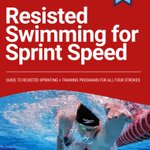
My new guide, Resisted Sprint Training for Swimmers, shows you exactly how to make resisted swimming work.
More force. More power. More speed.
And most importantly… more PBs.
Launching soon.
💥💥💥

How Ryan Murphy Built a World Class Underwater Dolphin Kick
yourswimlog.com/ryan-murphy-…

One of the biggest mistakes swimmers make when sprinting is trying to make the stroke too pretty and too quiet.
They try and use:
Big extension
Smooth, patient catch
Super clean hand entry
Which can look fantastic.
And works great for other distances.
But sprint freestyle is chaos.
There is little to no glide.
There is a more aggressive press into the catch.
The arms overlap more.
Intra-stroke velocity spikes get more spikey.
White-water everywhere.
Sprinters are riding the line of control and chaos.
At max speed, the stroke isn’t going to win a beauty contest.
Which is fine…
The goal is to red-line propulsion, not swimming “quiet” or pretty.

Why Swimmers Should Add Landmine Rotations to Their Core Training
yourswimlog.com/why-swimmers…

Why your sprint freestyle is stuck 👇
Sprint freestyle looks simple…
Just “try” really hard.
So swimmers do what swimmers do and unleash full effort in the water to try and get faster.
They sprint hard, lift heavy, and have the fanciest tech suit on the planet… but still can’t hit those elite sprint speeds.
But sprinting is more than just effort.
It’s:
➡️ Training the correct mechanics
➡️ Working the full force-velocity curve
➡️ Identifying where your swim speed is lacking
➡️ Attacking those opportunities
➡️ Progressing in a systematic way
➡️ Making increased speed inevitable
For most aspiring sprinters, it’s not an effort problem, but a system problem.
That’s the idea behind The 50 Freestyle Blueprint.
It’s a step-by-step blueprint (it is in the name, after all) to an elite 50 freestyle.
The start. Underwaters. Breakout. Sprint mechanics. Tempo. The right sets, training, and dryland.
The full system is below.
Built on more than 260 peer reviewed studies and decade of research into sprint performance.
No more guesswork, and no more feeling stuck.
💥 Get your hands on your faster 50 free here: yourswimlog.com/the-50-frees…