
PhD student at @CCVLatJHU @JHU. Research Intern at @NVIDIA. Working on Embodied AI, MLLM, Video Gen.
CCVL@Johns Hopkins University
Joined May 2019
- Tweets96
- Following185
- Followers143
- Likes246



Thrilled to see VFlash gaining momentum! 🚀
It's amazing to see the excitement around fast visual planning for Physical AI. Huge thanks to @DrJimFan for his enthusiasm and support!
Looking forward to pushing the boundaries of System-1 VLMs and embodied intelligence together!

The era of System One Vision Model is here! Introducing VFlash: parsing the visual world in parallel at unmatched speeds for Physical AI.
Most embodied prediction tasks like object localization, robot trajectory planning, and dense 3D motion are fixed-length float vectors. For example, a bounding box is always 6 tokens, a 10-waypoint robot arm trajectory is 54: we know these beforehand. Instead of decoding one token at a time, we can output the entire geometric shape in one go.
VFlash enables up to 12x faster action decoding and a 5.1x overall robot inference speedup on edge GPUs like the Jetson Thor and DGX Spark. What’s surprising is that it ends up even more accurate than the VLM backbone, with up to 61% lower 3D trajectory error. The intuition is that VFlash avoids the cascading errors of autoregressive decoding, where every coordinate is written in ink and every later point loses the chance to backspace.
Everything that moves will be autonomous, and everything autonomous will need to think on its own chip. The next inference revolution is physical reasoning at the speed of reflex.
And as always, it’s open paper, open source! Link in thread:
Excited to finally share VFlash! 🚀
It's been an incredible journey bringing this idea to life. Huge thanks to @ZhidingYu for his guidance and support, and to all our amazing collaborators who made this possible!
Excited to see where fast visual planning takes Physical AI next!

Embodied models don't just think in text, they can think in visual plans, and fast.
Introducing VFlash, System-1 VLM for Physical AI.
Joint work by @YuCheng_Chou_, Shihao Wang and Jin Huang, LPR Team (@jankautz), GEAR Lab (@DrJimFan), and many other collaborators.
🌐 Website: research.nvidia.com/labs/lpr…
🧵[1/8] More details in the thread👇
Yu-Cheng Chou retweeted

New #NVIDIA paper: what if robots never had to wait for their own thoughts?
TacitVLA learns to reason in chain-of-thought or subtasks, but its actions never read them.
→ Keeps the gains of reasoning at up to 3.4× lower latency on 4 benchmarks, and tops RoboMME and RMBench 🧵👇

Yu-Cheng Chou retweeted

🧑🚀 Embodied agents and world models both rely on space: object permanence, spatial memory, physics that still holds a thousand frames later.
🌟 The 2nd Embodied Spatial Reasoning (ESR) Workshop at #NeurIPS2026 in Sydney brings embodied AI, spatial reasoning, and world modeling together for one day.
Paper + demo tracks. Deadline Sep 5, 2026.
🌏 Website: embodiedsr.github.io/
📢 Call for Papers: embodiedsr.github.io/call-fo…
📢 Call for Demos: embodiedsr.github.io/call-fo…
Perception, physics, and action in one room.
#NeurIPS @NeurIPSConf


Yu-Cheng Chou retweeted

Congratulations, @jieneng_chen!

ALT Congratulations! Jieneng Chen successfully defended his dissertation “Physical-World Visual Intelligence Through Structured and Generative Representation” under the guidance of advisor Alan Yuille. Jieneng plans to join Stanford University as a postdoctoral researcher and Harvard University as a recipient of the Kempner Research Fellowship. We in the department are extremely proud of our students who have successfully completed their PhD. Congratulations on this achievement and best wishes as you begin an exciting new phase of life!
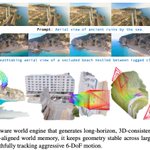
CVPR 2026🎥We built a model that lets you fly through a generated video world.
Not just generating frames —
but maintaining a consistent 3D world under complex camera motion.
Code, ckpt, and even the data pipeline are all open-sourced ↓
#AI #worldmodel #videogen #cvpr #drone
Deep gratitude to our advisors @never1andd, @YuilleAlan, and @cihangxie for their guidance and support throughout this work. Thank you! 🙏
🔗 Code: github.com/johnson111788/Cap…
🔗 Project: johnson111788.github.io/open…
If you’re working on video / world models —
would love to connect.

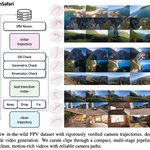
Importantly, we open-source the entire curation pipeline:
• trajectory reconstruction (SfM / hloc)
• geometric verification
• motion consistency checks
• automatic repair & filtering
→ You can build your own OpenSafari.

We also built OpenSafari, a dataset designed to break existing models:
• in-the-wild FPV drone videos
• large-scale camera motion
• strong parallax & elevation changes
Every trajectory is geometrically verified.

The difference is most visible under aggressive motion:
• sharp turns
• large parallax
• long trajectories
Baselines collapse, ours stays consistent.
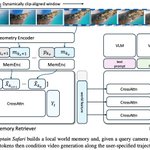
Our idea: build a world memory.
At each frame, the model retrieves 3D-consistent information conditioned on the camera pose.
→ This enables stable generation under 6-DoF motion
→ Even for long trajectories in complex outdoor scenes

But in reality, most video generation models today:
❌ Only work on narrow domains (e.g., real estate scenes)
❌ Break as soon as the camera moves
❌ Fail to follow the camera trajectory
The core issue?
→ No persistent world representation

Yu-Cheng Chou retweeted
Join us at #ICCV2025 for the 1st Embodied Spatial Reasoning Workshop!
We're thrilled to host amazing speakers from industry and academia, featuring Sifei Liu, @xiaolonw, @xf1280, and @kate_saenko_, to discuss frontiers of spatial reasoning, embodied agents, and robotics!
🔗 tinyurl.com/yn7b6mu6

Well-Formed, Ill-Grounded. We re-check GPT-OSS (InternVL3.5-aligned) vs Qwen on MMMU. Verdict: visual alignment ≫ formatting. Qwen wins with longer, grounded chains; OSS looks tidy but often doesn’t see the image. Blog + data ↓ #LLM #GPT #Qwen #InternVL irradiated-lace-40e.notion.s…

Deep gratitude to our advisors @cihangxie and @never1andd for their guidance and support throughout this work. Thank you! 🙏
[4/4] Next step: we’re releasing VLAA-Thinking-SFT-v0.1 (26k) to jump-start visual–reasoning SFT on OSS baselines—so you can sanity-check tokenizer, packing, and the OSS chat template. Blog + dataset in thread. huggingface.co/datasets/UCSC…

[3/4] Pretty markdown ≠ perception. OSS often formats well yet misses visual evidence or the question intent. Without grounding, style can even mask failure modes. We measure the gap explicitly on MMMU. #LLM #MMMU #VisualAlignment

[2/4] Longer chains, higher gains. Qwen’s deliberate, multi-step reasoning ties evidence→logic→answer, especially in STEM. OSS tends to be shorter, so accuracy lags when problems require real visual grounding. #STEM #Reasoning #LLM

[1/4] We tested InternVL3.5-aligned GPT-OSS on MMMU and found visual alignment gaps: misreads, shallow grounding, and repetition. It’s an early step, not the solution—good scaffolding, weak seeing. #Multimodal #VisionLanguage
