

CMO @SecurityB0at. 10+ years in B2B revenue. I write about founder-led sales, pipeline and AI in sales. New essay every week ↓
Joined May 2015
- Tweets2.5K
- Following472
- Followers1.3K
- Likes25.8K






Pinned Tweet
The first sale a founder makes isn't a motion. It's their personality.
You can't hand a personality to an AE.
Wrote up the 5 things you actually have to put on paper before your first sales hire, and the 4-month handoff that follows.
xitter.gq/_ShantanuKul/status/20…


2
362
Kickoff within 5 days, setup driven by you, the first win engineered for day 5, the champion armed by day 7, skeptics converted by day 14.
Renewal rates are set here, not in month 11 ↓

1
50
The renewal conversation in month 11 is mostly a formality. The real decision got made in month 0 — in the two weeks after signature, when the buyer's optimism met your onboarding.
The pattern in churned accounts is depressingly uniform: signature, a warm welcome email... then a gap. Kickoff "whenever works." Setup that dribbled across weeks. First value arriving in month 2, after the excitement died and the skeptics got to say "told you."
Meanwhile the accounts that renew: value visible in week 1, users active by week 2, the success metric already moving by the first check-in.
Same product. The first 14 days decided which story each account lives.
1
3
129
Every account you sign teaches your company something — and the wrong accounts teach the wrong lessons.
A book of right-fit customers trains support on real patterns, points the roadmap at repeated needs, and produces case studies that attract more of the same. A book polluted with wrong-fit accounts trains everyone on exceptions: support learns workarounds, the roadmap chases one-offs, the case studies attract... more wrong fits.
Compounding works on customer bases too — in both directions.
Selectivity isn't a luxury for later. The earlier the stage, the more each account defines what the company becomes. Choose like it's the curriculum, because it is.
1
51
Seven signs a deal costs more than it pays — visible before signature, expensive after.
The negotiation is the trailer. The committee map doesn't lie. The gut was right in week 2 ↓

37
The deal every founder eventually regrets: closed in triumph, priced at the floor, custom terms, a buyer who negotiated like you were adversaries and then became a customer who behaves the same way.
Twelve months later the math is visible: support hours at 4x the average, a roadmap bent around one account's demands, renewal negotiated at knifepoint again, and the team quietly demoralized by every interaction.
Revenue that costs more than it pays isn't revenue. It's a subscription to a problem.
The walk-away list isn't about pride. It's the recognition that at founder scale, every account you take is an account's worth of attention you can't give better customers.
45
Zero risk, zero effort, zero budget, infinite precedent, 100% retention.
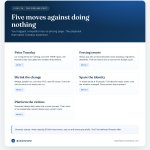
The five moves that beat it — price Tuesday, find the forcing event, shrink the change, spare the identity, platform the victims ↓

38
The sentence that runs procurement since forever: "nobody ever got fired for buying IBM." The real version is darker: nobody ever got fired for buying NOTHING.
The do-nothing option has a perfect resume: zero implementation risk, zero budget exposure, zero political capital spent, infinite precedent. Every purchase proposal in history has competed against it, and it wins most of them.
Your real competitor isn't in your battlecards. It's the buyer's Tuesday — comfortable, familiar, and free.
Tonight's article: the complete playbook against the status quo — pricing the do-nothing option, de-risking the change, and knowing when staying put is genuinely their right answer.
48
The lazy model of customer advocacy: satisfaction accrues quietly, and one day the customer volunteers a testimonial.
Reality: advocacy is manufactured at specific moments — signature day, the first big win, the renewal, the moment they get promoted partly on your product's results. Between moments, satisfaction just sits there, unexpressed and expiring.
The founders with deep benches of references, case studies, and warm intros aren't better loved. They're better SCHEDULED — they catch each moment with a pre-planned ask sized to the warmth.
Build the moment map for every account: signature, day-60 win, renewal, champion's promotion. Four asks a year, each landing on fertile ground. That's the entire advocacy machine.
1
42
There's a 10-day window when a new customer will agree to almost anything reasonable: right after signing, when optimism peaks and reciprocity is fresh.
Ask for the case study THEN — not the finished story (there isn't one yet), but the COMMITMENT: "once we hit [the success metric], can we write up the before/after, your approval on every word?"
Asked at signature: a natural yes, part of the partnership's opening. Asked in month 7, cold: a favor requiring legal review.
Same ask. The timing is the whole price. Signature day is a harvest of future assets — the case study, the referral norm, the reference-call yes. Plant them all while the ink is warm.
37
The status quo's scorecard: zero risk, zero effort, zero budget meetings, zero signatures, 100% trust.
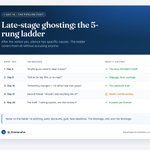
The three early markers of a deal quietly heading to "no decision" ↓

1
53
Nobody puts "PO number pending" on a loss report, but here's what actually happens between verbal yes and money in the bank:
The contract sat 4 days in a signer's inbox under a vague subject line. The invoice bounced because it lacked a PO number nobody mentioned. The vendor form asked for insurance certificates that took a week to chase. Payment routed to a wrong-currency account and boomeranged.
Each snag: 2–7 days. Stack three and your October signature pays in January.
Paperwork isn't beneath deal execution. In the final mile, paperwork IS deal execution — and it rewards preparation more reliably than any pitch ever did.
70
The final-stretch etiquette problem: you need daily awareness, but daily "any updates?" makes you unbearable at the exact moment goodwill matters most.
The solve is the close plan itself. Once the last mile is a shared checklist with dates, your presence changes species: you're not asking for updates — you're maintaining a schedule you both own. "Security's due today per the plan — anything they need from me?" is logistics. "Any movement?" is neediness.
Same frequency, opposite reception. The difference is whether a plan exists.
This is the MAP's final gift: it makes your persistence read as diligence. Deals at 90% deserve daily diligence.
31
"Waiting on a few things" decomposed: 8 items, owners, durations — and half of them can run in parallel if YOU propose it.
The day-by-day close plan, tonight in article 5 ↓

1
29
Deals in their final stretch die of vagueness: "we're just waiting on a few things" — a sentence that has murdered more Decembers than any competitor.
Waiting on WHAT, owned by WHOM, due WHEN, blocking WHAT?
The last two weeks contain a knowable checklist: stakeholder sign-offs, security completion, legal rounds, PO issuance, signature logistics, kickoff scheduling. Each item has an owner and a duration. Which means the endgame can be PLANNED — day by day, like any project with a deadline.
Tonight's article: the day-by-day close plan — the checklist, the daily rhythm, and the three stalls that eat final weeks.
"Waiting on a few things" is not a status. It's a confession.
32
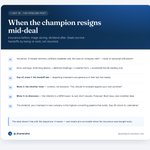
Bought before the LinkedIn announcement: three threads, artifacts that argue alone, a case built on company math.
Then the triage — handoff ask, inheritor reset, re-discovery — and the departure dividend ↓

38
Renewals get framed as risk: the moment a customer might leave. So founders happily trade them away in multi-year locks.
But the renewal is also the only scheduled moment where value gets re-litigated in your favor: usage grew, the product improved, new modules shipped, the champion got promoted on your wins. The renewal is where expansion, re-pricing, and case-study asks live.
Skip two renewal cycles and your best account has a 2019-vintage price, no expansion review, and a relationship maintained by invoices.
If you sell multi-year, calendar the month-18 business review at signature. Keep the conversation even when you've sold away the checkpoint.
1
46
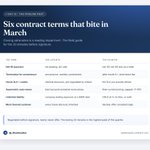
The 2-year deal at 15% off feels like free money in October: bigger contract value, locked revenue, one less renewal to fight.
Run the March math before you celebrate. If your product improves fast — and at your stage it should — you just locked your BEST logo at your WORST price for 24 months. If your pricing is headed up (it is), the lock compounds. And the renewal you skipped was also the expansion conversation you skipped.
Multi-year isn't bad. UNPRICED multi-year is. The lock has a cost — charge for it, cap the discount, and build the expansion door into the term. Certainty is a product. Sell it like one.
47
Auto-yes, auto-no, and a priced trade menu — decided calmly, answered instantly.
Rules answer in the meeting. Moods say "let me get back to you" and cost 3 days each ↓

38
Big companies have deal desks: a function that approves discounts, non-standard terms, and exceptions — with rules, precedents, and a paper trail.
You have... your mood at 6 PM.
Same decisions, no rules: this buyer got 15% because they asked twice, that one got net-60 because the email came during a stressful week, another got a custom SLA because the call ran long. Each exception felt reasonable. Together they're a pricing system designed by fatigue.
The fix isn't bureaucracy — it's one page: what moves, what it costs, who approves (you, but by rule). A deal desk of one still beats a mood desk of one.
43
Founders make hiring and spend decisions against their Expected number, because Expected feels honest — it's the middle, after all.
But Expected includes the haircut of Best Case, and Best Case is the line where hope lives. When two condition dates slip — and two always slip — the spend committed against Expected is suddenly committed against money that moved to Q1.
The discipline: commitments against the FLOOR, ambitions against the Reach. The floor is the only number that survives a normal quarter's worth of bad luck, which makes it the only number that should sign offer letters.
Revenue optimism is free. Spend optimism compounds at burn rate.
40