

postdoc, systems&functional programming, compilers, bioinformatics.
Joined January 2012
- Tweets2.5K
- Following514
- Followers164
- Likes1.6K





so after today's sha3 I hope everyone clearly understands they _should_ implement their own cryptography.
This is super sad. As an artificial lingiustics bonus, please feel free to spot a pro-microsoft hatebot in the thread.

@github copilot, with "public code" blocked, emits large chunks of my copyrighted code, with no attribution, no LGPL license. For example, the simple prompt "sparse matrix transpose, cs_" produces my cs_transpose in CSparse. My code on left, github on right. Not OK.

Anyone here who already used/contributed to @PeerCommunityIn ? (kinda scanning for opinions :] ) for #academic #research #publishing
1
Please do #DataScience and #MachineLearning responsibly. The dataset reviewed in this thread is startling.

Now that monkeypox is coming to the foreground I was afraid there would be a misuse of ML methods like we saw during the outbreak of the COVID-19 pandemic. Then I found the following preprint in arXiv authored by researchers from the University of Oklahoma.

2
@Google Hi, please where do I report Google Scholar issues? We've got authors missing in Harvard and Vancouver citation styles here scholar.google.com/scholar?q…


@LH Hi, what's the best place to ask question about pikaparser? I can't grasp how canMatchZeroChars can be filled correctly with cyclic grammars, in particular how to resolve this for connected components. Are cycles that can match zero chars completely disallowed?
Seems like I'll be slowly but progressively leaving🐦towards something more distributed, likely #MastodonSocial or so (other recommendations welcome)
1
Fact: McEliece cryptosystem is _wonderful_.

Posted new paper "Understanding binary-Goppa decoding": cr.yp.to/papers.html#goppade… This is an introduction to the decryption algorithms inside Classic McEliece (classic.mceliece.org), _the_ post-quantum encryption system for people prioritizing long-term security of their data.
2
10 billion cells (whole organs of cells!) clustered in just under 20 minutes🚀
GigaSOM.jl shines on the 🇱🇺#Luxembourg national #supercomputer #MeluXina! Many thanks @luxprovide
for granting access to our pilot project! @lcsb_uni_lu @uni_lu @JuliaLanguage #singlecell #cytometry

@huel Hi! Quick question-- Is there any reason for _not_ grinding the flaxseed that goes to savory huels (e.g. korma)? I'd assume that crushing them would make them much more digestible (and useful) than now. Thanks!
1

Hello @leland_mcinnes , quick question-- is there some simple C/C++ implementation of UMAP that we could plug into this instead of tSNE? (perhaps related: can UMAP run with the "normal" gradient descent, so that the stuff would stay "smooth" for the user?)

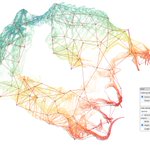
Apart from dragging the clusters to your preferred destinations (possibly solving some global layout ambiguities), there are goodies to help you with the global&local layouting. I added a few more landmarks and ran the "tSNE model trick" to organize them automatically:
1
1
We've got a new interactive dimensionality reduction tool BlosSOM🌼 and it's quite fun to use, so let's do a🧵 with videos.
For impatient: it helps with #cytometry data, the paper is here at arxiv.org/abs/2201.00701 and software at github.com/molnsona/blossom/

