



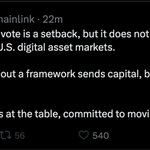



One of the most bearish Sergey talks I have seen. He says they keep building to "land and expand" but aren't getting the traction "expand". Also said any revenue needs to go back into the network which is crazy because they are dumping $700mil onto the market annually as well.

“All of this (adoption, tokenization) will generate a lot of revenue. The $LINK token will play a crucial role in this.” — @SergeyNazarov at LINK:NYC.
The Chainlink Reserve is how that thesis starts translating into token demand.
As institutional adoption drives greater usage of Chainlink services, a portion of the resulting revenue can be converted into $LINK through Payment Abstraction and accumulated in the Reserve.
The bigger Chainlink’s role in global financial infrastructure becomes, the more significant this mechanism gets.
We’re still early.

Chainlink will use regulation as why it is not transparent about revenue, token utility, etc. meanwhile this is Aave's transparent income statement updated quarterly. $link holders should demand more from @chainlink.


I recommend everyone reading this tweet.

The Path to Freedom: Why Fannie Mae and Freddie Mac Exiting the OTC Market Is a Generational Financial Event
For nearly two decades, the Federal National Mortgage Association (OTC: FNMA) and the Federal Home Loan Mortgage Corporation (OTC: FMCC) collectively known as Fannie Mae and Freddie Mac have existed in a state of financial purgatory. Since being forced into federal conservatorship during the 2008 financial crisis, their common and junior preferred shares have been banished to the Over-the-Counter (OTC) markets, trading as highly speculative penny stocks despite underpinning America's $12+ trillion housing finance system. However, a confluence of regulatory shift, aggressive corporate restructuring, and high-profile investor backing has transformed a multi-year stagnation into a realistic exit strategy. Prominent institutional voices, including billionaire investor Bill Ackman, have targeted a NYSE relisting and a subsequent public offering as a pivotal milestone.
Exiting the OTC market is not just a technical change in trading venues; it represents the ultimate monetization catalyst for shareholders and the total restructuring of U.S. mortgage finance. From OTC Back to the NYSE When the Federal Housing Finance Agency (FHFA) seized the Government-Sponsored Enterprises (GSEs) in 2008, the major exchanges delisted the equities due to a lack of independent corporate governance and capital compliance. Returning to the New York Stock Exchange (NYSE) requires a structured sequence of events designed to transition the entities back to fully autonomous private operators. The U.S. Treasury holds massive tranches of senior preferred stock and warrants representing a ~79.9% equity stake in both enterprises. To execute a public offering or an exchange up-listing, the Treasury must convert, restructure, or write down these government stakes to allow public equity to hold tangible value.
Under previous regulatory agreements, the Enterprise Regulatory Capital Framework (ERCF) set highly demanding capital reserve thresholds before the GSEs could operate independently. Current initiatives under the Trump administration have directed the FHFA to evaluate lower, more realistic capital requirements, opening a viable window for an exit. Once the balance sheets are normalized, the companies will undergo a massive secondary public offering or a re-IPO. A major portion of the capital raised will be used to fill the remaining reserve gaps estimated at billions of dollars and satisfy final regulatory hurdles. The structural transformation of Fannie and Freddie can be mapped across distinct phases, shifting from low-liquidity speculative instruments to institutional-grade blue-chip financials:
The thesis for buying FNMA or junior preferred shares (like FNMAS) hinges entirely on this structural pivot. The Erasure of the Liquidity Discount, Stocks trading on the OTC markets inherently trade at a steep discount due to wide bid-ask spreads, low volume, and a complete absence of institutional capital. Up-listing to the NYSE instantly eliminates this liquidity penalty, automatically forcing a broad re-valuation of the underlying equities.
Under the direction of FHFA Chairman Bill Pulte, the agencies have engaged in rapid organizational reform. Over a dozen board members have been replaced, and a sweeping sweep of senior management—including several C-level executives has taken place to streamline operations, cut legacy administrative bloat, and prepare the financial models for public market scrutiny.
The Strategic Conclusion and Exiting the OTC market and transitioning back to a major exchange will mark the end of the largest conservatorship in financial history. It provides a blueprint for returning massive financial engines to private capital while shielding taxpayers from systemic real estate risk. For investors holding shares on OTC Markets, the current volatility represents the final chapter of a 18-year waiting period.
16
687


what you are going to witness in silver is going to get silly. $300 will happen sooner than anyone realizes.

1
186
There are so many mining stocks that will at minimum double by eoy its crazy. So many ways to play this 2nd leg of the bull market.


3
331


Welp pretty much spot on - $link to sub $1 sooner than you think.


