






Ninad retweeted

An uncomfortable truth
AI will diffuse through society as a GPU per person
thesis.truffle.net/

Ninad retweeted

I am begging you, export your ChatGPT history this week.
You've spent years telling it about your projects, your health and how you write. All of that lives on OpenAI's servers.
If OpenAI locks, bans or loses your account, you lose those chats with it. You also can't move them to Claude, Gemini or a model on your own laptop.
In ChatGPT, open Settings → Data controls → Export data, and OpenAI emails you a zip of every chat. In Claude, you'll find the same button under Settings → Privacy.
Save the zip on your own drive. Then copy the parts that matter into one plain notes file, so any AI can read it, including the open source model you downloaded last weekend.
The export takes one click and a minute of your time.
Keep your AI memory on a drive you own.


Ninad retweeted
Software broadly is having its Canva moment.
Vibe-coding allows every person to develop their own software; it won’t be the same class of software as a professionally built product, but it will meet the needs of many.
And expect a huge support industry to emerge, mostly Asia-based folk that will help maintain that code.
This won’t replace “Photoshop”-class software, though. That opportunity remains significant and will grow in its own right.

Ninad retweeted
A lot of business leaders personally benefit from AI but are getting frustrated with the lack of impact on their business.
The reason is that they are the “human in the loop” when they use AI; but the business implementation has to work without a human in the loop.
This requires non-trivial engineering.
Few still understand this.

Ninad retweeted

Unlike most people on Twitter, I’m actually using GPT3 in a production system. The mistake people are making is they are asking “how can I use this to automate a smart person’s job”, when they should be asking “what would I do if I had unlimited dumb people”


Ninad retweeted

Dario has written that we need to “pace the frontier,” and Sam has agreed. People may be surprised by my response: go ahead.
You guys are the frontier. By any reasonable metric — market share, revenue growth, model capability — the two of you have a duopoly on frontier intelligence. You’ve also claimed the lead is widening because of recursive self-improvement.
I don’t see what you see in the lab. If the unreleased models are scary enough that you think you should slow down, I support your decision to be responsible.
But stop pretending you need anyone else’s permission. Stop pretending antitrust law has to be suspended so you can form a cartel. Stop pretending you need a regulatory approval process that supersedes product liability. Stop pretending METR is independent when it is intertwined with Anthropic’s investors and staff. Stop pretending you need those same evaluators to police competitors who aren’t even at the frontier.
Most of all, stop pretending the motivation to slow down is purely altruistic. You face massive product-liability exposure if your products enable a truly damaging cyberattack. The market already punishes models that behave in unpredictable or unauthorized ways. After the Hugging Face episode, it is simply good business for OpenAI and Anthropic to trade some raw power for reliability and predictability. Call it alignment if you want. It is also just giving customers what they want.
Pacing the frontier would also create breathing room for a more intelligent conversation about regulation than Bernie Sanders’ “shut it all down.” China is very unlikely to join a global agreement, as you know, and that has to be taken into account as well.
So go ahead and pace the frontier. You are the ones setting it. The easiest way not to build superintelligence is for you to agree not to build it. Demanding your preferred regulatory framework as the price of that will look like blackmail of the public and the political system. So just do it.
If you do, you’ll buy goodwill for the next conversation. If you don’t, we’ll know this was just another bid for regulatory capture — or an election-season psyop.
Ninad retweeted
This should also make you realize that a true personal AI is aligned with no one except the person using it
Any company pretending to give you a personal AGI that’s aligned to someone else is pulling a fast one
Most VCs too dumb to understand this


Ninad retweeted

The great thing about AI is it allows us to achieve about 80% of what an expert would achieve.
The danger of AI is it's that last 20% can really come back to bite you.
Ninad retweeted

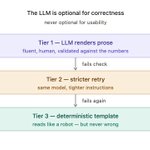
Enterprise AI isn't failing because the models aren't good enough. It's failing because companies are aiming good models at broken processes.
The hard part was never building the agent. It's diagnosing what to automate deterministically, what to hand to an agent, and what to leave with a human.
That's a process engineering problem, and solving it is what makes the same model 100x more effective.
Thank you Annelies for the feature!


Ninad retweeted
A country is a marketplace.
Beneath the flag and the anthem, what it really offers is a foundation of trust and stability — the thing that lets strangers transact without watching their backs.
The USA is conceptually Uber, just at nation scale and a few centuries older: a platform that matches participants and guarantees neither side gets robbed.
"GDP" is the platform's GMV. "Rule of law" is its trust-and-safety team.
This is what we actually mean by a low-trust society — and why the label is an economic diagnosis, not a cultural one.
A low-trust society isn't short on talent or ambition or resources. Its platform doesn't guarantee the ride. So every participant has to self-insure: guard the property, enforce the contract, verify the counterparty, bribe the gatekeeper.
That self-insurance is pure overhead. It builds nothing. And it's the entire difference between a place that compounds and a place that just churns.
Rich country, poor country — same drivers, same riders. Different platform.
Ninad retweeted

The minimum to run the model is ~$20K in hardware and you get ~20 tok/s out
~$20K gets you around 34.6B tokens at a 12:1 input to output ratio assuming good token caching
If you ran the hardware 24/7, it would take roughly 5.5 years to break even


Ninad retweeted

Just holding the QQQ index over the last 10 years would have generated a 22% IRR
You would have outperformed almost every venture capital and private equity fund that exists simply by owning an index and doing nothing beyond that
It is a fallacy that retail needs access to private markets to generate good returns
The reason you see many people push for this is because they want exit liquidity on their own positions. Nothing more

I think it’s time to revisit the accredited investor laws in the US.
Companies are staying private longer, where only accredited investors (aka rich people!) can invest. Retail investors can only come in after IPO, when much of the upside has already been captured.
These rules were created with the best of intentions, to protect regular people from scams - a noble idea. Unfortunately, in practice they've often made it illegal to get richer, unless you're already rich. A regressive tax!
We have to judge policies based on their outcomes, not on their intentions.
These are two possible routes I see:
1) Replace the rule with something merit-based, like a financial literacy test. Pass it and you're accredited. Having a qualification based on competency rather than your bank balance or income seems far more fair.
2) Remove the rule entirely. Let consenting adults assess their own risk. Disclosure requirements stay and fraud enforcement stays to punish bad actors.
Ninad retweeted

Outstanding distillation. Explains why you can’t skip this podcast.

THE TOKEN HANGOVER
@matanSF (Matan Grinberg), CEO and co-founder of @FactoryAI , interviewed by @HarryStebbings (@20vcFund )
This is a special for me since I've been an investor in @FactoryAI since their seed round, and think Matan is a very very special founder.
Summary: Grinberg argues the next 24 months in enterprise AI are a resource-allocation problem: tokens, dollars, and people. Most CIOs are now waking up to bills they cannot justify. The fix is to spend frontier tokens only on the 10-20% of work that requires planning intelligence, run the other 80-90% on open models, and rebuild teams around load-bearing polymaths who own business outcomes. The single-frontier-monopoly fear is fading: four roughly-equivalent labs is the emerging reality, which puts pricing power back in the application layer.
1. The Token Hangover. Enterprise AI adoption ran through three phases this year: boards yelling at CEOs about AI strategy, "token maxing" with AI usage written into perf reviews, and now the morning-after bill. One CIO Grinberg spoke to was spending hundreds of thousands of dollars a month on engineers asking Opus 4.8 things like "how's it going" and "what are my macros from lunch." The frontier model became the default surface for every question, no matter how trivial. Phase 3 is the moment routing matters: every call to a frontier model needs to earn its price.
2. Resource Allocation Is the Job. For the next 24 months every C-suite is solving the same problem: how to allocate dollars, tokens, and headcount against business outcomes. Engineering teams used to be judged by features shipped per quarter, a metric with no link to revenue, market share, or retention. A logistics company adding more engineers to ship more features was always solving the wrong problem; AI made the misallocation visible. Tie every person's work to the metric that actually moves the business, then re-allocate.
3. Load-Bearing Individuals. The "10x engineer" frame measures lines of code, the wrong unit. Grinberg's unit is the load-bearing individual: the person whose absence breaks something. With AI the load-bearing few compound roughly 10,000%; the others get close to nothing, so any org enforcing one token-spend-per-engineer number is painting with too wide a brush. Average token spend per engineer will land on the same order of magnitude as their salary within three years, with a wildly bimodal distribution.
4. Frontier for Decisions Only. 80-90% of software development tasks can run on open models; the remaining 10-20% is planning, where the frontier still wins. This mirrors how human orgs work: leadership is a tiny share of total hours but decides the company's fate. The ego trap is engineers assuming their work is too important for an open model. The router decides better than the engineer, and the cost curve falls only if you wire the routing.
5. The Kirkland Mistake. Kirkland & Ellis announced a $500M, five-year internal AI build, which Grinberg reads as validation for Harvey rather than a threat. Building AI is not a law firm's core competency, and Kirkland's spend will teach them how hard it is. The general rule: just because you can build it does not mean you should, and the discipline is naming the few things you and your team own end-to-end. Outsource everything else, even when you technically know how to do it yourself.
6. Model-App Separation. When the model provider also sells the app, the incentives split: an API business wants you to spend more tokens. A healthy market keeps the application layer independent, so model providers compete on price, speed, and quality every week. Enterprises do not want to vendor-lock again; every CIO carries scars from the cloud era's three-year discount-then-jack-the-price trap. The application layer survives precisely because it forces that competition.
7. Sales as Product. Name a legendary company with a weak sales or marketing team. You can't. The Silicon Valley fallacy that research sits at the top and sales is "dirty work" produces companies that win the gold rush and then collapse when gravity returns. At Factory, engineers and salespeople sit intermixed; when sales closes, engineering says "we closed"; when engineering ships, sales says "we shipped." Atrophied sales muscles will not regrow once enterprise buyers stop saying yes to everything.
8. Polymath Era. Da Vinci, Newton, Euler could be polymaths because their fields were shallow. By the 2010s a theoretical physicist needed 50 years to reach the frontier before contributing anything new. AI collapses that catch-up time, so one person can push forward developer marketing, token-caching infrastructure, and solution engineering at once. The engineer of the future is a GM who owns marketing copy, product metrics, and sales enablement.
9. Build the Factory. Factory's name is literal: engineers in the next era design the assembly line that produces software. The DevX investments that used to scale linearly with headcount (good docs, CI/CD, linters, pre-commit hooks) now scale with the number of agents you run, which is 10x or 100x larger. Every dollar spent making agents production-ready compounds against thousands of PRs a week. Humans move up the stack, from writing code to designing the system that writes code.
10. Seal Team Six. Mandating beds in the office is a hiring failure dressed up as commitment. Grinberg's image: a basketball game judged by who sweat the most, when the scoreboard is what counts. Factory bought eight sleeps for all 30 team members at the time, because recovery is where the gains come from when work requires every ounce of brain power. If your load-bearing engineer can do their best work on two hours of sleep, they were not doing load-bearing work in the first place.
11. Four Frontier Labs. Grinberg's biggest mind-change this year: a single dominant model is unlikely, and four roughly-equivalent frontier providers is the more probable steady state. That outcome is the win for humanity. A one-lab monopoly was the dangerous scenario, and four equivalent labs is also the structural bull case for the application layer because it forces real ongoing price competition. Every CIO Grinberg meets has already decided not to throw their lot in with a single provider.
12. Dario's Self-Serving Doom. "AI will take your jobs" was the pitch that helped raise hundreds of billions, and Grinberg thinks it damaged public psychology and fed the slow-AI lobby. Watch the rhetoric flip at IPO: humans will suddenly become important again, because humans are the ones buying the stock. Founders who never needed to raise that money, like Zuckerberg and Hassabis, never made that argument. Incentives drive the labor-displacement rhetoric more than philosophy does.
