
Building, Physics & Philosophy @ Oxford, IOAA Gold
Oxford, England
Joined November 2022
- Tweets120
- Following256
- Followers404
- Likes464




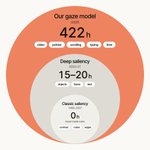


UX designers are now using Orion to improve conversion and engagement
It's great seeing the diverse use of our new foundation model
Try it yourself
github.com/ryanlin10/orion-g…


Thank you for the Orion Gaze API, it's been genuinely useful.
We ran about 50 screenshots through /v1/predict. Setup took minutes, the docs were clear, predictions came back in seconds, and DELETE cleaned everything up exactly as documented. EU-only processing was a big plus for us.
It changed a real design decision. Our Run button was getting almost no predicted attention (about 0.1–0.2× chance). Making it bigger, bolder or adding an accent did nothing. Moving it to the top of the image column took it to roughly 4–10× chance, at a small cost to the image itself. We're adopting that placement, and screening variants with Orion is now a standard step before we show design finalists.
Some feedback, in case it's useful:
• Per-element scores. Attention share for a region or CSS selector would save us the post-processing we do on the grid.
• Phone viewports. 390×844 screenshots are accepted, but the grid stays 64×40 and attention piles into the top-left corner, so we couldn't rank phone layouts. Phone-tuned predictions would be great.
• Known priors. We noticed a pull toward the left edge and the top of the page. A short note on the model's known biases would help us read the results fairly.
Thanks again, and looking forward to where this goes
1
5
336
Ryan Lin retweeted

Thank you for the Orion Gaze API, it's been genuinely useful.
We ran about 50 screenshots through /v1/predict. Setup took minutes, the docs were clear, predictions came back in seconds, and DELETE cleaned everything up exactly as documented. EU-only processing was a big plus for us.
It changed a real design decision. Our Run button was getting almost no predicted attention (about 0.1–0.2× chance). Making it bigger, bolder or adding an accent did nothing. Moving it to the top of the image column took it to roughly 4–10× chance, at a small cost to the image itself. We're adopting that placement, and screening variants with Orion is now a standard step before we show design finalists.
Some feedback, in case it's useful:
• Per-element scores. Attention share for a region or CSS selector would save us the post-processing we do on the grid.
• Phone viewports. 390×844 screenshots are accepted, but the grid stays 64×40 and attention piles into the top-left corner, so we couldn't rank phone layouts. Phone-tuned predictions would be great.
• Known priors. We noticed a pull toward the left edge and the top of the page. A short note on the model's known biases would help us read the results fairly.
Thanks again, and looking forward to where this goes
Luke and Avi are incredible, they held conviction on the bet on duplex voice models long before it was mainstream, check out their work
You’re unable to view this Post because this account owner limits who can view their Posts. Learn more
1
11
669
Ryan Lin retweeted

A very interesting area of research!
The future of voice interfaces requires a large amount of visual understanding as well
Both will come hand in hand


We are releasing an open-source pipeline to predict your user sentiment from computer actions
Connect to your existing session replay tool
Prevent loss of signal with high-fidelity mouse capture
Pick refined recipes to train sentiment models on your user data
Check it out: paradigmmachines.ai/orion
6
8
642
Synthetic sentiment labelling with VLMs allows us to push past previous data walls
VLMs can label based off semantic (prompt) and visual (UX) context
22
