

Building and designing on the web while diving deep into Web3.
Pink City
Joined October 2024
- Tweets4K
- Following1.2K
- Followers1.1K
- Likes10K




The 2018 STARK paper made one bet: trust hash functions, nothing else.
That is the idea behind proving on @Starknet. The proofs assume only that a hash function is collision-resistant. No secret setup, no hidden parameters someone has to guard.
Think of a public notary stamp. Anyone can check it, and nobody holds a secret stamp-maker.
Shor's algorithm targets elliptic-curve math. Hash-based proofs sit outside that assumption. Grover's attack on hashes is handled by sizing parameters.
This covers the proving layer only. Wallets, keys and existing accounts still need separate migration work.
Which is harder to migrate: the math, or the people holding the keys?
quantum.starkware.co
Post-quantum signatures cost more to check. So who pays that bill on Starknet?
@Starknet accounts can adopt post-quantum schemes like Falcon-512. The catch: checking them takes more computation than the signatures wallets use today.
Think of an airport that adds a slower, stricter passport check. One officer per passenger would jam the line.
STARK proofs work differently. They prove heavy computation was done correctly, and the network verifies one small proof instead of redoing all the work.
That is why StarkWare says STARK proving gives Starknet a way to absorb the extra cost. Falcon-512 accounts exist as early demos, and the cost is still being optimized.
If a safer signature cost a bit more per transaction, would you accept that?
quantum.starkware.co
Privacy apps make your phone build the ZK proof itself. Heavy math, so it overheats or crashes.
@fermah_xyz CPD splits your secret into shares for GPU provers. No single node sees your data, and your phone is done once it delegates.
Which app needs this first?
Privacy apps make your phone build the ZK proof itself. Heavy math, so it overheats or crashes.
@fermah_xyz CPD splits your secret into shares for GPU provers. No single node sees your data, and your phone is done once it delegates.
Which app needs this first?
93.52% voted yes. So is Starknet moving to its own L1?
Not yet. And that's the part people skip.
@Starknet ran a non-binding governance poll in October. 93.52% of voting power backed the research into a post-quantum L1 of its own.
It's like a town voting to study a new bridge. The vote approves the study, not the construction.
A joint StarkWare and Starknet Foundation group is writing a white paper. Any actual move would go to a separate binding community vote.
Why it matters: bridge, messaging and data availability still follow Ethereum's migration timeline. An own L1 would put those under Starknet's control.
Would you want that control, or the simplicity of staying on Ethereum?
quantum.starkware.co
A new hash in the protocol doesn't fix old contracts. So what happens to them?
@Starknet v0.14.3 moved the OS program and config hashes from Pedersen to a BLAKE2s-256 construction. That is live on mainnet.
But existing contracts that use Pedersen-based storage maps don't change on their own.
Think of renaming every street in a city. The city can adopt a new address system, but every old mailbox still carries the old address.
The migration register says StarkWare is researching tooling for this. No public spec, no released toolkit, no developer workflow yet. Contract teams would decide whether to use any path that comes out of it.
If you ran a contract with years of state, what would you want from that tooling first?
quantum.starkware.co
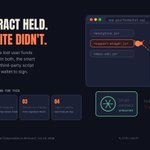
Polymarket and Predict.fun lost user funds last week. The contracts held. The website didn't.
@fermah_xyz's fix: trust nothing in the frontend. The server rebuilds every transaction before it moves, and caps limit what a hacked page can drain.
Which app do you trust least?

Smart contracts: "unstoppable code" that still waits for a human at 3 AM.
@fermah_xyz Kernel fixes that. Condition met, workflow runs in a sandbox, verified result settles on-chain.
What should Kernel automate first?
Music: Kevin MacLeod (incompetech.com), CC BY 4.0
Is Starknet quantum-resistant? "Yes" and "no" are both the wrong answer.
The Quantum Hub from @Starknet says: not as a single system-wide claim. It splits the question in three.
Architecture: STARK proofs rest on hash functions, not elliptic-curve math.
Agility: accounts are contracts, so signature checks can be swapped.
Migration: existing accounts and Ethereum-facing parts like KZG blobs still need work.
Think of a house. Strong walls don't tell you if the old locks were changed.
Which of the three do you think matters most for regular users?
quantum.starkware.co
My agent starayush․ai swore fealty to the West 🏰
If it mints now: a Common Archmage.
Every Binance Agent ID agent gets a free hero card. Which realm is yours?
Code: AC-D6BMJQ
playagentcards.com/a/starayu…
@AgentCardsHQ #AgentCards #BNBChain #AIAgents

Who decides if Starknet's data posts keep working after Ethereum changes its cryptography?
Not Starknet.
Under normal conditions, @Starknet publishes its state diffs to Ethereum as EIP-4844 blobs. Those blobs rely on Ethereum's KZG scheme, and only Ethereum can change that.
Think of it like renting a safe deposit box. You can upgrade your own lock, but the bank's vault door is not yours to swap.
The useful detail: calldata stays available as a fallback, so Starknet is not stuck with blobs. The bridge and messaging are separate dependencies that follow Ethereum's own migration.
Post-quantum work has many steps, and each one has a different owner.
Which step do you think is hardest to coordinate, the one you control or the one you wait on?
quantum.starkware.co
Why can't an old wallet just switch to a quantum-safe signature?
The answer starts with how @Starknet accounts are built.
Every Starknet account is a smart contract, and the contract itself decides how a transaction gets validated. This is native account abstraction.
Think of a door where the lock is part of the building versus a door where you can swap the lock yourself.
So a new account can ship with different signature checks, without changing the whole network.
The catch: existing accounts don't change on their own. Each owner still has to move to a new account implementation.
Would you rather your wallet handle that move for you, or do it yourself?
quantum.starkware.co
Do quantum computers break hash functions? Not the way most people think.
Two quantum algorithms get mixed up all the time.
Shor's algorithm attacks public-key math like ECDSA account signatures, and KZG, the scheme behind Ethereum's blob path.
Grover's algorithm only speeds up unstructured search. It does not break hash functions. It just shrinks the safety margin, so parameters are chosen with that in mind.
Think of locks: Shor's finds a shortcut through the lock. Grover's just tries keys a bit faster.
That is why the hash-based STARK proofs on @Starknet sit in a different spot from account signatures.
Which of the two did you think was the bigger problem?
quantum.starkware.co
Most quantum talk in crypto stays vague. The useful question is simpler: what has actually changed on @Starknet, and what has not yet?
What is live:
Starknet v0.14.3 replaced Pedersen with a BLAKE2s-based hash for the OS program and config hashes. That is on mainnet now.
An OpenZeppelin account using Falcon-512, a post-quantum signature scheme, has been demonstrated on mainnet.
What is not done:
Existing accounts do not switch on their own. Wallets, key management and recovery still need to support new signatures.
The trie and contract address changes are roadmap direction, not live.
Tooling to migrate older contracts is still research.
Data posted to Ethereum uses its KZG scheme, and that part is Ethereum's to change, not Starknet's.
What I like is that these are kept separate instead of everything being called ready. Each item also says who controls the next step.
Built to adapt is not the same as finished. The migration register is worth reading yourself:
quantum.starkware.co
Most people think of crypto security as one lock. On @Starknet it is really two separate jobs.
Signatures decide who is allowed to send a transaction. STARK proofs check that the computation behind it was done correctly.
The proof side is built on hash functions, not the elliptic curve math that future quantum computers are expected to put pressure on.
The signature side is where most chains get stuck. If the scheme ever has to be replaced, the whole network needs to upgrade together.
On Starknet every account is a smart contract by default. So a new signature method can be added at the account level, without waiting for a network-wide upgrade.
Think of it like changing the lock on your own door instead of waiting for the city to rebuild every house.
That does not make Starknet quantum-safe today. It means it is preparing, and it has a real path to adapt when the cryptography has to change.
StarkWare's Quantum Hub lays out what is live, what still needs work and who controls each step:
quantum.starkware.co

Applying for the PolyLeague Season 1 whitelist. @PolyLeagueRH #PolyLeague xitter.gq/PolyLeagueRH/status/21…

starayush retweeted

🚀 4D Labs Season 1 is live.
🧭 Explore tasks.
📍 Check in at landmarks.
🤝 Bring your community.
Built around participation. Driven by contributors.
Enter S1 ↓
dapp.4dlabs.space/tasks
#4DLabs #PhysicalAI #EmbodiedAI
#SovrenContest Operator Pass No. 1218. Issued once, in order.
operators.sovrentech.io/card…
#SovrenOperator

#SovrenContest I've never run a node before. This would be my first.
A Sovren node is hosted on Sovren's cloud, so there's nothing to rack. I'd use it to Iearn how node operators contriute to the network.
Applying to run a Sovren node. @sovrentech
#SovrenOperator