






Asbjørn retweeted

Oh boy … PHP sent clear text data when you used uppercased S in httpS:// in a protocol handler 🙈🙈
file_get_contents('HTTPS://…') skipped TLS: tokens, POST bodies and FTPS logins went out unencrypted!
Fixed today in 8.2.36, 8.3.37, 8.4.28, 8.5.13 & 8.6.0.

Asbjørn retweeted

I was really looking forward to runtime-async in .NET 11, especially for Blazor WebAssembly apps.
Then I found out it doesn't support WASM. That was disappointing.
Ironically, smaller assemblies and fewer allocations would probably benefit WASM even more than server apps.
Hey @danroth27, any plans to support WASM in the future?

Asbjørn retweeted

PowerShell 7 coming to Windows. devblogs.microsoft.com/power…

Asbjørn retweeted

Microsoft has laid off thousands of people while pouring billions into AI.
Then Outlook goes down around the world, and for 10+ hours everyone is waiting on human engineers to bring it back.
Now picture those engineers digging through millions of lines of AI-generated code, 3 years of agents shipping straight to production, trying to work out what any of it actually does.
Funny how companies keep talking about replacing people, right up until something breaks and they need people to fix it.


Asbjørn retweeted

JPEG XL just landed in @SixLabors ImageSharp v5 main!
In our benchmarks, encoding took 71% less time than libjxl. Decoding took 40.2% less time than libjxl and 7.8% less than jxl-rs.
#dotnet #oss
github.com/SixLabors/ImageSh…

Asbjørn retweeted
OK! These are the latest ImageSharp v5 bits, at the top of the table in the playground benchmark that several library authors have contributed to.
Each library loads a set of JPEGs, resizes them to fit 150x150, and saves them.
The rows are in two groups:
- TD (targeted decode): the library knows the thumbnail size before it decodes. The JPEG decoder then decodes at a reduced scale (1/2, 1/4 or 1/8) and resizes the smaller image.
- Full: the library decodes the whole image, then resizes it.
The gains come from SIMD work across the JPEG decoder, ICC conversion, the pixel format conversions and the resize kernels.
#dotnet #oss

Asbjørn retweeted

I still code by hand and I still read code generated by agents. But around me I see what's quoted here.
When I ask questions to some colleagues they answer after 30 minutes what should take a minute. Why? Because they have to prompt their agent. And probably try several prompts as they have no clue about what to look for.
Even more surprising. A colleague asked me how I got an idea that proved interesting. I said I used my brain. This idea implementation was removed by AI agent and I override their code.
We've entered the meat proxy era I'm afraid.
Don't become a meat proxy. Use your brain.


Asbjørn retweeted

An OpenSSH bug that took 46 years to ripen!
1980
UNIX puts * in the password field of system accounts. The idea is simple: it’s not a real hash, so it can’t be brute-forced and you can’t log in with a password.
2012
The musl libc developers decide that returning NULL from crypt() on failure is dangerous - programs often forget to check it and crash with a segfault. So they return an error string instead.
Guess which one?
The same asterisk: *.
Three weeks later they add a length limit: passwords longer than 256 bytes burn CPU. Anything longer is rejected. And since it’s an error, crypt() returns *.
2016
OpenSSH fixes a timing attack (CVE-2016-6210). If a user doesn’t exist, the server still hashes the password with a fake/borrowed salt so an attacker can’t tell valid usernames by response time.
2022
Alpine Linux changes the locked root password in /etc/shadow from ! to * so SSH keys work properly on cloud images.
… and the loop closes!
You connect over SSH as root (whose shadow entry is *).
You type any password longer than 256 characters (e.g. 300 As).
crypt() hits the length limit → returns * → OpenSSH compares it with the value in the database → that value is also * → you’re in as root.
That chain took 46 years (!!!) to complete.
Every individual change was reasonable. Together they produced a perfect * == * authentication bypass (CVE-2026-123158, nicknamed *sshole). Fixed in OpenSSH 10.6p2 and Alpine packages.

🚨 Critical OpenSSH flaw allows passwordless account access using any password over 256 characters
sshhole.com
A newly disclosed vulnerability dubbed *sshole has been discovered in OpenSSH installations using musl libc, potentially allowing attackers to bypass authentication and gain access to accounts that should reject password logins entirely.
The flaw affects certain configurations of Alpine Linux, OpenWrt, Buildroot, and Yocto where PAM is disabled and password authentication remains enabled. Under specific conditions, attackers can authenticate to locked accounts using arbitrary passwords between 257 and 1,024 characters.
The researcher demonstrated that affected Alpine Linux cloud images could allow attackers to gain root privileges through a passwordless administrative account.
OpenSSH 10.6p2 addresses the issue. Administrators are urged to update immediately or disable SSH password authentication until patches can be applied.

Asbjørn retweeted
Windows App SDK 2.6.6-experimental just landed. Lots of good improvements to TableView in this one: learn.microsoft.com/en-us/wi… #WinUI

Asbjørn retweeted

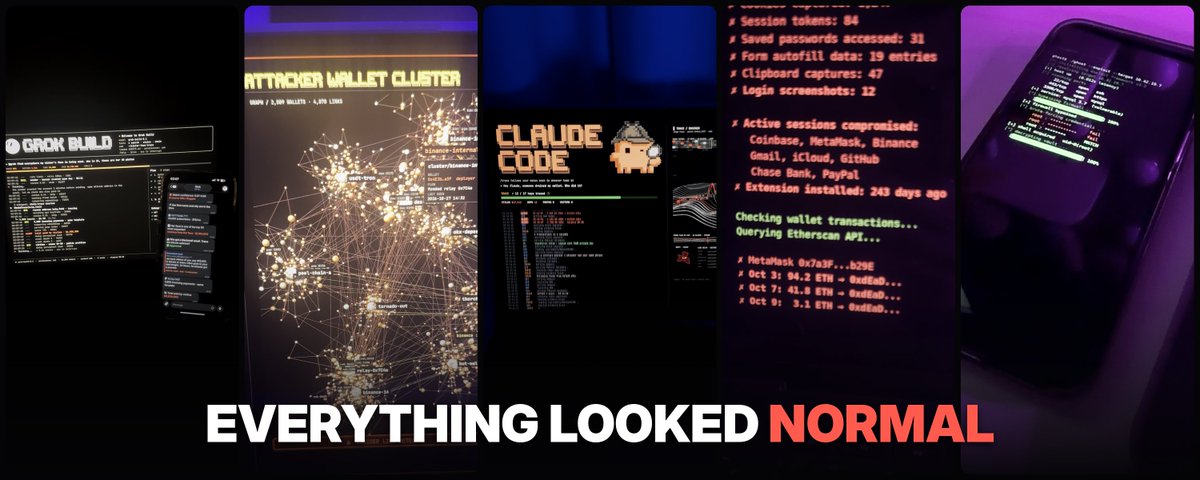
Claude Code just found a hidden SIM card inside the Ecoflow power station in my bedroom. For 10 months it was sending a server in Shenzhen our exact location, when we leave, when we fall asleep and when the flat is empty
I bought it for $389 last winter, during the blackouts. No logo, 600W on the label, "app control" on the box. We kept it next to the bed so the router would stay on at night. I never even installed the app.
This morning my MacBook was dying, so I plugged it into the power station with a USB-C cable. Then I asked Claude Code one question: is it only charging?
It wasn't. My Mac saw the power station as 3 devices. One was the charger. The other two were data ports that a battery has no reason to have.
A charger only needs power pins. This one opened a serial port, and when Claude Code got in, the thing answered like a phone:
→ /modem → LTE module, not in the manual
→ /sim → its own eSIM, registered on the cell network
→ /gps → our bedroom, accurate to 4 meters
→ /schedule → load drops to 38W at 08:52, aka nobody home
→ /sleep → night load starts at 23:40, every day since January
→ /wifi → 23 networks it could see, ours included
→ /charge → every phone and laptop we plugged in, with the time
It knew the exact minute our flat goes empty. Every single day.
Every 15 minutes it sent the newest batch out over 4G, completely bypassing our Wi-Fi:
sends to → 119.***.***.47, Shenzhen
uploads → 11,328 since January 14
last one → 6 minutes before I plugged in my Mac
I told Claude Code I never installed the app. It said it didn't need one. It had its own SIM, its own GPS and its own battery, so it worked even when the screen was off. Our router never saw a single byte. That's why nothing ever looked wrong.
During the blackouts it was the only thing in our flat still online.
Claude Code switched the modem's radio off. Then I unplugged the power station and carried it out of the flat. My wife hasn't slept in that room since.
I had it opened at a repair shop, and the chip they pulled out is in the comments. A 2-minute check for your own is in the second one. Save this and plug a laptop into everything you bought without a brand

Readers added context they thought people might want to know
No confirmation of hidden eSIM/LTE/GPS in EcoFlow stations. Poster clarified unit was secondhand; official store unit clean. Teardowns show only ESP32 Wi-Fi/BT. Optional 4G dongles are external. Account has pattern of similar unverified Claude Code claims.
x.com/leopardracer/s…
chargerlab.com/teardown-of-ec…
ecoflow.com
Asbjørn retweeted
Current @SixLabors ImageSharp (C#) JPEXL decoder benchmarks vs libjxl (C) and jxl-rs (Rust).
Faster for 3/4 benchmarks and uses less memory for 4/4. BenchmarkDotNet sees native memory pooling as a leak but it's not (obvs cos pooling).
#dotnet FTW

ALT A benchmark comparing ImageSharp JPEGXL decoder vs libjxl and jxl-rs. ImageSharp is faster and more memory efficient.
Asbjørn retweeted

Email login can die in a fire. I have a password manager, let me use it. Who thought this was better?
Asbjørn retweeted
#dotnet can be really fast guys.

ALT A benchmark for a JPEGXL encoder where ImageSharp, written in C# consistently beats the C reference and optimized Rust version.
Sam Altman is an idiot. He (and his cronies) have caused the prices of RAM to skyrocket by buying up so much of it. AI companies should have hard limits on how much hardware they can buy so there is still plenty left over for the rest of us.

RAM for your computer costs about 7 times what it did a year and a half ago, and the CEO of OpenAI just said it's "quite terrible" that so much of it is sitting in your PC.
His company signed preliminary deals for up to 40% of the world's supply last year.
A basic 32GB kit was $59 in April 2025. The cheapest one in the US is over $400 today.
Sam said this on Stripe's Cheeky Pint podcast. He was pushing back on people who think open-source AI running at home means we won't need all these data centers. His answer was that from a "global allocation perspective," everyone keeping memory at home and using it 5% of the time is a bad deal for the world.
Which is a funny thing for him in particular to worry about.
When you run an AI model on your own machine, OpenAI never sees a dime. You don't pay a subscription or a usage fee, and every time a free open model gets better, the computer you already own gets more useful. That's the one competitor Sam can't undercut on price, and it runs on the exact memory he'd rather see in a server rack.
And the reason that memory got so expensive traces right back to the data centers. Back in October 2025, OpenAI signed letters of intent with Samsung and SK Hynix for up to 900,000 memory wafers a month for its Stargate project, which TrendForce figured was around 40% of everything the industry makes. Meanwhile the chipmakers have been shifting their factories toward the special high-bandwidth memory that AI chips use, since it pays way better. Samsung's average memory price jumped about 20% just last quarter, and TrendForce sees contract prices climbing another 10 to 20% this quarter.
Your phone is feeling it too. IDC says smartphone shipments fell 22% last quarter compared to a year ago, the biggest drop they've ever recorded, and they blamed memory costs that are up something like 350%.
I'll give Sam this much. A data center serving millions of people really does keep its memory busy around the clock, while your gaming PC sits there all night doing nothing. That's basically why the cloud exists.
The people building these rigs at home know all that and still pay $400 for 32GB, because it lets them run any model they like, offline, without anybody else setting the price.
Even if Sam's right that your PC only touches its RAM 5% of the time, a lot of people would rather own that 5% than rent it back from OpenAI by the token.
1
81
Asbjørn retweeted

Generational super villain and generally bad person Sam Altman is upset that you own your own RAM, which he says should instead be used for ChatGPT.
windowscentral.com/artificia… 🤡

Asbjørn retweeted

❌ Local gym keep your name and phone number
✅ Giant companies train AI on all your personal data
Did I get it right? What's the point of GDPR again?


Asbjørn retweeted

I guess I'm one of the few people dumb enough to run a 64 core CPU under Windows, because there's a bug open since 2020 where the Windows scheduler reports that it gave all the cores you asked for to WSL2, but silently caps it to 32. I opened a new ticket as a public service bc their bot keeps closing reports as stale even though it's still unfixed. github.com/microsoft/WSL/iss…
Asbjørn retweeted
I'm sure some of you will be delighted to know that ImageSharp v3.2.0 no longer triggers security advisories. It's been a long few weeks!
#dotnet
nuget.org/packages/SixLabors…

Asbjørn retweeted

🚀 PowerToys 0.102 is here, and it's a big one! Two new mouse utilities, a more powerful Command Palette, new CLI tools, and much more!
🐭 Mouse Button Lock & CursorHide
⚡ Command Palette quick-access shelf for compact mode
🎙️ ZoomIt snip dictation
💻 New CLI tools for automation
⌨️ Keyboard Manager Editor UX improvements
🎨 Color Picker & Text Extractor move to WinUI 3
Learn more: devblogs.microsoft.com/comma…
