

AAS is a peer-reviewed journal on the dynamics, physics, and chemistry of the atmosphere and oceans. @theIAMAS associated journal. Impact Factor: 5.0
Beijing
Joined November 2013
- Tweets5K
- Following1.8K
- Followers1K
- Likes1.2K
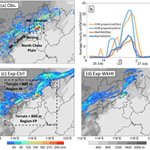


What drove the extreme rainfall that struck northern Beijing on 26 July 2025? New research shows warm-rain processes supplied 77.8% of the increase in rainwater sedimentation.
doi.org/10.1007/s00376-026-6…
#AAS #ExtremeRainfall #Meteorology #AtmosphericScience

German President Steinmeier visited Beijing’s 325 m meteorological tower on 29 Oct. Discover the science in an AAS review of two decades of tower observations, from urban boundary-layer physics to atmospheric chemistry.
doi.org/10.1007/s00376-024-4…
#AtmosphericScience


Steinmeier visits China's 325-meter meteorological observation tower
German President Frank-Walter Steinmeier visited the Institute of Atmospheric Physics under the Chinese Academy of Sciences on October 29, exploring opportunities for further China-Germany cooperation on climate change research.
The institute's 325-meter meteorological observation tower is a flagship research platform in China for studying the atmospheric boundary layer and urban environments. As China and Germany have a long history of collaboration on climate research, the visit offered an opportunity to explore how the two sides can continue working together to address climate challenges. #diplomacy
FY-3G’s spaceborne radar agrees closely with China’s ground-based weather radars. This study reports a 0.87 correlation across 98,226 matched samples.
doi.org/10.1007/s00376-025-5…
#AAS #Meteorology #RadarScience #RemoteSensing #AcademicSky

Have you submitted yet? The Advances in Atmospheric Sciences special issue on CliC OSC 2026: Climate and Cryosphere closes on 10 November 2026. Open to all worldwide
link.springer.com/collection…

⏰ Deadline reminder: Submissions to our special issue “CliC OSC 2026: Climate and Cryosphere” close on 10 November 2026!
Share your latest climate and cryosphere research.
link.springer.com/collection…
@WCRP_climate @CliC_WCRP #CallForPapers
Why did Antarctic sea ice hit a record low in February 2023? La Niña, a positive Southern Annular Mode and a negative Indian Ocean Dipole, together with low spring sea ice, helped set the stage.
doi.org/10.1007/s00376-025-4…
#ClimateChange

ALT Figure 2 from Dou and Zhang (2025), Advances in Atmospheric Sciences. Top: composite Antarctic sea-ice concentration anomalies from austral spring (SON) to February for four positive-SAM/negative-IOD/La Niña events: 1998/99, 2010/11, 2021/22 and 2022/23. Blue shades indicate less ice and yellow-red shades indicate more ice. Bottom: years ranked from highest to lowest February sea-ice extent, compared with SAM, Niño-4 and IOD indices in the preceding season. Source: https://doi.org/10.1007/s00376-025-4309-9
Warmer world, bigger CO2 punch? Not quite. This research shows CO2’s heating effect grows 42% at first, but the atmosphere’s own adjustments cut that to 17%.
doi.org/10.1007/s00376-026-5…
#AAS #AcademicSky #ClimateChange

Air models keep underestimating sulfate pollution. Why? Missing dust and haze chemistry. Adding them to GEOS-Chem cut the bias from 63% to under 1% in a dust event.
doi.org/10.1007/s00376-026-5…
#AAS #AirQuality #ClimateScience #Climatecrisis

🏆 ESI Highly Cited Paper
~25% of clouds overlap in layers, yet satellites struggle to see inside them. Overlap-CloudDiff, a probabilistic deep learning model, retrieves their properties day and night from Aqua infrared data.
doi.org/10.1007/s00376-025-5…
#AAS #AI #RemoteSensing
🏆 ESI Highly Cited Paper
How can a classic ENSO model simulate El Niño better? This study refines the Zebiak–Cane model's heating scheme and tests how key atmospheric parameters shape ENSO amplitude, period and diversity.
doi.org/10.1007/s00376-025-4…
#AAS #ENSO #ClimateScience
Is typhoon risk moving north? 🌀 Using 1980–2025 records, new research shows tropical cyclone landfalls in East Asia are declining south of 20°N but rising north of 30°N — and storms now reach land ~1 day faster.
doi.org/10.1007/s00376-026-5…
#AAS #TropicalCyclones #ClimateScience

Why do Antarctic sea ice anomalies now persist longer? Weakened subsurface stratification and shoaling Circumpolar Deep Water may hold the answer.doi.org/10.1007/s00376-025-4…

Why is summer ozone worsening in North China? Atmospheric ridges trap heat and fuel ozone formation. New research shows what drives them has shifted over the decades.
doi.org/10.1007/s00376-026-6…
#AAS #AirQuality #ClimateScience #Ozone

New issue alert. @aasjournal Vol 43, Issue 11 is live! The first 4 papers form a special topic honoring 10 years of Fudan University’s atmospheric sciences discipline, alongside 12 more papers on climate, air quality and AI forecasting.
#AAS #AtmosphericScience #ClimateScience
Climate is what you expect, weather is what you get. Learn the difference this #EarthScienceWeek! What climate question do you want answered?
Follow @aasjournal for the latest atmospheric and climate science research
#AAS #ScienceWeek #Weather #AcademicSky

Clouds look calm from outside. Inside, aerosols quietly rewrite droplet size and cloud water. A tethered balloon gave scientists a rare front row seat over the Tibetan Plateau.
doi.org/10.1007/s00376-026-6…

Ever wondered why cloud droplets come in two sizes? Mixing in drier air can create a second mode and boost droplet spread. The new model cuts error by up to 33%.
doi.org/10.1007/s00376-026-6…
#AAS #ClimateScience #nature

Cities, coasts, and villages all share one sky! This #WorldHabitatDay, atmospheric science insights help us to balance our population growth with protecting wildlife!
link.springer.com/journal/37…
#ClimateScience #ClimateChange

How high can desert dust climb? Balloon soundings from Golmud give the first in situ look at dust reaching the tropopause over the northern Tibetan Plateau. Dust aloft traced to the Thar Desert; lower dust came from the Taklamakan. doi.org/10.1007/s00376-026-5… @EurekAlert @theIAMAS

How far can wildfire smoke travel? Analysis of the March 2025 wildfires in South Korea found elevated PM2.5 across parts of Japan, showing how extreme fires can rapidly affect air quality beyond the country where they begin.
doi.org/10.1007/s00376-025-5…
