

Physician | Building & evaluating intelligent systems in technology + biology.
Nigeria
Joined December 2020
- Tweets1.2K
- Following244
- Followers959
- Likes1.4K




Today is World Radiography Day, marked on the anniversary. Röntgen won the first Nobel Prize in Physics in 1901, and the Nobel site has a short biography.
nobelprize.org/prizes/physic…

On 8 November 1895, Wilhelm Röntgen noticed a screen glowing across his darkened lab in Würzburg, from a tube he had wrapped in black card.
Within weeks he had an image of the bones in his wife's hand. He never patented it, and hospitals were taking X-rays within months.
The researchers call it intermediate progress, and nobody has independently tested the security claims yet.
techcrunch.com/2026/11/03/an…

When a lab result comes back, I want to know which lab ran it. With AI, you usually have to take the provider's word for which model gave you the answer.
Anthropic researchers have released FlashProve, open-source code meant to prove cryptographically that a particular output came from a particular model. In principle, a company couldn't quietly swap in a cheaper model while charging for the expensive one.
It isn't deployed anywhere yet, and no lab, Anthropic included, has plans to deploy it. If AI notes are going into patient records, though, this is the kind of check I'd want in place first.
Dr Abdulbasit Sadiq retweeted

Announcing a contest! 💸💸
I'll give $420.69 in @XMoney to someone who makes the best Claudia music video by Friday, 10pm EST USA!
$69.42 for runner up
To make it easy: use the Claudia MCP at claudia.gallery

STREAM was run in Switzerland, France and the Netherlands, planned for about 1,800 people aged 70 and over taking statins with no history of heart disease or stroke, and it also measured quality of life, muscle pain and falls. The protocol is here.
ncbi.nlm.nih.gov/pmc/article…

Your patient is 82. She has never had a heart attack or a stroke. She takes nine tablets a day, has been on a statin for years "to prevent problems", and asks which tablets she can stop.
Would you stop the statin?
Guidelines disagree, and the evidence is thin. The only earlier randomised trial of stopping statins enrolled people with less than a year to live. STREAM randomised older adults with several long-term conditions to stop or continue, and it is presented in Chicago tonight.
I'd like to hear what you'd do before we see the result.
AHA's summary of Lp(a)HORIZON, with Steven Nissen's comments, and the ZEUS coverage.
One safety point worth knowing is that 19 people had anaphylaxis on pelacarsen against none on placebo, and about 21% stopped the drug because of side effects, against about 7% on placebo.
newsroom.heart.org/news/lp-a…
medicalxpress.com/news/2026-…

Lp(a)HORIZON was presented in Chicago this afternoon and published in NEJM.
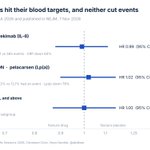
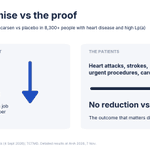
Pelacarsen lowered Lp(a) by 78%. Over a median of 4.7 years, a heart attack, stroke, urgent artery procedure or cardiovascular death happened to 12.3% of people on the drug and 12.1% on placebo (hazard ratio 1.02, 95% CI 0.90 to 1.15).
People with the highest Lp(a), 90 mg/dL and above, did no better (hazard ratio 1.00). That was the group I most hoped would benefit.
By this morning's four questions, the trial holds up. The drug hit its target, the patients were high risk, and the confidence interval rules out a benefit bigger than about 10%. Background care was also very good. About three in four people already met their blood pressure and cholesterol targets.
The investigators suggest that a few years of lower Lp(a) may not match a lifetime of low levels.
ZEUS was similar. Ziltivekimab cut CRP by 64%, yet 561 people on the drug and 565 on placebo had a heart attack, stroke or cardiovascular death, and serious infections were slightly more common (20% against 18%).
If a patient with high Lp(a) asks me on Monday, I'll still tell them it marks higher risk and is worth measuring, and that their LDL and blood pressure need treating properly. We just don't have a drug yet that lowers the Lp(a) risk itself.

Someone asked what my plans were for Saturday night. I said there's a statin trial being presented in Chicago tonight and I want to see how it ends.
They haven't asked about my weekend since.
This is from Novo's Q3 2026 report, filed with the SEC on 4 Nov. The quarter's impairments totalled DKK 8.7 billion, of which DKK 4.6 billion was ziltivekimab.
sec.gov/Archives/edgar/data/…
What does a failed heart trial cost a drug company?
Novo Nordisk's third-quarter report puts one figure on it. The company took a DKK 4.6 billion non-cash impairment charge on ziltivekimab, the anti-inflammatory drug whose ZEUS results were presented at AHA today.
Novo got the drug in 2020 when it bought Corvidia Therapeutics for $725 million upfront. When ZEUS missed its main goal in July, Novo's shares fell about 7% that day. Two more ziltivekimab trials, in heart failure and after heart attacks, are still running and should report in the first half of 2027.
Drug companies often point to failures like this when asked why new heart drugs are so expensive. Whatever you make of that argument, this is what a failure looks like on the books.
It's still a clever result, and the team released their logs and editing files. The benchmark was MATH-500.
venturebeat.com/ai/like-gene…

MIT researchers let GPT-6 Astra edit the weights of a small Qwen model directly. It changed about 0.016% of them, and the model's maths score rose from 7.9% to 48.1%.
That sounds like one AI teaching another maths. It mostly wasn't. Before the edit, 93% of the small model's answers ran out of space because it kept repeating itself. After it, 33% did. Most of the gain came from fixing the repetition, and on a model without that problem (Gemma 3 270M) the same approach produced no clear improvement.
We see this on the wards. An elderly patient does badly on a memory test, then someone finds his hearing aid. His score improves, but his memory was never the problem.

The ZEUS headline result from Novo Nordisk on 31 July was a hazard ratio of 0.99, 95% CI 0.88 to 1.11. Novartis gave the Lp(a)HORIZON top line on 4 Sept.
Both are in the 8:30 a.m. Chicago session, which is 15:30 Nigeria time.
novonordisk.com/news-and-med…
lipid.org/resource/top-line-…

Two of the biggest bets in heart disease prevention are presented in Chicago in about an hour. Both sponsors have already announced that their trial missed its main goal.
ZEUS tested ziltivekimab, a monthly injection that blocks IL-6, one of the body's main inflammation signals. It enrolled more than 6,300 people with artery disease, kidney disease and a raised CRP. The drug lowered inflammation markers as planned. Heart attacks, strokes and cardiovascular deaths did not fall (hazard ratio 0.99).
Lp(a)HORIZON tested pelacarsen in 8,323 people with heart disease and high Lp(a). The drug lowered Lp(a), and the main outcome again did not improve.
For years, inflammation and Lp(a) have been the leading candidates for the heart risk that remains after cholesterol is treated. Both now have a drug that changed the blood test without changing what happened to patients, at least overall.
This afternoon I'll be looking for three things.
1. Whether people with the highest CRP or the highest Lp(a) did any better, keeping in mind that subgroup findings are often chance.
2. How many serious infections came with blocking IL-6. Novo Nordisk has already said there were more than with placebo.
3. How low LDL cholesterol already was in Lp(a)HORIZON, which may have left less risk for pelacarsen to remove.
Both trials were large, well run and reported honestly, which is how an idea should be tested. I'll post the numbers tonight.

Sources are the NCSC annual review 2026 and NHS England's figures on the Synnovis attack (9,423 outpatient appointments and 1,660 elective procedures postponed at King's and Guy's and St Thomas' by 1 August 2024).
ncsc.gov.uk/collection/annua…
england.nhs.uk/london/2024/0…

The UK's cyber security agency now says it is "highly likely" that AI-powered malware will be used in a ransomware attack on Britain's critical infrastructure by 2028. Hospitals are part of that infrastructure.
We already know what one of these attacks does to a hospital. In June 2024, ransomware hit Synnovis, the pathology provider for two large London trusts. Blood testing was badly disrupted, and by August more than 11,000 outpatient appointments and planned procedures had been postponed.
That attack didn't need AI. The NCSC expects AI to make attacks like it bigger and more efficient.
Hospitals rehearse for fires and power cuts. I'd like them to rehearse a week without computers too.