

“many chains, one”
NY
Joined February 2012
- Tweets2.1K
- Following1.2K
- Followers127
- Likes2.1K


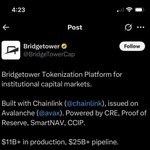


And if you’re going to be forward looking, would also want to include the growing strategic portfolio of institutional relationships …

AVAX跌到6美元,可能是被市场低估的老牌公链?
今天重新研究了一下AVAX,发现一个有意思的现象。
目前AVAX市值约30亿美元,SUI市值也在30亿美元附近。
但两条链的基本面存在一些差异。
先看几个数据:
AVAX的DeFi TVL约5.35亿美元,SUI约3.45亿美元。
AVAX稳定币规模约7.67亿美元,SUI约5.84亿美元。
AVAX的24小时DEX交易量约3440万美元,SUI约2685万美元。
更值得关注的是RWA。
Avalanche第三季度末的C-Chain代币化现实世界资产规模达到约12.2亿美元,BlackRock的BUIDL基金在Avalanche上的规模约4.87亿美元。
再看估值:
AVAX的Mcap/TVL约5.68倍,SUI约8.75倍。
也就是说,两条链市值几乎相同,但AVAX承载的DeFi资金更多。
如果按照SUI的Mcap/TVL倍数给AVAX估值,对应市值约46.8亿美元,按当前流通量计算,代币价格约10.48美元。
当然,这只是相对估值推演,并不是目标价。
我认为AVAX真正值得关注的不是过去的辉煌,而是未来三个方向:
机构RWA和代币化国债。
Avalanche独立L1生态。
Aave、Pharaoh等DeFi生态的持续增长。
不过也要看到,AVAX目前链上手续费收入仍然偏低,生态收入不等于代币持有者收入,而且未来仍有代币解锁。
我的结论:AVAX在同等市值公链中具有一定估值优势,属于值得研究的潜在低估项目。
如果牛市重新启动,你更愿意选择AVAX还是SUI?
欢迎讨论。
5
beginning_depth (Ben Garfield)🔺 retweeted

Avalanche was architected around a fundamental premise: global financial infrastructure cannot depend on a single shared execution environment.
Independent consensus, sovereign L1s, and customizable execution environments were deliberate design decisions, made years before institutional adoption became a shiny object.
Now the focus is on translating those architectural advantages into sustained economic activity, with network incentives and AVAX tokenomics evolving alongside global adoption.


beginning_depth (Ben Garfield)🔺 retweeted

The opportunity ahead of Avalanche is enormous, and we intend to make the most of it.
Here’s where we’re going:
Has there been a change in Coinbase accepting USDC from c-chain? Couple of transfers showing up as “unrecognized”
8
beginning_depth (Ben Garfield)🔺 retweeted

Avalanche holders have been through it. Other chains got the spotlight, hearing it's dead, wondering if anything was ever coming.
Then NYSE's affiliated platform picks Avalanche tech for its clearing and settlement layer. 24/7 trading, clearing, settlement. They tested multiple chains for over a year and this is where they landed. Massive credit to Ava Labs for the years of quiet BD work.
Meanwhile the Foundation is funding 6 research teams from Stanford, Oxford and Imperial on validator economics, fee burning and how value flows back to $AVAX. Institutions coming in while the token gets built to capture it is the combo we've waited for.
To anyone fading $AVAX because of the chart: look at what's under it. Price lags. NFA

In b4 “but why choose Avalanche?”Moving beyond consensus, settlement, and product. Per usual, Avalanche out in front in bringing blockchain to the real world. Vision.

Introducing the six research teams selected through our first Call for Research Proposals 🔺
The teams will take on some of the most important open questions in blockchain economics.
Accelerating research already underway through our economic research agenda.
18
beginning_depth (Ben Garfield)🔺 retweeted

Why Avalanche for NYSE?
It’s important to note that this was not a quick, monetarily-driven decision made without due diligence, as I’ve seen a few posts speculating that. After more than a year of evaluating and testing multiple blockchain networks, NYSE arrived at Avalanche for a multitude of reasons.
For those who have followed Avalanche closely, this shouldn’t come as much of a surprise. For everyone else, it’s worth understanding the fundamental difference between building for speculative crypto markets and building the infrastructure that underpins global capital markets.
For regulated financial institutions, high TPS and low transaction fees are the baseline. Most modern blockchains can offer some version of both, with the much harder problem being architectural.
Monolithic chains share consensus, execution, and blockspace. Conventional EVM L2s introduce dependencies on external settlement layers, sequencing, and data availability. Both models come with constraints that become particularly consequential when institutions need direct control over their infrastructure, especially when it comes to regulatory compliance.
Avalanche was designed around a different premise.
Avalanche L1s operate with independent consensus, dedicated validator sets, customizable virtual machines, configurable fee markets, and protocol-level permissioning. Institutions can define who validates, who participates, how transactions are processed, and how their networks are governed, with the flexibility to implement regulatory requirements directly into the infrastructure.
They can do so without inheriting the congestion or settlement dependencies of another chain, while retaining the ability to interoperate with other networks and access the broader Avalanche ecosystem’s assets and liquidity.
This combination of sovereignty, customization, performance, and interoperability is what makes Avalanche uniquely suited for true capital markets. It’s one thing to offer institutions a place to deploy applications, anyone can do that. It’s another thing to give them the ability to operate the underlying infrastructure on their own terms.
We’ve spent years building around the conviction that the world’s largest financial institutions would eventually need purpose-built blockchains of their own, rather than forcing entirely different businesses and regulatory environments onto a single shared network.
NYSE’s decision is a powerful validation of that thesis.
And I believe we’re only beginning to appreciate just how important these architectural decisions will be as global financial markets continue to move onchain.
beginning_depth (Ben Garfield)🔺 retweeted

WSJ Exclusive: Avalanche (@avax) will provide the core ledger technology for the clearing firm on the NYSE-affiliated tokenized securities platform.
Subject to regulatory approvals, the platform is designed to support 24/7 trading, clearing and settlement for its subscribers.
@WSJ in thread

beginning_depth (Ben Garfield)🔺 retweeted

Today is a perfect example of what happens when marketing works exactly as it should. You don't just make headlines. You own the entire news cycle and then some.
I couldn't be prouder of this team, how far we've come, and what we've built together.
A massive virtual cheers 🥂 to the Avalanche marketing team for showing up, executing at every level, and delivering one of the biggest launches in our history.
@_babymegs @Jones___Lab @kyledineen @vohvohh @0xcoolgirl @meghangardler @Tess_Lucia @0xBryan @hodl_avax
Look at us. Who would have thought? …Little ole Avalanche emerging as center stage. Congrats @el33th4xor @jonwu_ VISION!
22


beginning_depth (Ben Garfield)🔺 retweeted
The debate on the threat AI poses for crypto is mostly just wankery.
We will see AI exploit systems-level bugs far before ECDSA falls. We will see AI discover bugs in systems code, libraries and wallets that enable attackers to steal billions of dollars long before we have to worry about cryptosystems failing wholesale due to new math.
Sure, there's definitely a non-zero possibility that ECDSA might fail wholesale, and the ramifications would be systemic -- all balances on such a chain would be in question. That's why Hoseeb's backup crypto proposal is sensible. Namely, build an alternative cryptosystem onto which one could shift should ECDSA doomsday arrive one fine morning. That's an approach that we will be exploring for Avalanche.
But our focus regarding AI's impact on blockchains ought to center on vulnerabilities in existing software first and foremost. If you think that, say, Ripple's (or insert any other high value low use chain here) under scrutinized code contains no 0-day bugs, difficult for humans to spot but easy for AI to identify, then you're deluded.
My take on this issue, as with all other issues, is pragmatic and oriented towards what matters most today. That said, in the tail risk category, hash-based crypto is really interesting, and we have an active group exploring hash-based alternatives to ECDSA.
beginning_depth (Ben Garfield)🔺 retweeted

Reading the comments of junior mathematicians confirms what many senior mathematicians have been warning about over the past month:
It is becoming clear that people with the intellectual ability to understand these proofs will not be interested in spending their lives training to check LLM logs.
This is the tragic side of what is happening that almost no one — except the actual mathematicians — seems to get.
Either we figure out how to keep people interested in doing mathematics, or in 20 years LLMs will have no one’s work left to recombine into new proofs, and no one interested in reading those proofs.
That would be the thermal death of mathematics.
The argument that “LLMs will read LLM math” is so shortsighted that it makes me want to cry…
beginning_depth (Ben Garfield)🔺 retweeted
The most sensible take so far on the risk AI poses to public let cryptography, and what chains should do about it.


In @el33th4xor and team we trust; interesting days ahead

Today I call upon the blockchain industry to calmly begin planning for "bunker mode". My personal recommendation is to set in motion a controlled mass migration of assets to fresh addresses, i.e. addresses whose pubkeys remain hidden behind a hash.
Holders, starting with large and sophisticated ones, should consider moving the bulk of their funds to addresses that have never signed a transaction. And when they do sign one, they should also move remaining funds to a new address (possibly generated from the same seed phrase).
Don't rush. While I believe there is cause for action a rushed migration would do more harm than good. Don't panic either. Moving assets to protected addresses is a simple, preventative step which does not require new cryptography or new wallets.
IMO it is now reasonable to brace for the possibility that ECDSA breaks before qday, in the worst case in months not years. By "break" I mean fast private key recovery (e.g. in one week) on available hardware (e.g. a large GPU cluster).
Recent days have been humbling for human mathematical intuition. Long-held, unquestioned hypotheses have fallen. This includes the n log(n) bound for integer multiplication and the 3SUM conjecture. In hindsight, May's unexpected disproof of the Erdős unit distance conjecture was our warning shot.
Yesterday's OpenAI drop made it clear that mathematical superintelligence is upon us. They say there are weeks where decades happen. We are about to live through weeks where centuries of mathematical progress happen. Could our magic 64-byte ECDSA signatures be too good to be true? Was it just security through obscurity all this time?
Elliptic curves feel especially vulnerable to superintelligence. Curves carry rich structure, with room for fancy tricks like Schoof, Frobenius, pairings. (By contrast, hashes are designed to minimise algebraic structure.)
Separately, as Ewin Tang can attest, an efficient quantum algorithm sometimes foreshadows an efficient classical one. We should be open to the possibility of a classical counterpart to Shor that breaks elliptic curves and RSA at once.
Also noteworthy is the striking under-representation of cryptographic breakthroughs among the 722 mathematical results OpenAI published. I've witnessed first-hand the US government censoring academic quantum cryptanalysis results. Backroom interventionism is my base case.
I urge large, sophisticated actors to lead by example. Project11's "risq list" (bitcoin-risq-list.projecteleven[.]com) is a great tracker of exposed BTC pubkeys. Binance, Bitbank, Robinhood, Bitfinex, and Tether have an opportunity to harden their cold storage. Next month I'll address institutions in London in a live Q&A (forum.ethereuminstitutional[.]org/london-2026).
Again, please do not rush. Wallets holding under 50 BTC enjoy partial cover from "Satoshi's shield", i.e. his 20K exposed addresses that hold 50 BTC each. Load-bearing signers like oracles and L2 security councils should consider rotating ECDSA pubkeys with every signed message and/or multi-signing with a hash-based schemes like SPHINCS.
Exiting bunker mode safely will require post-AI cryptography. My inclination is to go all-in on hash-based cryptography and avoid structured mathematical assumptions entirely, whether from curves, lattices, or isogenies. A single battle-tested hash (e.g. from the SHA or BLAKE families) yields plausible post-AI security.
The Ethereum roadmap on strawmap[.]org fully embraces hash-based cryptography with end-to-end formal verification as a response to the quantum threat. Those timelines must now be revisited and accelerated in light of mathematical superintelligence. I'll be pushing for maximum defensive acceleration.
20
🎇🎆🎇🎆

BREAKING: Goldman Sachs is bringing its $100B flagship Treasury fund to Avalanche
The fund will be offered through Lynq, a private, permissioned Avalanche L1 used by 30+ institutional digital asset firms, including B2C2, Wintermute, Galaxy, FalconX, and Fireblocks.
This gives institutions a way to put cash to work between trades and earn yield without leaving the infrastructure they already use.

2
22
When unintentionally auditioning for Avalanche BD…

"Maybe the altcoins actually outperform Bitcoin by 50x." 🤯
@cryptomanran told me a @BlackRock report on AI agents made him think his own altcoin chart may be too conservative.
1
20
beginning_depth (Ben Garfield)🔺 retweeted

Hyundai is testing blockchain infrastructure to accelerate development and improve payment processing time. Hyundai Card’s stablecoin pilot on Avalanche saw transfer time reduced by over 96%.
Now the company is exploring how these faster transfers, even after banking hours, can reduce idle liquidity and make their working capital go further.
American Banker reports on the pilot.
